
Jacketed Vessel Heating Time: Worked Example
How to calculate heat up and cool down times for a jacketed vessel or reactor, with steam and with cooling water, comparing glass lined and stainless steel.
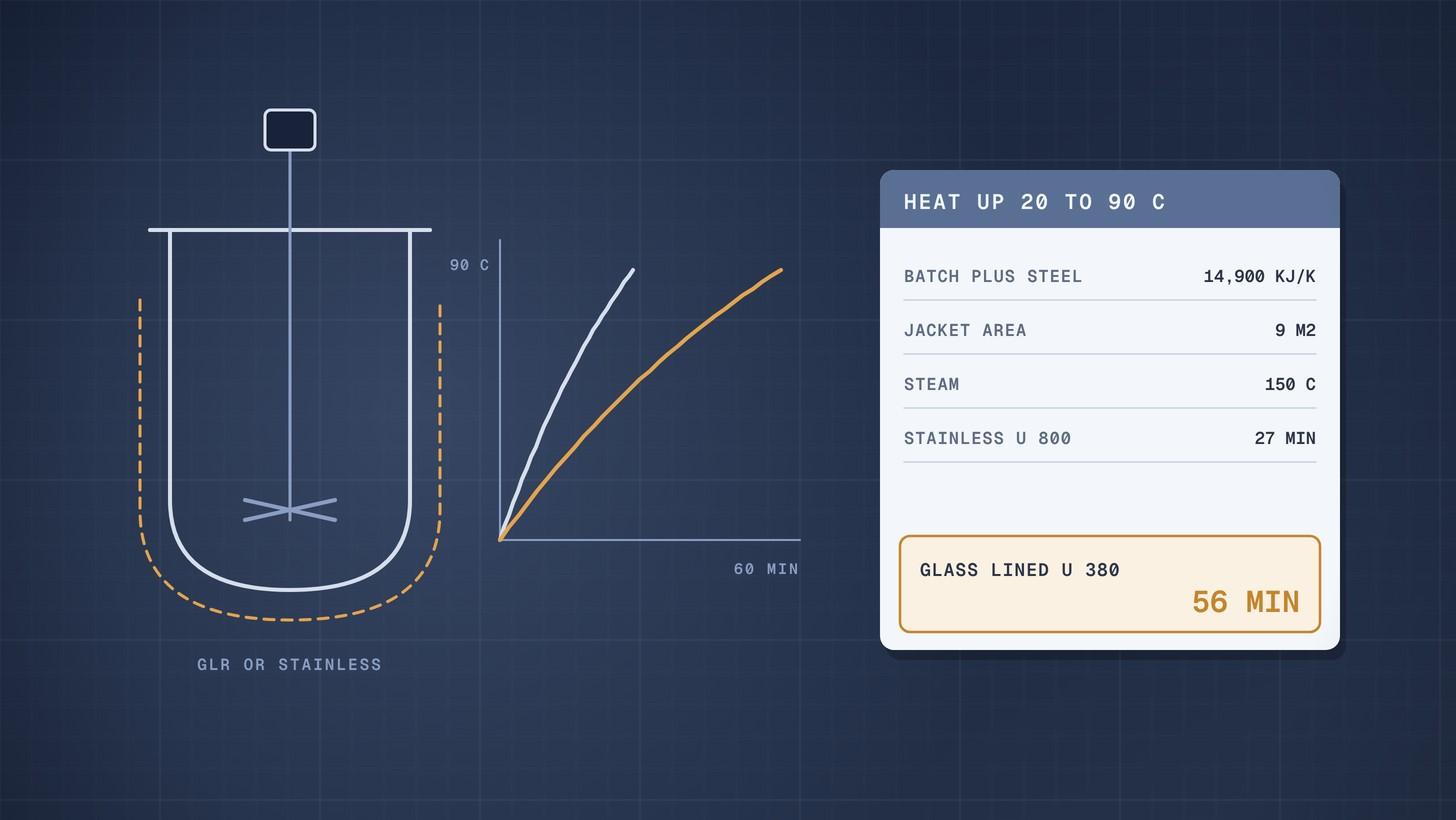
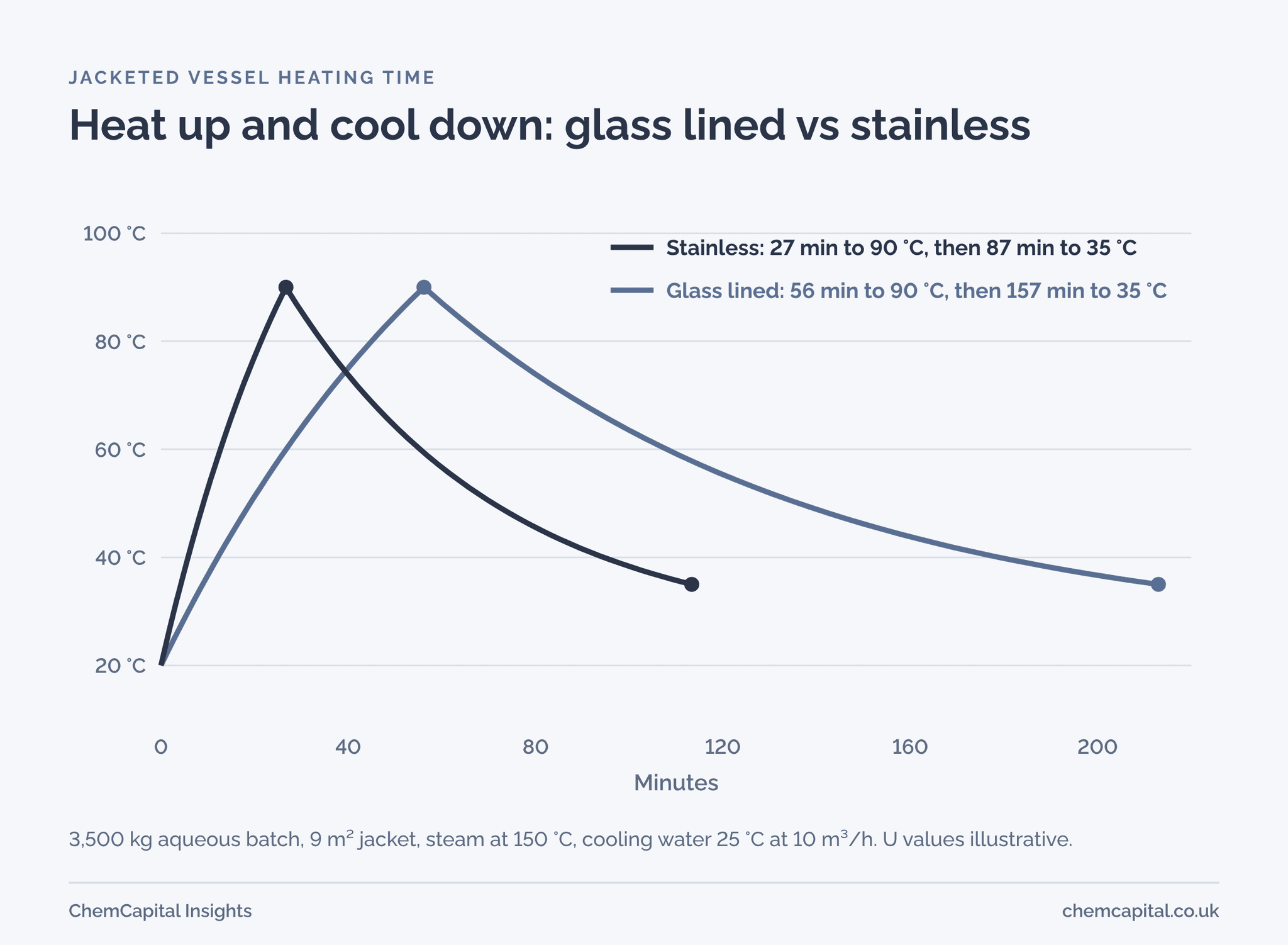
The heating time of a well stirred batch in a steam jacketed vessel is t = (M × c) ÷ (U × A) × ln((Ts minus T₁) ÷ (Ts minus T₂)), where M × c is the heat capacity of the batch and vessel, U × A is the jacket's overall capacity, Ts the steam temperature and T₁ and T₂ the start and end temperatures. In the worked example below, a 3,500 kg aqueous batch heats from 20 °C to 90 °C in 56 minutes in a glass lined reactor and 27 minutes in a stainless one with the same jacket area. Cooling back to 35 °C with tower water takes 157 and 87 minutes.
The formula comes from a simple heat balance. The hard part is the U value, and that is what a buyer should test in every vessel offer.
Why this matters now
Cycle time decides how many batches a reactor can make. A vessel that heats and cools in half the time can double throughput, or let a smaller vessel do the job. Yet many vessel quotes give jacket area and design pressure, but no heat up or cool down time at your conditions.
The choice between glass lined and stainless steel, the agitator and the cooling water flow all change cycle time. With the method below you can test those choices before you order, and check a supplier's predicted times. Our guide to jacketed vessels and glass lined reactors covers the vessel types themselves.
Create and manage RFQs in minutes
ChemCapital handles the entire procurement cycle, from structured RFQs and supplier comparisons to formal purchase orders and delivery tracking.
Where the formula comes from
John Pietranski's course on heating and cooling agitated batches derives the same equation from a differential heat balance [1]. It is exact if:
- the batch is well mixed, so it has one temperature;
- U is uniform over the heating surface;
- the batch's specific heat is constant, taken at the average temperature;
- the batch does not change phase;
- the heating medium enters at a constant temperature and flow, or condenses at a constant temperature, as steam does;
- heat losses are small [1].
Include the steel in contact with the jacket in M × c, because it heats up too.
When the medium changes temperature. Hot water, thermal oil or cooling water warms or cools as it passes through the jacket. Treat the jacket as an exchanger at each moment. With flow W, specific heat c_w and inlet temperature T_in, the jacket outlet approaches the batch temperature by a factor K₁ = e^(U×A ÷ (W×c_w)), and the heat rate is W × c_w × (K₁ minus 1) ÷ K₁ × (T_in minus T). Integrating gives:
- t = (M × c) ÷ (W × c_w × (K₁ minus 1) ÷ K₁) × ln((T₁ minus T_in) ÷ (T₂ minus T_in))
When the medium flow is large, (K₁ minus 1) ÷ K₁ × W × c_w tends to U × A and this becomes the steam formula again.
U is where the time is won or lost
The overall coefficient is the sum of resistances in series: the process side film, the wall, the jacket side film and fouling. Pietranski's course on agitated vessel coefficients sets it out as 1 ÷ U = the sum of the individual resistances [2]. A glass lining adds a thick, low conductivity layer, so the same jacket transfers less.
Spirax Sarco gives typical steam jacket U values with moderate agitation [3]:
| Process side | Stainless steel vessel | Glass lined steel vessel |
|---|---|---|
| Water | 850 to 1,700 W/m² K | 400 to 570 W/m² K |
| Aqueous solution | 450 to 1,140 W/m² K | 285 to 480 W/m² K |
| Organics | 285 to 850 W/m² K | 170 to 400 W/m² K |
The ranges are wide because agitation, viscosity and fouling vary. Use the low end for an early estimate, and ask the supplier for its design U and how it was derived.
Worked example: a 4 m³ reactor, glass lined or stainless
A reactor holds 3,500 kg of aqueous solution with a specific heat of 3.9 kJ/kg K, the value Spirax uses for a weak acid solution [4]. About 2,500 kg of steel is in contact with the jacket, at 0.5 kJ/kg K [4]. Jacket area is 9 m². Batch, vessel and U values are illustrative; U values sit inside Spirax's ranges.
- M × c = 3,500 × 3.9 + 2,500 × 0.5 = 14,900 kJ/K
- Glass lined: U = 380 W/m² K, so U × A = 3.42 kW/K
- Stainless: U = 800 W/m² K, so U × A = 7.20 kW/K
Heating from 20 °C to 90 °C with steam at 150 °C.
- ln((150 minus 20) ÷ (150 minus 90)) = ln(130 ÷ 60) = 0.773
- Glass lined: 14,900 ÷ 3.42 × 0.773 = 3,368 s, about 56 minutes
- Stainless: 14,900 ÷ 7.20 × 0.773 = 1,600 s, about 27 minutes
The stainless vessel's faster heating comes with a higher peak steam demand: 7.20 × 130 = 936 kW at the start, against 445 kW for the glass lined vessel. Our guide to steam consumption for heating a vessel shows how to size the steam supply for that peak.
Cooling from 90 °C to 35 °C with tower water at 25 °C, 10 m³/h. With water at about 997 kg/m³ and 4.18 kJ/kg K [5], W × c_w = 10 × 997 ÷ 3,600 × 4.18 = 11.58 kW/K.
| Glass lined | Stainless | |
|---|---|---|
| K₁ = e^(U×A ÷ W×c_w) | 1.344 | 1.863 |
| Effective capacity, W × c_w × (K₁ minus 1) ÷ K₁ | 2.96 kW/K | 5.36 kW/K |
| Cooling time, 90 to 35 °C | about 157 minutes | about 87 minutes |
| Cooling duty at the start | 193 kW | 349 kW |
Cooling is slower than heating because the driving temperature difference is smaller: 65 K at the start, falling to 10 K at the end.
Does more cooling water help? For the glass lined reactor, doubling the water to 20 m³/h only cuts cooling time from 157 to 146 minutes. The glass lining's U, not the water, is the bottleneck. Spend on a colder coolant or more area instead.
What actually cuts cycle time
Run the same reactor through the formulas with one change at a time:
| Change | Glass lined | Stainless |
|---|---|---|
| Base case: heat with steam at 150 °C | 56 minutes | 27 minutes |
| Steam at 130 °C instead of 150 °C | 73 minutes | 35 minutes |
| Jacket area 12 m² instead of 9 m² | 42 minutes | not needed |
| Base case: cool with water at 25 °C | 157 minutes | 87 minutes |
| Chilled water at 10 °C instead of 25 °C | 98 minutes | 54 minutes |
A colder coolant does far more than more coolant, because it raises the driving temperature difference across the whole cool down. A higher steam pressure helps heating for the same reason, at the price of a higher peak steam demand. More jacket area or a better U helps both steps, but costs money at the vessel; agitation changes U too, which is why the agitator in the offer matters. Decide which step limits your cycle before you pay for any of these.
Checking a vessel offer
Ask each supplier for jacket area, design U for heating and for cooling, the basis of each U (agitator, speed, viscosity, fouling), and predicted heat up and cool down times at your utility conditions. Then:
- Recompute the times with the formulas above.
- Compare each U with the ranges for that construction and duty.
- Check the utility demand at the start of each step.
- Make sure the agitator in the offer is the one the U assumes; see agitator and impeller types.
ChemCapital's structured RFQs ask every vessel supplier for the same thermal data, so cycle times can be compared bid for bid.
Ready to compare reactor quotes on cycle time as well as price? Start a free 14 day ChemCapital trial, with no credit card needed.
Frequently asked questions
How do you calculate the heating time of a jacketed vessel?
With steam in the jacket, time equals the heat capacity of batch plus vessel divided by U times A, multiplied by the natural log of (steam temperature minus start temperature) over (steam temperature minus end temperature). It assumes a well mixed batch, constant U and negligible heat losses.
Why does a glass lined reactor heat more slowly than stainless?
The glass lining adds a thick layer with low thermal conductivity, which lowers the overall heat transfer coefficient. Typical steam jacket U values for water are roughly half those of stainless steel, so heating takes about twice as long for the same jacket area.
How do you calculate cooling time with cooling water in a jacket?
Because the cooling water warms as it passes through the jacket, use the non isothermal form: an effective capacity of water flow times specific heat times (K1 minus 1) over K1, where K1 is e to the power U A over water flow times specific heat, in place of U A in the time formula.
What U value should I use for a jacketed vessel?
Spirax Sarco gives about 850 to 1,700 W/m² K for steam jackets on stainless vessels heating water with moderate agitation, and 400 to 570 W/m² K for glass lined vessels. Organic liquids and higher viscosity give lower values, so ask the supplier for its design U and basis.
Continue reading
Informational only, not procurement or legal advice. Cited names, frameworks, and statistics belong to their respective owners.
Create and manage RFQs in minutes
ChemCapital handles the entire procurement cycle, from structured RFQs and supplier comparisons to formal purchase orders and delivery tracking.
Start for freeRelated articles
Pipe Thermal Expansion: Worked Example
How to calculate pipe thermal expansion for carbon and stainless steel, what restrained expansion does, and how loops and expansion joints absorb it.
Horizontal Tank Volume When Partly Filled: Worked Example
How to calculate the volume of a partly filled horizontal tank with dished heads, with a worked example and a full dip table you can rebuild in a spreadsheet.
Cooling Water Flow Calculation: Worked Example
How to calculate cooling water flow from heat duty and temperature rise, then size the cooling tower circulation, evaporation and make up water.