
Hold Point vs Witness Point: What They Mean in an ITP
A hold point stops work until the buyer releases it in writing; a witness point lets work go on if nobody comes. ITP codes, notice and costs, with an example.

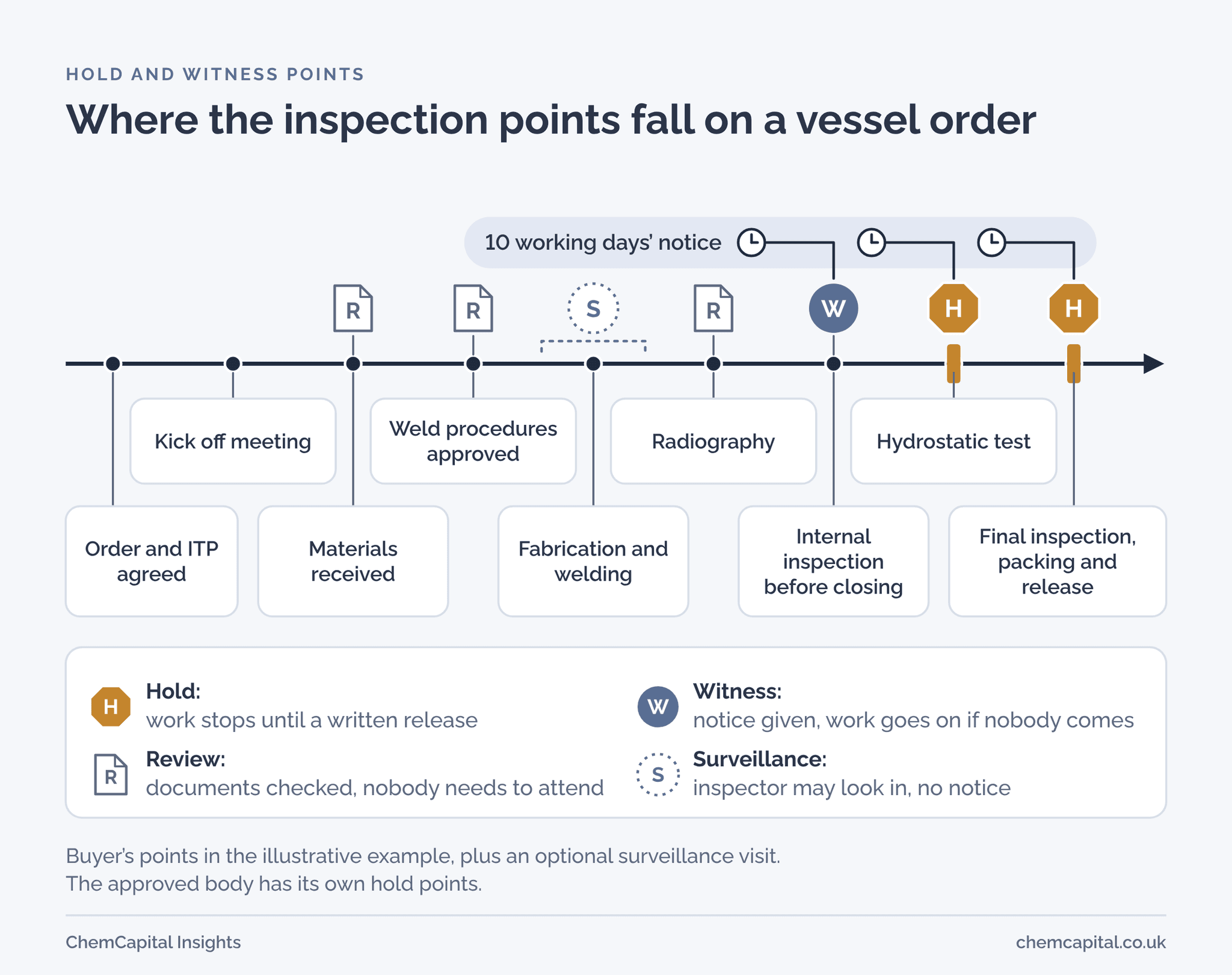
A hold point is a step in manufacture that the supplier must not pass until the buyer, or the buyer's inspector, has released it, normally in writing. A witness point is one the buyer must be told about in advance and may attend, but if nobody comes once the notice period has run, work carries on [1, 2]. Both are marked in the inspection and test plan (ITP), which lists every check on the equipment in the order the work happens.
Why this matters now
The letters on an ITP decide two things that cost money: whether the buyer sees the tests that matter, and whether a fabrication shop stops and waits. A hold point nobody releases idles a test bay; a missed witness point is a test you only see on paper.
Pressure equipment adds points the buyer does not control. In Great Britain, when a vessel is certified on its own (unit verification), the approved body carries out the final inspection and performs, or arranges, the proof test [3]. Under the EU directive, used in Ireland, the notified body on the quality assurance routes for the higher hazard categories, III and IV, makes unexpected visits to sample equipment for final assessment, and the manufacturer must share its production schedule [4].
Notice periods vary widely: Air Products asks suppliers for at least ten working days before every hold and witness point [1], the UK National Nuclear Laboratory three working days for UK manufacture [5], and Queensland's road works specification one working day before a witness point [2].
Join ChemCapital to streamline sourcing and connect with verified partners
Whether you're buying or supplying, ChemCapital gives you the tools to manage the complete procurement cycle in one platform.
What an ITP is and who sets the points
An ITP lists each inspection and test in sequence, with the procedure, acceptance criteria, the record that proves it was done and an intervention code for each party. Air Products sets these as the minimum content [1].
Points come from five places:
- The buyer. Air Products issues its ITP with the purchase order, and the supplier's ITP must include all of it [1].
- The buyer's client, if there is one. Air Products asks for twelve working days' notice of its client's points [1].
- An inspector acting for the buyer, either an employee or from an outside agency [1].
- The approved or notified body, depending on the conformity assessment route [3, 4]. For ASME code vessels, a Canadian regulator's guide expects the ITP to reach the Authorized Inspector and the owner before work starts, so hold points can be assigned [6].
- The supplier, which may add hold points of its own [2].
Agree the points before ordering and confirm them at a kick off meeting. Air Products holds a pre inspection meeting at the place of manufacture where the order requires one [1].
Hold, witness, review and surveillance points compared
Codes vary by client; the UK National Nuclear Laboratory adds approval and sample witness codes [5]. Air Products defines four, and the Queensland specification applies the same hold and witness rules [1, 2]:
| Code | What it means | Notice? | If nobody attends |
|---|---|---|---|
| H, hold | Work stops until written release | Yes | Work waits |
| W, witness | Buyer may attend | Yes | Work goes on once notice expires |
| R, review | Documents checked, not the work | No | No attendance needed |
| S, surveillance | Inspector may look in, usually on an H or W visit | No | Work goes on |
A witness point is the buyer's option. Once the agreed notice has been given, the supplier may proceed whether or not anyone comes [1, 2]. Missing it costs the buyer the chance to see the test; it never gave a right to stop work.
A hold point needs a written release. Both specifications require written authorisation, and Air Products treats a point as waived only once it has issued a signed waiver form [1, 2]. A phone call is not a release. If a document needs approval before work starts, such as a weld procedure, make it a hold point.
Inspection does not shift responsibility. Both specifications leave the supplier responsible for its own inspection and testing [1, 2], so check its quality system before award with a supplier qualification checklist.
Typical points on a vessel or skid
UK pressure equipment law lies behind several usual points [3]:
- Material certificates. For main pressure parts of category II to IV equipment, the material maker's documentation must be a certificate of specific product control.
- Weld procedures and welders. For category II to IV, the procedures and people making permanent joints need approval by a competent third party.
- NDT (non destructive testing, such as radiography). For category III and IV, NDT staff need approval by a recognised third party organisation.
- Internal inspection before closing. Where safety requires, the final inspection covers every part inside and out, during manufacture if it could not be examined later.
- Hydrostatic test. The normal form of the proof test, and a natural hold point.
A skid adds its factory acceptance test (FAT); see our FAT checklist for process skids. Last comes release: equipment that Air Products inspects cannot ship until it issues an inspection release note [1].
Practical example
A pharma site orders a 316L stainless steel process vessel. All figures are illustrative. The £185,000 order carries liquidated damages of 0.5% of its value per week of late delivery and requires ten working days' notice for hold and witness points. The vessel is certified by unit verification, so the approved body has points of its own [3].
| Activity | Buyer | Approved body | Record |
|---|---|---|---|
| Material certificates | R | R | Certificates |
| Weld procedures and welders | R | H | Approvals |
| Radiography of main seams | R | R | NDT reports |
| Internal inspection before closing | W | H | Inspection report |
| Hydrostatic test | H | H | Test certificate |
| Final inspection, packing, release | H | H | Release note |
The fabricator performs each activity and signs each record first.
In week 20 the fabricator gives four working days' notice of the hydrostatic test instead of ten. The buyer's inspector cannot travel for five more working days, so the vessel waits at the hold point. The idle test bay and crane cost £2,100 and rebooked haulage £850, and with no float left, delivery slips a week: £925 in liquidated damages. That is £3,875, all the fabricator's and all avoidable. A supplier that keeps doing this belongs in your vendor risk management.
Reverse it. Proper notice is given, the inspector cancels the day before, and the vessel waits five working days for the buyer's release. That is the buyer's delay. In construction cases, English courts have treated even legitimate acts by the employer as prevention if they push completion past the contract date, and see an extension of time clause mainly as protection from liquidated damages for delay that is not the contractor's risk. Clear contract terms on delay still prevail over the prevention principle [7]. Expect a request for more time, not liquidated damages for that week. This is general information, not legal advice.
If nobody can travel, issue a written waiver of attendance, signed by the person the order names, on conditions such as a video link and the record within 24 hours. The approved body's hold point still stands: under unit verification, the final inspection and proof test are its job [3].
Write the inspection regime into the order
Before award, put four things in the order: the ITP, the notice period, who can sign a waiver and who pays for a wasted visit.
ChemCapital does not run your ITP; it handles the sourcing and ordering around it. A structured RFQ sends every supplier the same requirements, so include your inspection codes, notice periods and waiver rules, and every supplier prices the same inspection scope. Purchase orders are issued in the platform, suppliers confirm them and post milestone updates, and every interaction, revision and decision is logged with a timestamp.
Want inspection requirements priced into every quote? Start free with ChemCapital, with no credit card needed.
Frequently asked questions
What is the difference between a hold point and a witness point?
At a hold point, work must stop until the buyer or its inspector gives a release, normally in writing. At a witness point, the supplier gives the agreed notice and the buyer may attend, but work carries on once the notice period has run if nobody comes.
What is a review point in an ITP?
A review point is a check of documents or certificates, such as material certificates, rather than of the work itself. Nobody needs to attend, and in Air Products' published requirements, for example, the supplier does not need to give formal notice of it.
How much notice should a supplier give for a witness point?
Whatever the purchase order says, so set the period there and allow for travel. Published examples range from one working day in a Queensland road specification, through three working days for UK manufacture at the UK National Nuclear Laboratory, to ten working days in Air Products' supplier quality requirements, or twelve where its client has points.
Continue reading
Informational only, not procurement or legal advice. Cited names, frameworks, and statistics belong to their respective owners.
Join ChemCapital to streamline sourcing and connect with verified partners
Whether you're buying or supplying, ChemCapital gives you the tools to manage the complete procurement cycle in one platform.
Get started freeRelated articles

Inspection and Test Plan (ITP) Template for Pressure Vessels and Skids
What an inspection and test plan is, who writes and approves it, its columns, a complete ITP for a pressure vessel, a short one for a pump skid, and how it ties to payment.
Site Acceptance Test (SAT) Checklist for Process Skids
What a site acceptance test must prove once a skid is installed, how SAT differs from FAT and commissioning, a full SAT checklist and how to handle failed tests.
Recommended Spares List: Commissioning, Operating and Insurance Spares
What a recommended spares list should hold: commissioning, two year operating and insurance spares, criticality, what to ask in the RFQ, and a pump and vessel template.