
Dryer Evaporation Load: Worked Example
How to calculate a dryer's evaporation load from wet and dry basis moisture, then the minimum and real heat input, with a worked filter cake example.
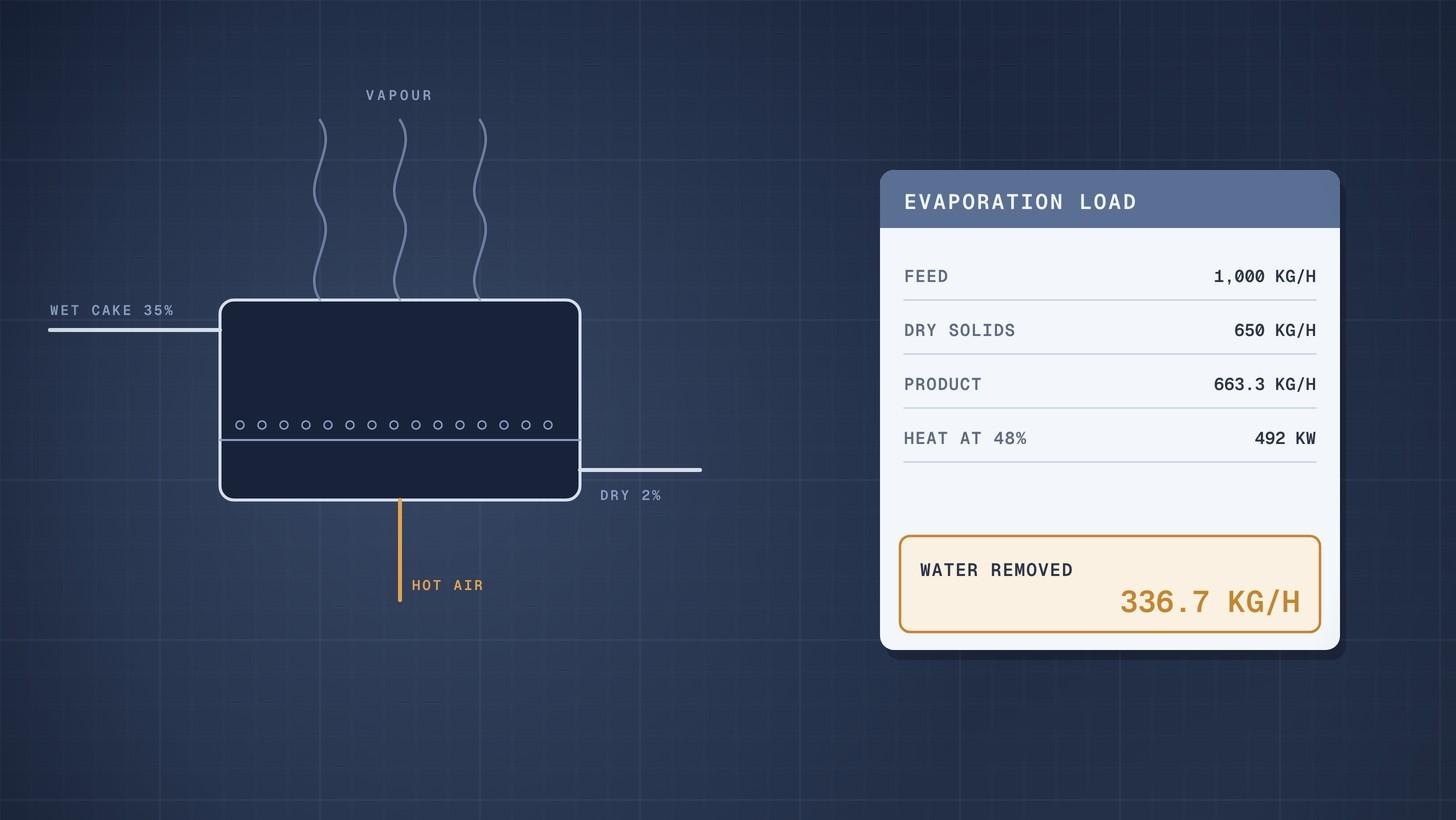
A dryer's evaporation load is the water it must remove each hour: the wet feed rate minus the dry product rate, worked out from the moisture contents in and out. In the worked example below, 1,000 kg/h of filter cake at 35% moisture dried to 2% means evaporating about 337 kg of water an hour, which needs about 236 kW of heat in theory and nearer 490 kW in a real dryer.
Get the moisture basis right first. A mix up between wet and dry basis is the most common reason two dryer quotes for the same duty look nothing alike.
Why this matters
Drying is one of the most energy hungry steps in a process plant. A SINTEF report cites estimates that drying accounts for 15% to 25% of industrial energy demand in developed countries [1]. The evaporation load sets the dryer size, the heat supply, the air or vacuum system and the running cost, so it is the first number a dryer supplier needs from you.
Create and manage RFQs in minutes
ChemCapital handles the entire procurement cycle, from structured RFQs and supplier comparisons to formal purchase orders and delivery tracking.
Wet basis and dry basis
Moisture content can be stated two ways [2]:
- Wet basis: water ÷ (water + dry solids). This is what a moisture balance usually reports.
- Dry basis: water ÷ dry solids. It can exceed 100%.
To convert: dry basis = wet basis ÷ (100 minus wet basis) × 100, and wet basis = dry basis ÷ (100 + dry basis) × 100 [2]. A cake at 35% wet basis is 53.8% dry basis. State which one you mean on every datasheet.
Step 1: the water to remove
The dry solids pass through unchanged, so work from them.
A filter cake is fed at 1,000 kg/h with 35% moisture, wet basis, and must leave at 2%, wet basis (illustrative).
- Dry solids: 1,000 × (1 minus 0.35) = 650 kg/h
- Dry product: 650 ÷ (1 minus 0.02) = 663.3 kg/h
- Water evaporated: 1,000 minus 663.3 = 336.7 kg/h
The dry basis gives the same answer: 650 × (0.538 minus 0.020) = 336.7 kg/h.
Note what happens if someone takes 35% minus 2% of the feed instead: 330 kg/h. Close here, but the error grows quickly at high moistures.
Step 2: the minimum heat
The minimum heat is the sum of three parts: warming the product, warming the water and evaporating it. A 2025 Oak Ridge National Laboratory study models the minimum this way, taking the latent heat as a constant 2,260 kJ/kg [3], close to the 2,257 kJ/kg steam tables give at atmospheric pressure [4].
Take the feed in at 20 °C and the product out at 60 °C, with solids of specific heat 1.2 kJ/kg K (illustrative) and water at 4.18 kJ/kg K [5]:
| Part | Calculation | Heat |
|---|---|---|
| Evaporate the water | 336.7 kg/h × 2,260 kJ/kg | 211.4 kW |
| Warm the water evaporated | 336.7 × 4.18 × 40 | 15.6 kW |
| Warm the solids | 650 × 1.2 × 40 | 8.7 kW |
| Warm the moisture left in | 13.3 × 4.18 × 40 | 0.6 kW |
| Minimum | 236.3 kW |
Evaporation is 89% of the total. Everything else is small.
Step 3: the real heat input
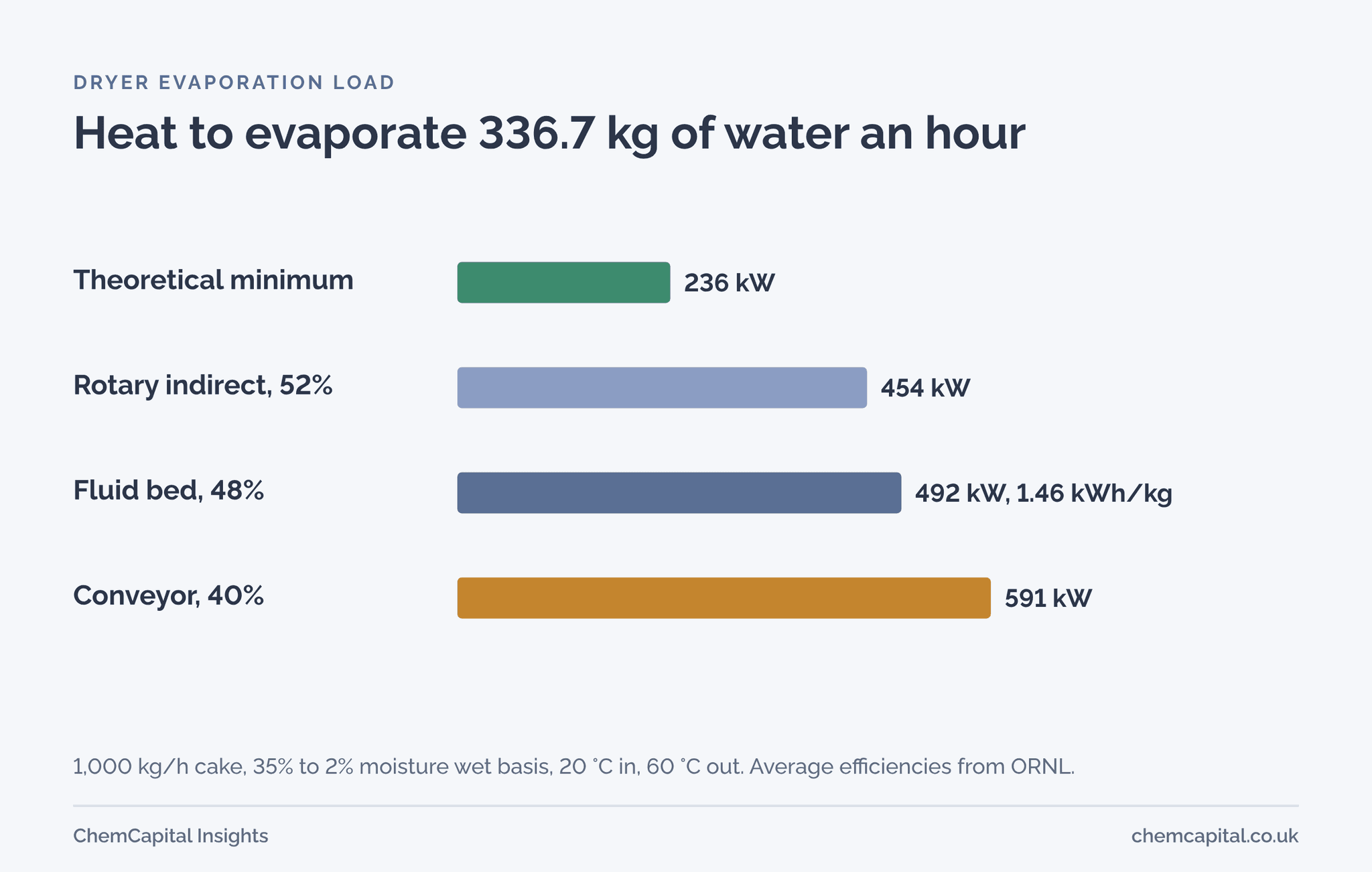
No dryer reaches the minimum: hot exhaust air, leaks and shell losses all cost heat. The Oak Ridge study uses average system efficiencies of 52% for rotary indirect dryers, 50% for flash, 48% for fluid bed, 47% for drum, 46% for spray and 40% for conveyor dryers [3].
For a fluid bed at 48%: 236.3 ÷ 0.48 = 492 kW, or about 1.46 kWh per kg of water. That sits inside the 0.8 to 2 kWh/kg the SINTEF report gives for convective dryers, against a theoretical floor of about 0.63 kWh/kg [1].
Running cost. At an illustrative 6p per kWh of gas over 6,000 hours a year, 492 kW costs about £177,000 a year.
The cheapest kilowatt is the water you never evaporate
Mechanical dewatering is far cheaper than thermal drying. If better filtration or a centrifuge brought the feed down from 35% to 30% moisture, the same 650 kg/h of solids would arrive as 928.6 kg/h of cake, and the dryer would evaporate 265.3 kg/h: 21% less water, and roughly 21% less heat. Our guide to industrial centrifuge types covers the options.
Heat pumps are the other lever. The SINTEF report found that a heat pump assisted dryer could need roughly 0.24 to 0.27 kWh/kg in simulation, though it notes these are modelled results [1].
What to put in a dryer RFQ
- Feed rate and solids rate, with moisture in and out and the basis stated.
- Product limits: maximum temperature, particle size, dust and any solvent instead of water.
- Heat source available: steam pressure, gas, hot water or electricity.
- What you want back: evaporation rate, heat input, specific energy per kg of water and the exhaust conditions.
Our guide to industrial dryer types explains which dryer suits which feed, and the agitated nutsche filter dryer guide covers filtering and drying in one vessel. With ChemCapital's structured RFQs, every dryer supplier gets the same duty and basis, so energy use can be compared like for like.
Ready to compare dryer quotes on energy per kilogram, not just price? Start a free 14 day ChemCapital trial, with no credit card needed.
Frequently asked questions
How do you calculate dryer evaporation rate?
Find the dry solids rate from the feed rate and its moisture, calculate the product rate from the solids and the final moisture, and subtract the product rate from the feed rate. For 1,000 kg/h at 35% moisture dried to 2%, that is 1,000 minus 663.3, or 336.7 kg/h of water.
What is the difference between wet basis and dry basis moisture?
Wet basis is water divided by the total wet mass; dry basis is water divided by the dry solids only. A material at 35% wet basis is 53.8% dry basis. Always state which basis a moisture figure uses.
How much energy does a dryer use per kg of water?
The theoretical minimum is about 0.63 kWh per kg of water evaporated. Convective dryers commonly use about 0.8 to 2 kWh/kg, and average system efficiencies of roughly 40% to 52% are typical across common dryer types.
How do you reduce dryer energy use?
Remove as much water as possible mechanically before the dryer, by better filtration, pressing or centrifuging. In the worked example, cutting feed moisture from 35% to 30% reduces the water to evaporate by 21%. Heat recovery and heat pumps can cut it further.
Continue reading
Informational only, not procurement or legal advice. Cited names, frameworks, and statistics belong to their respective owners.
Create and manage RFQs in minutes
ChemCapital handles the entire procurement cycle, from structured RFQs and supplier comparisons to formal purchase orders and delivery tracking.
Start for freeRelated articles
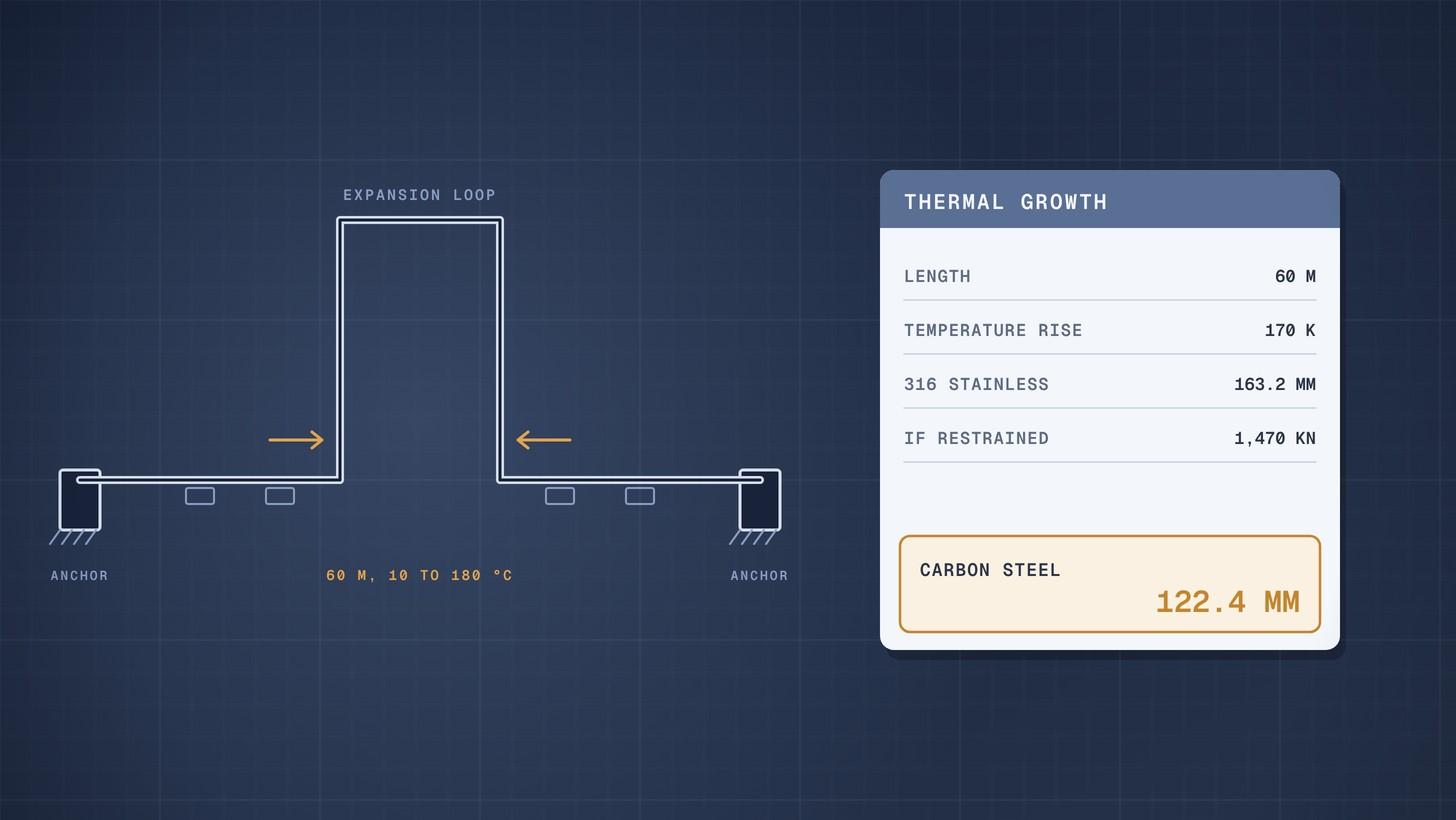
Pipe Thermal Expansion: Worked Example
How to calculate pipe thermal expansion for carbon and stainless steel, what restrained expansion does, and how loops and expansion joints absorb it.
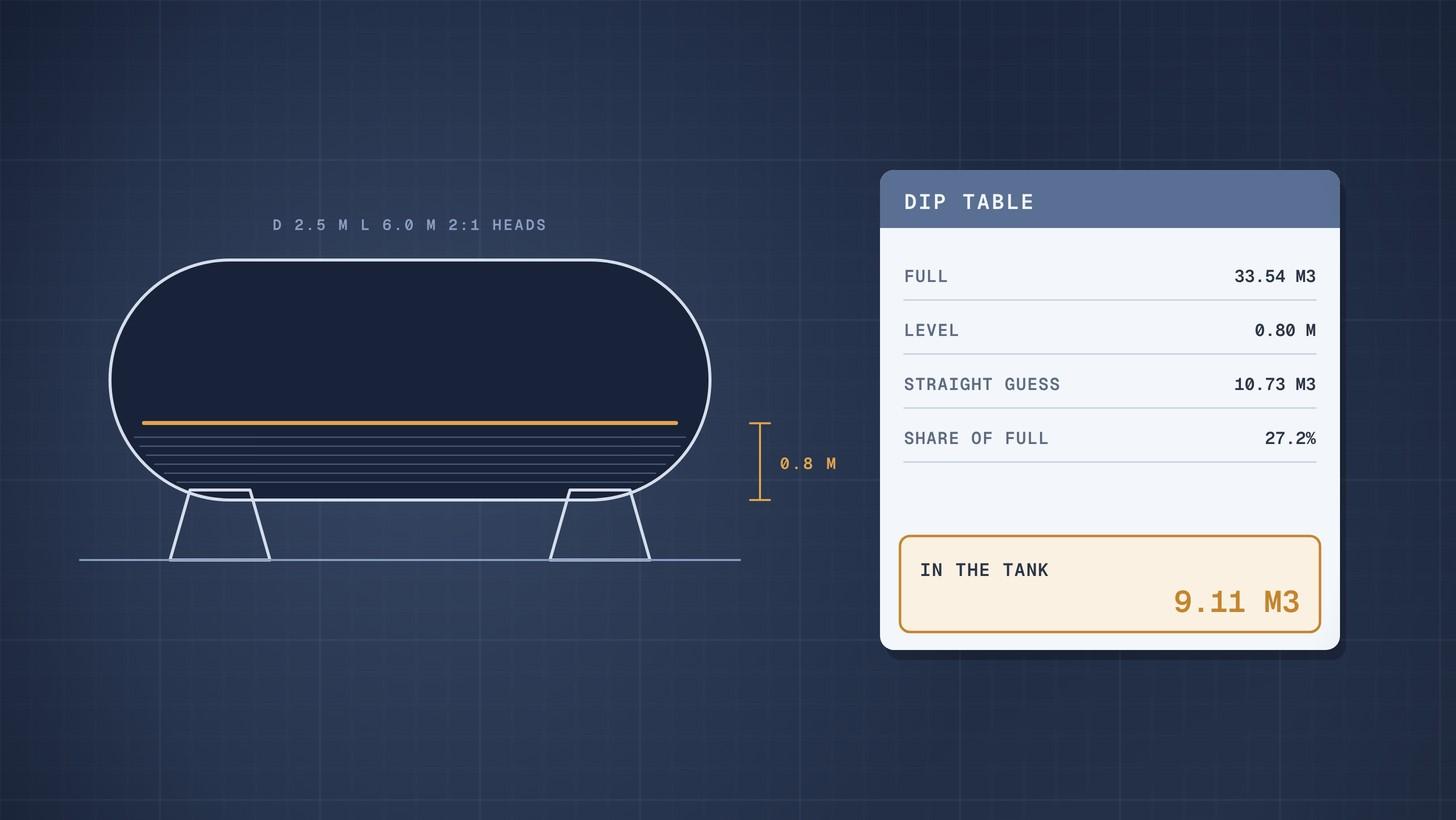
Horizontal Tank Volume When Partly Filled: Worked Example
How to calculate the volume of a partly filled horizontal tank with dished heads, with a worked example and a full dip table you can rebuild in a spreadsheet.
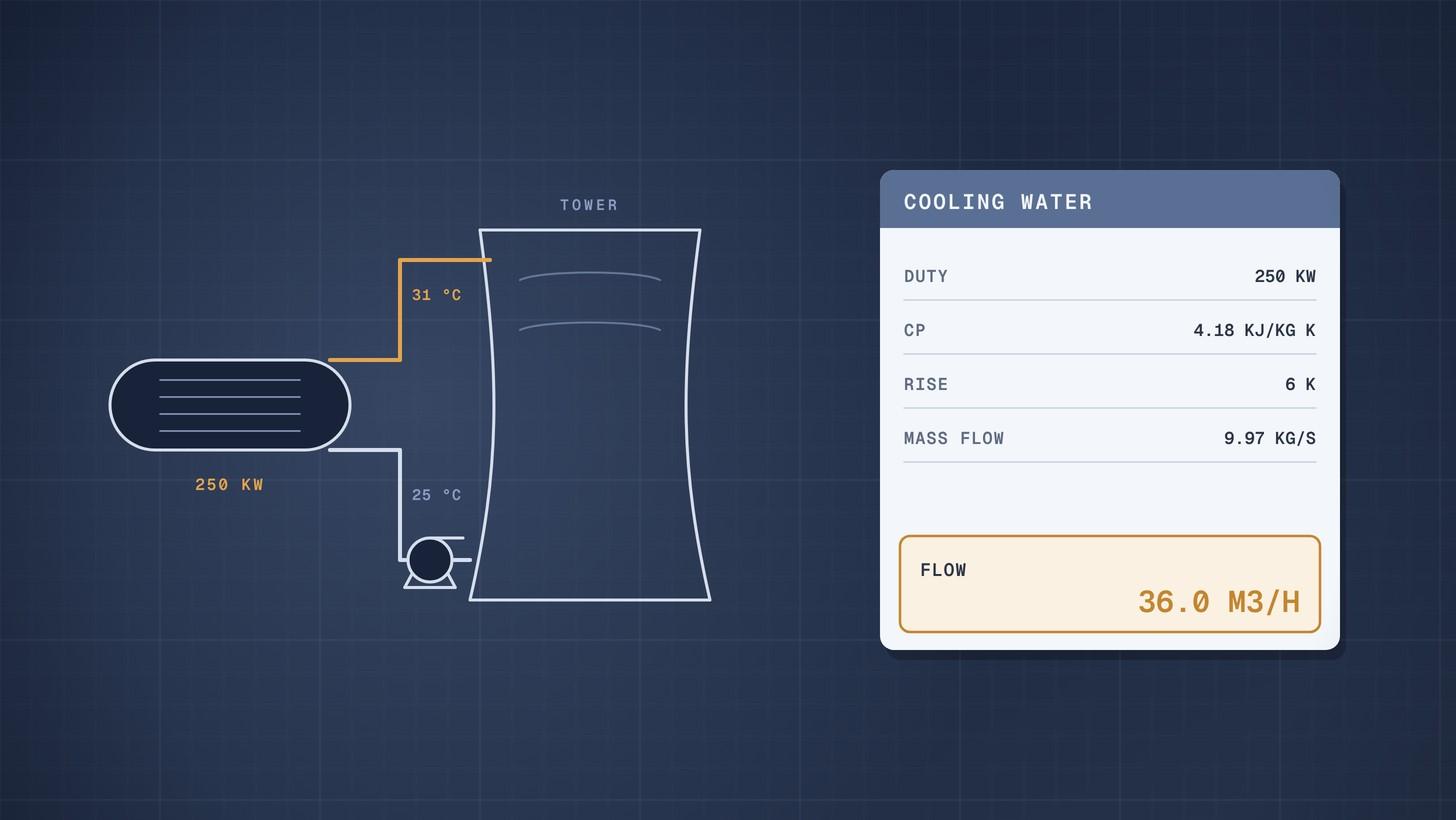
Cooling Water Flow Calculation: Worked Example
How to calculate cooling water flow from heat duty and temperature rise, then size the cooling tower circulation, evaporation and make up water.