
Evaporator Types: Falling Film, Forced Circulation, Wiped Film, MVR
Falling film, forced circulation, plate, wiped film and short path evaporators compared, with steam use for multiple effects, TVR and MVR, RFQ data and a worked example.
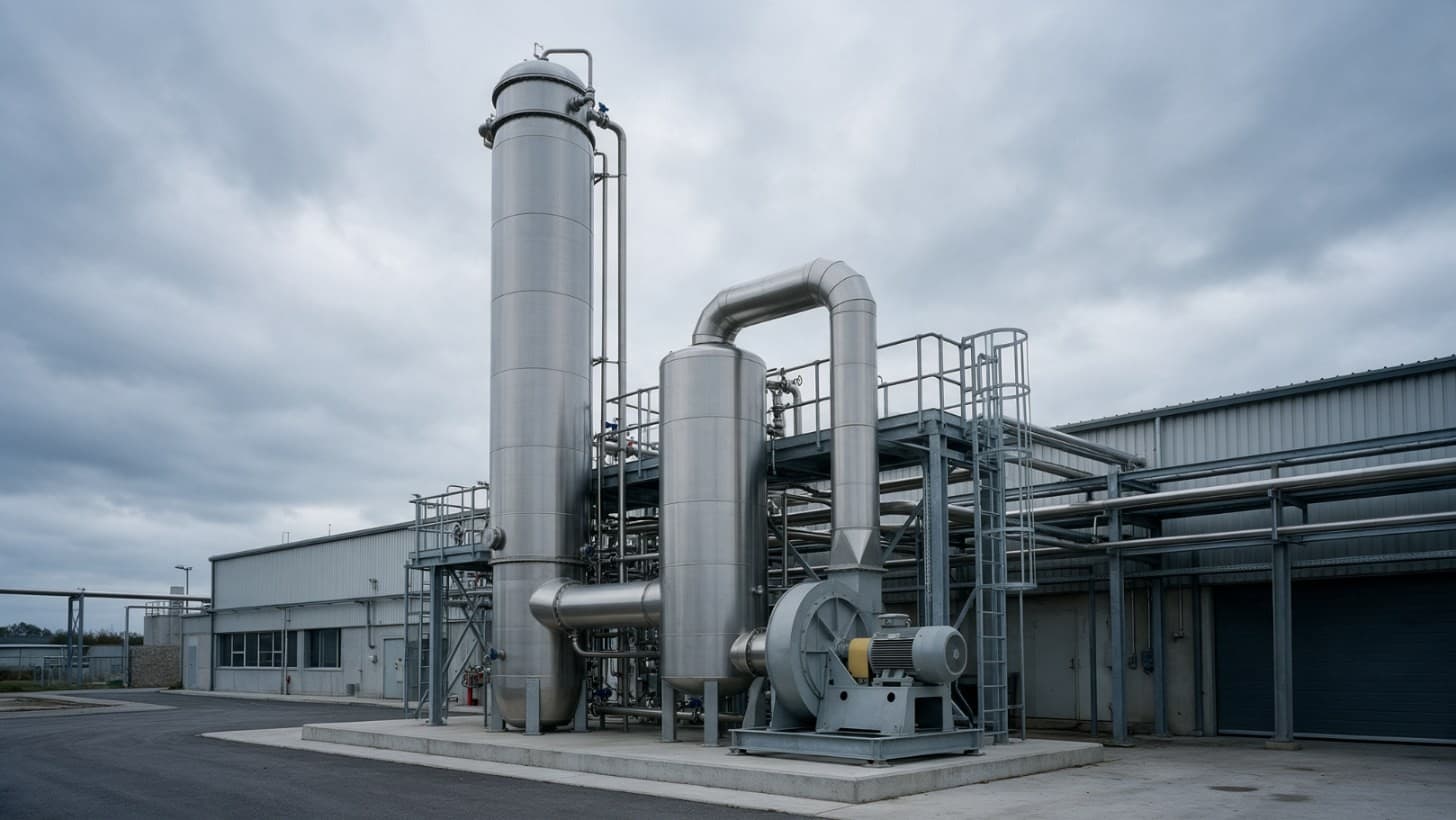
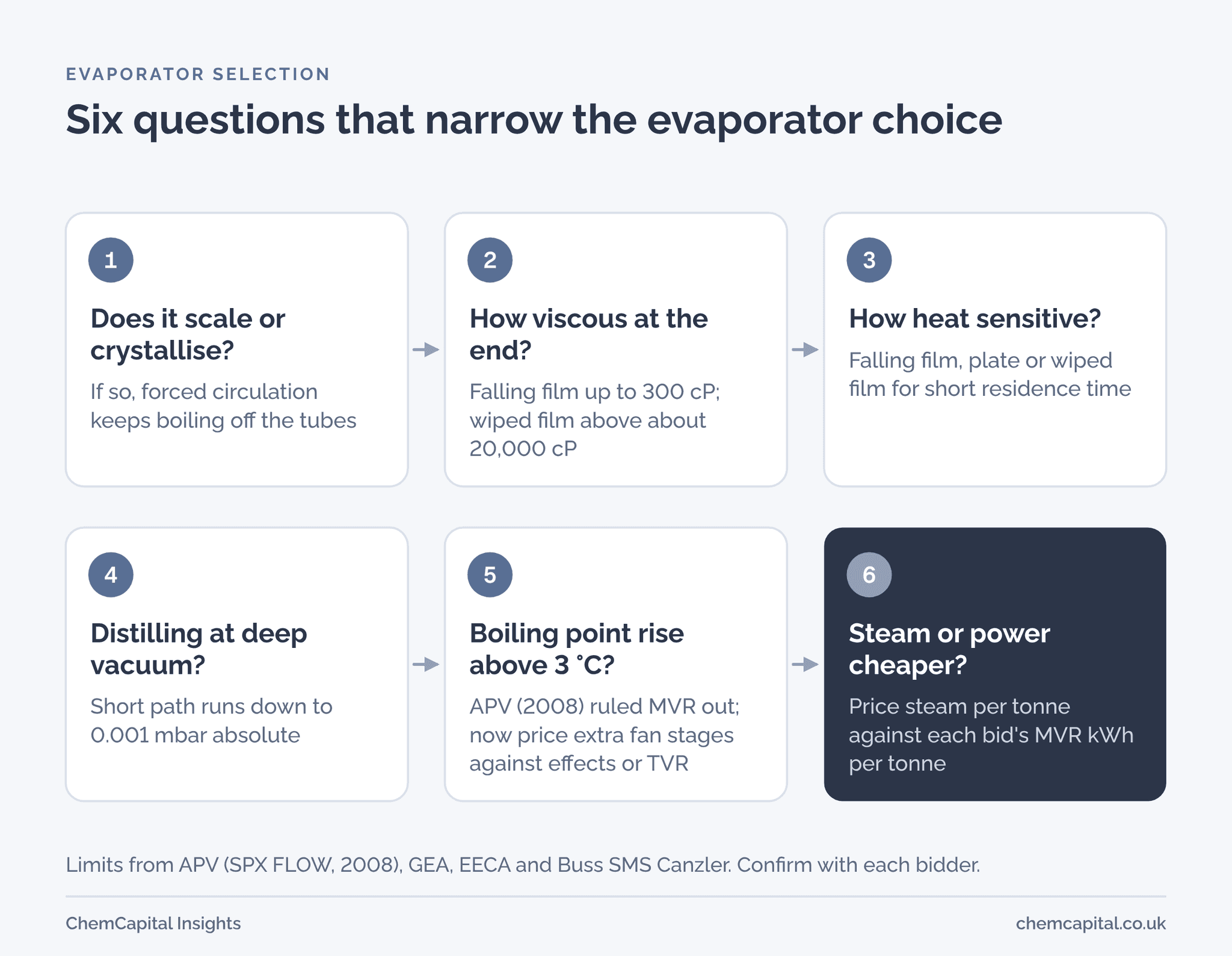
The right evaporator type depends mostly on the liquid. Falling film evaporators suit clean, heat sensitive liquids of low viscosity. Forced circulation suits liquids that scale, crystallise or turn viscous. Wiped film evaporators handle very viscous or fouling products, and short path units distil at very deep vacuum [1, 2, 5].
MVR (mechanical vapour recompression) is not a body type but a way of heating one, like multiple effects or TVR (thermal vapour recompression), and it sets the running cost. As a rough guide from GEA, a single effect uses about 1 tonne of steam per tonne of water evaporated, three effects about 0.33 tonnes, and MVR replaces most of the steam with about 30 to 50 kWh of electricity per tonne at a 10 K temperature difference, often less in practice [1, 3]. So the RFQ (request for quotation) must describe the liquid fully and ask for energy use on one basis.
Why this matters now
An evaporator runs for thousands of hours a year, so its heating choice fixes much of its energy bill for the life of the plant. MVR runs on electricity and cuts on site boiler emissions, but can need more capital. New Zealand's Energy Efficiency and Conservation Authority (EECA) puts first among its economic tests how much an extra tonne of process steam costs compared with the electricity that would replace it [4].
In EECA's 2019 examples, a fruit juice plant that replaced TVR with an extra effect and three stage MVR repaid its investment in about two years, on EECA's stated financing basis. In a Californian case, MVR needed nearly a decade to overtake a TVR steam ejector of about USD 15,000, its compressor alone costing close to USD 250,000 [4]. So bids for one duty can differ widely.
Create and manage RFQs in minutes
ChemCapital handles the entire procurement cycle, from structured RFQs and supplier comparisons to formal purchase orders and delivery tracking.
The main evaporator types and the duties they suit
Every evaporator has a heating surface, a tube bundle (the calandria) or a plate pack, and a separator where vapour leaves the concentrate. The types differ in how liquid moves over the surface.
Natural circulation and rising film. Liquid enters the bottom of the tubes and boiling drives it upwards. GEA suggests this for heat tolerant products, large evaporation ratios and liquids that foul readily [2]. APV says a rising film unit typically needs at least 14 °C across the heating surface [1].
Falling film. Liquid fed to the top of the tubes flows down the wall as a thin film, with extremely short residence time and capacities up to 150 t/h; the whole surface must stay wet, as dry spots lead to deposits [2]. APV rules it out above 300 cP (centipoise, equal to mPa s) and for heavy foulers [1].
Forced circulation. A pump drives the liquid through the calandria under enough hydrostatic head that it does not boil on the tubes; it flashes in the separator instead [1, 2]. That suits scaling and crystallising liquors, such as saline solutions, and the final step of a multiple effect plant [2]. APV says it copes with over 5,000 cP, at the cost of large pumps and pipework and considerably higher operating costs [1].
Plate. A plate pack replaces the tubes, giving high heat transfer, short residence time and low headroom [1]. Alfa Laval's AlfaVap Inline, for example, is a rising film plate unit built as a skid, for heat sensitive liquids of low to medium viscosity and fouling [6].
Wiped film and short path. A wiped film (agitated thin film) evaporator is a heated cylinder whose rotor and wiper blades spread the liquid as a thin film. Buss SMS Canzler quotes up to 70,000 mPa s at process temperature for its range, and a residence time usually under a minute [5]. APV says that above about 20,000 cP wiped and thin film systems are usually the only option, but the blades need maintenance and capital cost per kilogram evaporated is very high [1]. A short path evaporator adds an internal condenser close to the heated wall, so it can run down to 0.001 mbar absolute, for products such as vitamins and flavours [5].
| Type | Best suited to | Watch for |
|---|---|---|
| Natural circulation | Heat tolerant products, fouling liquids | Not for heat sensitive products |
| Falling film | Heat sensitive, low viscosity, few solids | Over 300 cP, heavy fouling, dry spots |
| Forced circulation | Scaling, crystallising, viscous liquids | Higher capital and operating cost |
| Plate | Heat sensitive liquids, low headroom | Low to medium rates; few solids, no fouling [2] |
| Wiped film | Very viscous or fouling products, solvent stripping | Wiper maintenance, high cost per kg |
| Short path | Distilling very heat sensitive products | Specify vacuum and condenser duty |
Steam economy: multiple effects, TVR and MVR
Steam economy is the mass of water evaporated per mass of steam supplied. In a single effect, a kilogram of steam evaporates about a kilogram of water [2].
Multiple effects. Vapour from one effect heats the next, which runs at lower pressure [7]. The saving is paid for in surface: Earle's analysis shows each effect needs about the same area as a single effect doing the whole job [7].
TVR. A steam jet compressor uses higher pressure motive steam to recompress about half the vapour, saving as much as one extra effect, says GEA [2]. APV wants motive steam above 3 barg, preferably 7 barg [1].
MVR. An electric fan compresses all the vapour, a single stage fan typically at compression ratios of 1.2 to 1.5, and live steam is needed mainly at start up [2]. The catch is the small temperature lift, usually up to 10 °C for a single stage [4]. Boiling point rise, how much hotter a solution boils than water at the same pressure, grows as the liquid concentrates and eats into the temperature difference [8]. APV's 2008 handbook treats a rise above 3 °C as essentially ruling MVR out [1]; today a higher rise usually means more fans in series and more power per tonne, to be priced rather than assumed away [2, 4].
| Heating option | Steam per tonne evaporated | Electricity per tonne | Cooling water per tonne |
|---|---|---|---|
| Single effect | 1 t | Minor | 60 m³ |
| Two effects | 0.5 t | Minor | 30 m³ |
| Three effects | 0.33 t | Minor | 20 m³ |
| Four effects | 0.25 t | Minor | 15 m³ |
| TVR | About 0.5 t | Minor | 30 m³ |
| MVR | Minor | About 30 to 50 kWh | Minor |
GEA's figures assume a 10 K temperature difference [3]; MVR plants often run at smaller differences and use less power [4]. In APV's skim milk case, evaporating 83,000 lb/h (about 37.6 t/h), five effects used 17,000 lb/h of steam, five with TVR 11,000 lb/h, and MVR none but 560 kW, about 15 kWh per tonne [1].
What to put in the RFQ
Give every bidder:
- feed rate, and dissolved and suspended solids in and out
- viscosity at the final concentration and temperature
- boiling point rise at the final concentration, measured rather than guessed
- maximum product temperature and allowable time at temperature
- fouling, scaling, crystallising and foaming behaviour
- volatile and corrosive components
- utilities: steam pressure, spare electrical capacity, cooling water temperature
- operating hours a year, turndown and the CIP (clean in place) regime
Ask each bidder to guarantee steam, power and cooling water per tonne of water evaporated at stated conditions, and to state the number of effects, compression ratio, heat transfer area and assumed run time between cleans.
In Great Britain, steam is a relevant fluid under the Pressure Systems Safety Regulations 2000 [9], so a steam heated evaporator will usually be part of a pressure system that needs a written scheme of examination, as our PSSR written scheme guide explains. This is general information, not legal advice.
Practical example
Take an illustrative duty: concentrate 10,000 kg/h of feed from 10% to 40% dissolved solids, 8,000 hours a year.
- Solids balance: product = 10,000 × 0.10 ÷ 0.40 = 2,500 kg/h, so 7,500 kg/h is evaporated, 60,000 t a year.
- Lab results (illustrative): 150 cP and a boiling point rise of 1.5 °C at 40%, no crystallisation, so falling film and MVR stay in play.
- Prices (illustrative): steam £40 per tonne, electricity £0.20 per kWh.
| Option | Steam or power per tonne | Per year | Energy cost per year |
|---|---|---|---|
| Single effect | 1 t steam | 60,000 t steam | £2,400,000 |
| Single effect with TVR (GEA's TVR row) | 0.5 t steam | 30,000 t steam | £1,200,000 |
| Three effects | 0.33 t steam | 19,800 t steam | £792,000 |
| Four effects | 0.25 t steam | 15,000 t steam | £600,000 |
| MVR, GEA basis (10 K) | 30 to 50 kWh | 1,800 to 3,000 MWh | £360,000 to £600,000 |
| MVR, APV case rate | About 15 kWh | 900 MWh | £180,000 |
MVR saves £1.8 million a year or more against a single effect, but against four effects only £0 to £240,000 on GEA's basis, or about £420,000 at APV's case rate. At these prices a tonne of steam costs the same as 200 kWh, so the guaranteed kWh per tonne, at a stated temperature difference, and the capital difference decide it. MVR would also need about 110 to 375 kW of electrical capacity, which EECA flags as a possible constraint, and some steam [4]. Had the boiling point rise come back at 5 °C, a single fan stage might not give enough lift; MVR would need more stages and more power, and effects or TVR might win [1, 4].
Find evaporator suppliers who fit the duty
Supplier Discovery searches the web for evaporator suppliers from a plain text description, a pasted RFQ or an uploaded specification. It extracts each supplier's published parameters with source links, and a deterministic engine gives a verdict of Strong, Partial, Information Missing or Rejected. Certifications are shown as claimed, not verified, and nothing is sent automatically. You can try three searches free without signing up. When bids arrive, our guide to technical bid evaluation shows how to score them.
Ready to find evaporator suppliers who fit your duty? Start a free 14 day ChemCapital trial, with no credit card needed.
Frequently asked questions
What are the main types of evaporator?
The main types are natural circulation, rising film, falling film, forced circulation, plate, wiped film (agitated thin film) and short path. They differ in how the liquid moves over the heating surface, which decides how each copes with viscosity, heat sensitivity, fouling and crystallisation.
What is the difference between a falling film and a forced circulation evaporator?
In a falling film evaporator the liquid runs down the tubes as a thin film with a very short residence time, which suits clean, heat sensitive liquids; APV rules it out above 300 cP. In forced circulation a pump keeps the liquid from boiling in the tubes so it flashes in the separator, which suits scaling, crystallising and viscous duties at higher capital and operating cost.
Is an MVR evaporator cheaper to run than a multiple effect evaporator?
Often, but not always. GEA puts MVR at about 30 to 50 kWh per tonne of water at a 10 K temperature difference, and APV's skim milk case works out at about 15 kWh, against 0.25 to 0.33 tonnes of steam for four or three effects, so local steam and electricity prices decide it. A high boiling point rise needs more fan stages and more power, which APV's 2008 handbook says largely rules out MVR above about 3 °C.
When should you use a wiped film evaporator?
Use one for very viscous or fouling products, or to strip solvents to very low levels. APV says above about 20,000 cP wiped and thin film systems are usually the only suitable options, and Buss SMS Canzler quotes up to 70,000 mPa s at process temperature for its range, with a residence time usually under a minute.
Continue reading
Informational only, not procurement or legal advice. Cited names, frameworks, and statistics belong to their respective owners.
Create and manage RFQs in minutes
ChemCapital handles the entire procurement cycle, from structured RFQs and supplier comparisons to formal purchase orders and delivery tracking.
Start for freeRelated articles
Where to Find Pharma and Chemical Plant Projects Before They Go to Tender: the 2027 Pipeline
Twenty pharma and chemical plant projects checked against owner or government announcements, the buying timeline on each, and where to watch for the next ones for free.
TEMA Heat Exchanger Types: How to Read AES, BEM and AEU
How to decode the three letter TEMA type, what AES, BEM, AEU and other common types mean for cleaning, expansion, leaks and cost, and how to compare bids that differ.
Safety Valve vs Relief Valve vs Bursting Disc: How to Choose
How safety valves, relief valves and bursting discs differ, when to fit a disc under a valve, the pressure terms that matter, GB duties and what to put in the RFQ.