
Filter Area Sizing: Worked Example
How to size a batch filter from cake volume and cake depth, read a lab filtration test and scale it to a nutsche or filter press.
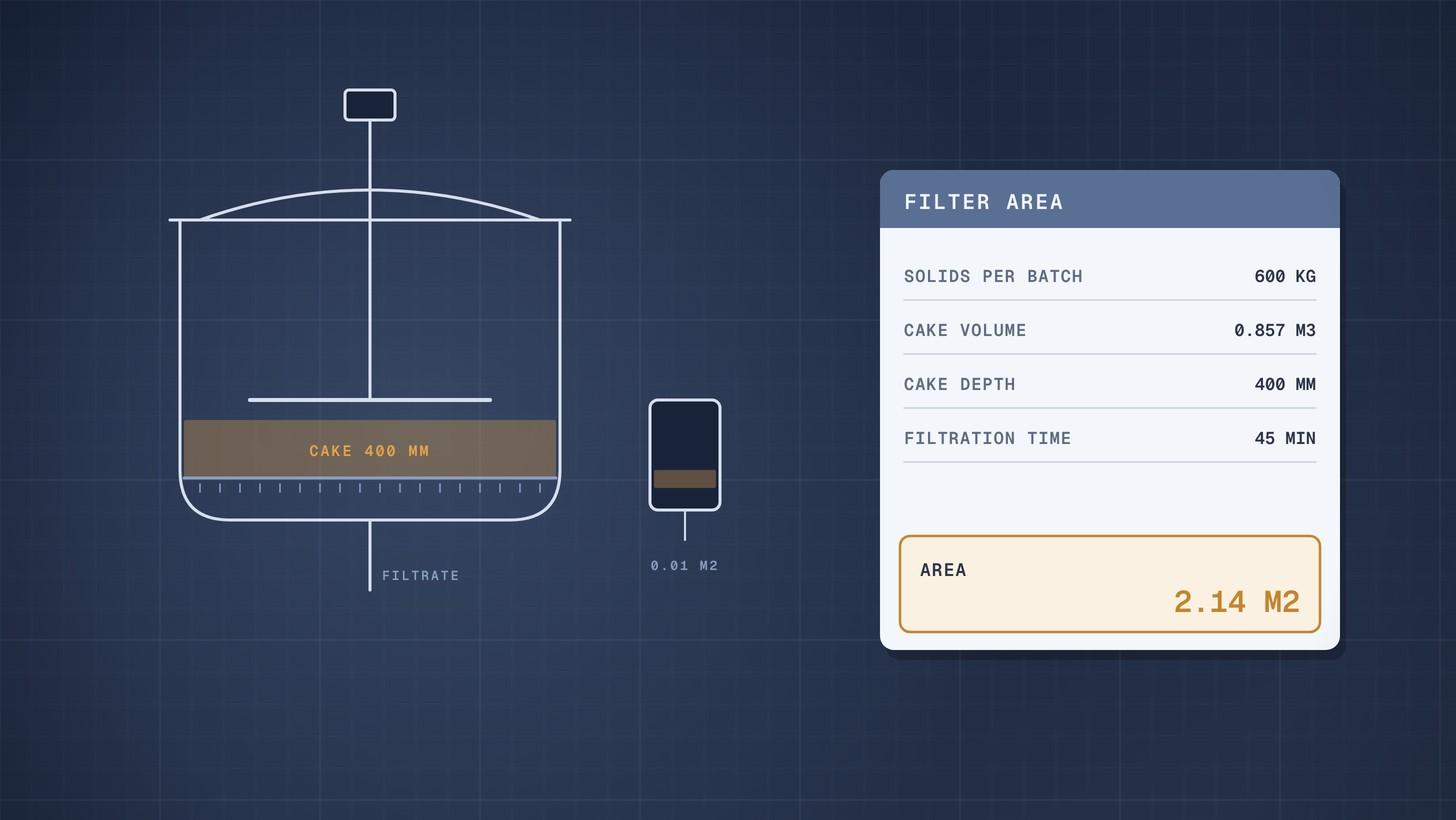
Filter area for a batch filter is the cake volume per batch divided by the cake depth you can accept, checked against how long that cake takes to filter in a lab test at the same depth and pressure. In the worked example below, 600 kg of solids per batch makes 0.86 m³ of cake; at a 400 mm cake depth that needs about 2.1 m² of filter area, and a lab test predicts 45 minutes to filter.
The lab test is what turns a guess into a size. Filtration rates vary enormously from one slurry to the next, and no table of typical values replaces filtering your own material.
Why this matters
Too little area and the filter becomes the bottleneck of the plant: batches wait, cakes crack and wash poorly. Too much and you pay for a larger vessel, a heavier agitator and more stainless steel than you need. Filters are also hard to change after installation, so the area decision deserves real data.
The case for testing is old. A 1960s Canadian review of filtration research quotes Carman's observation that it is seldom possible to produce a sludge with constant filtering properties, which has long made it hard to apply laboratory results to full scale design [1]. Test the slurry you will actually make, from the actual crystalliser or reactor where possible.
Create and manage RFQs in minutes
ChemCapital handles the entire procurement cycle, from structured RFQs and supplier comparisons to formal purchase orders and delivery tracking.
Step 1: the cake volume
Start from the solids per batch and the cake's bulk density, measured on a lab cake.
- Dry solids per batch: 600 kg (illustrative)
- Cake bulk density: 700 kg of dry solids per m³ of cake (illustrative, from the lab)
- Cake volume: 600 ÷ 700 = 0.857 m³
Step 2: the area from the cake depth
The area follows from how deep a cake you are willing to form. Process simulation software works the same way: SuperPro Designer's help notes that cake thickness is the cake volume per cycle divided by the filter area, and warns if it exceeds the maximum you set [2].
- Target cake depth: 400 mm (illustrative; set by washing, drying and the filter design)
- Area: 0.857 ÷ 0.40 = 2.14 m²
A deeper cake means a smaller filter but longer filtration, washing and drying. A shallower cake means a larger filter but faster cycles.
Step 3: the lab test
A small pressure filter with a known area, run at the plant's pressure, gives the filtration time. Powder Systems, which makes filter dryers, describes lab units with filter areas of 0.01 m² and 0.05 m², and notes that 2 bar(g) is typical for pressure filtration [3].
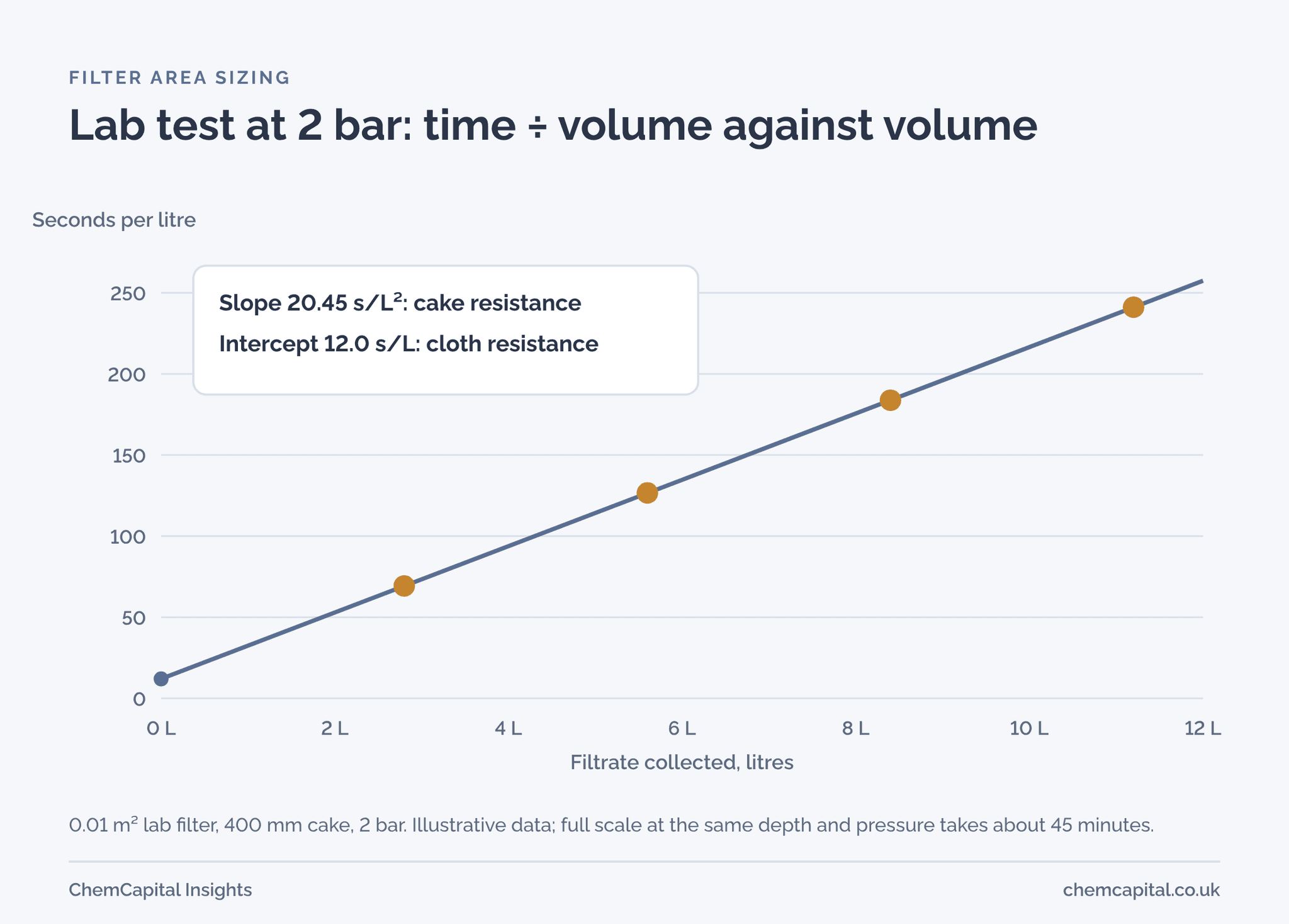
The test. Scale the slurry to the lab area so the lab cake has the plant depth. The plant filters 2.4 m³ of mother liquor per batch, or 1.12 m³ per m² of area. On a 0.01 m² lab filter that is 11.2 litres of filtrate and a 4.0 litre cake, 400 mm deep. Record the filtrate volume against time at 2 bar. The results below are illustrative.
| Filtrate collected | Time | Time ÷ volume |
|---|---|---|
| 2.8 L | 194 s | 69.3 s/L |
| 5.6 L | 709 s | 126.6 s/L |
| 8.4 L | 1,544 s | 183.8 s/L |
| 11.2 L | 2,700 s | 241.1 s/L |
Reading it. Filtration theory based on Darcy's law predicts that, at constant pressure, a plot of time ÷ volume against volume is a straight line: the slope gives the specific cake resistance and the intercept the resistance of the cloth [4]. Here the slope is 20.45 s/L² and the intercept 12.0 s/L, so the cloth adds little and the cake controls the rate. Early points can stray from the line, so use the straight part [4].
Step 4: scale to the plant
Keep the cake depth and pressure the same as the lab, and the filtration time should be comparable at full scale; Powder Systems reports this has worked from lab to production, provided the agitator stops cracking and channelling [3].
- Plant filtration time: about 45 minutes
- Average flux: 1.12 m³/m² in 0.75 h, or 1.49 m³/m² h
What if you choose a different area? Because the cake controls the rate, filtration time rises roughly with the square of the cake depth. From the lab line:
| Filter area | Cake depth | Predicted filtration time |
|---|---|---|
| 2.14 m² | 400 mm | 45 minutes |
| 2.50 m² (next size up, illustrative) | 343 mm | 33 minutes |
| 4.29 m² (double) | 200 mm | 12 minutes |
Doubling the area cuts filtration time to about a quarter. Whether that is worth the price depends on what else limits the cycle: washing, drying, discharge and the upstream batch time.
Do not skip the staged route for new processes
For a new process, a single lab test is a starting point. A BHS Sonthofen case study describes moving from a 20 cm² pocket leaf test, through pilot candle filters, to a 0.6 m² demonstration belt filter before the commercial design, with the performance guarantees based on the demonstration plant [5]. The pilot stage showed one filter type was unsuitable, which the lab test alone had not.
Filter presses
The same cake volume sizes a filter press. Divide the cake volume per cycle by the volume of one chamber from the maker's table to find the number of chambers, and check the cake thickness the chamber gives against your lab test.
What to put in a filter RFQ
- Solids per batch and the slurry volume, concentration and temperature.
- Lab results: filtrate volume against time, cake depth, pressure and cake bulk density.
- Wash and drying targets: wash ratio, final moisture and residual solvent.
- The cycle time the filter must fit into.
Our guide to the agitated nutsche filter dryer explains the equipment, and industrial centrifuge types covers the alternative for fast filtering solids. With ChemCapital's structured RFQs, every filter supplier sizes from the same lab data, so their areas and cycle times can be compared.
Ready to send filter RFQs backed by real test data? Start a free 14 day ChemCapital trial, with no credit card needed.
Frequently asked questions
How do you calculate filter area?
Divide the cake volume per batch by the cake depth you can accept, then check the filtration time with a lab test at the same cake depth and pressure. For 0.857 m³ of cake at 400 mm depth, the area is about 2.14 m².
How do you scale up a filtration test?
Run the lab filter at the plant pressure with the same cake depth as the plant. With depth and pressure the same, the filtration time should be comparable at full scale, as long as the cake does not crack or channel.
What does a plot of t/V against V show?
At constant pressure, filtration theory based on Darcy's law predicts a straight line. The slope gives the specific cake resistance and the intercept gives the resistance of the filter cloth. Ignore early points that stray from the line.
How does cake depth affect filtration time?
When the cake controls the rate, filtration time rises roughly with the square of the cake depth. In the worked example, doubling the filter area halves the cake depth and cuts filtration time from 45 minutes to about 12.
Continue reading
Informational only, not procurement or legal advice. Cited names, frameworks, and statistics belong to their respective owners.
Create and manage RFQs in minutes
ChemCapital handles the entire procurement cycle, from structured RFQs and supplier comparisons to formal purchase orders and delivery tracking.
Start for freeRelated articles
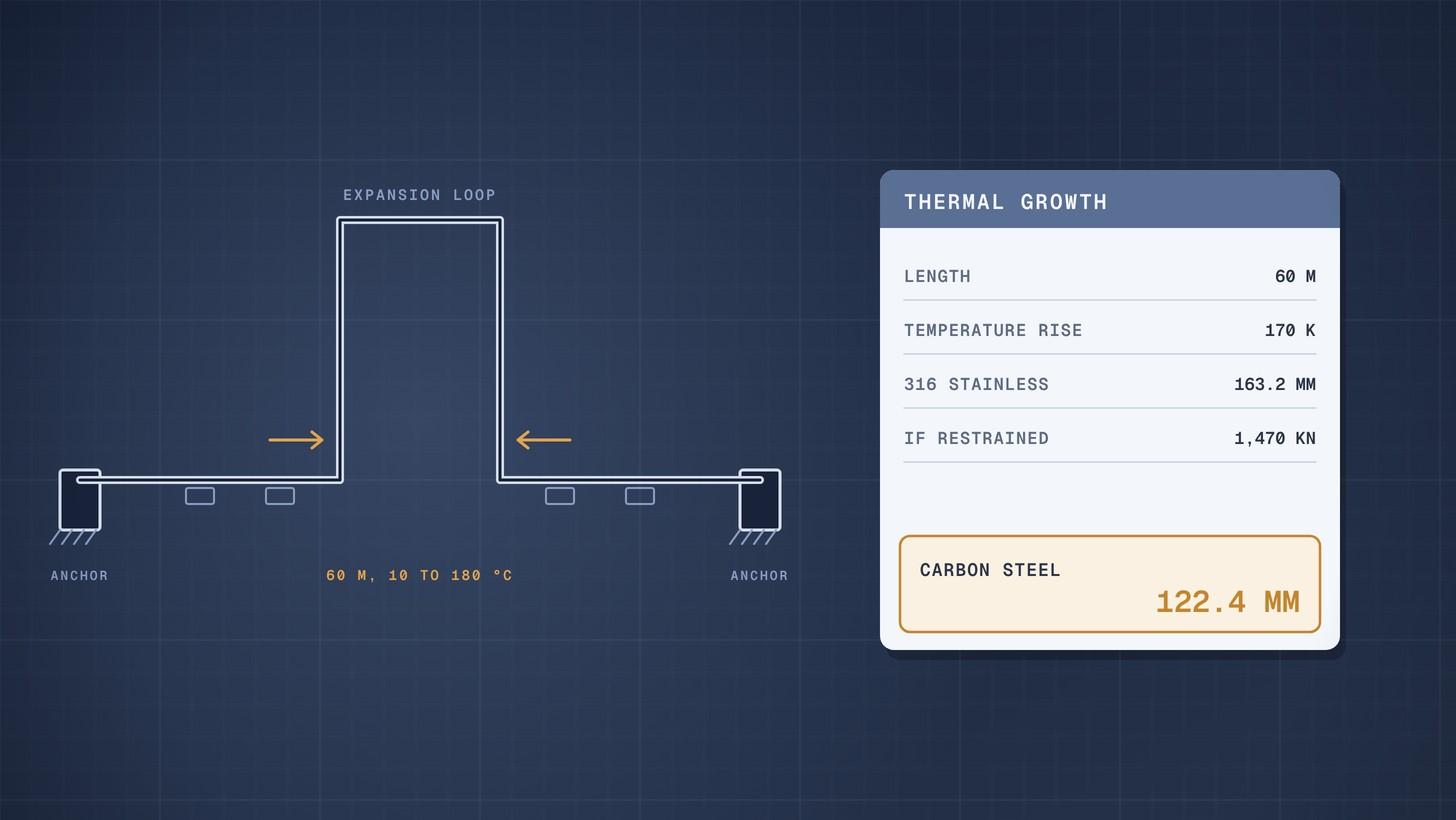
Pipe Thermal Expansion: Worked Example
How to calculate pipe thermal expansion for carbon and stainless steel, what restrained expansion does, and how loops and expansion joints absorb it.
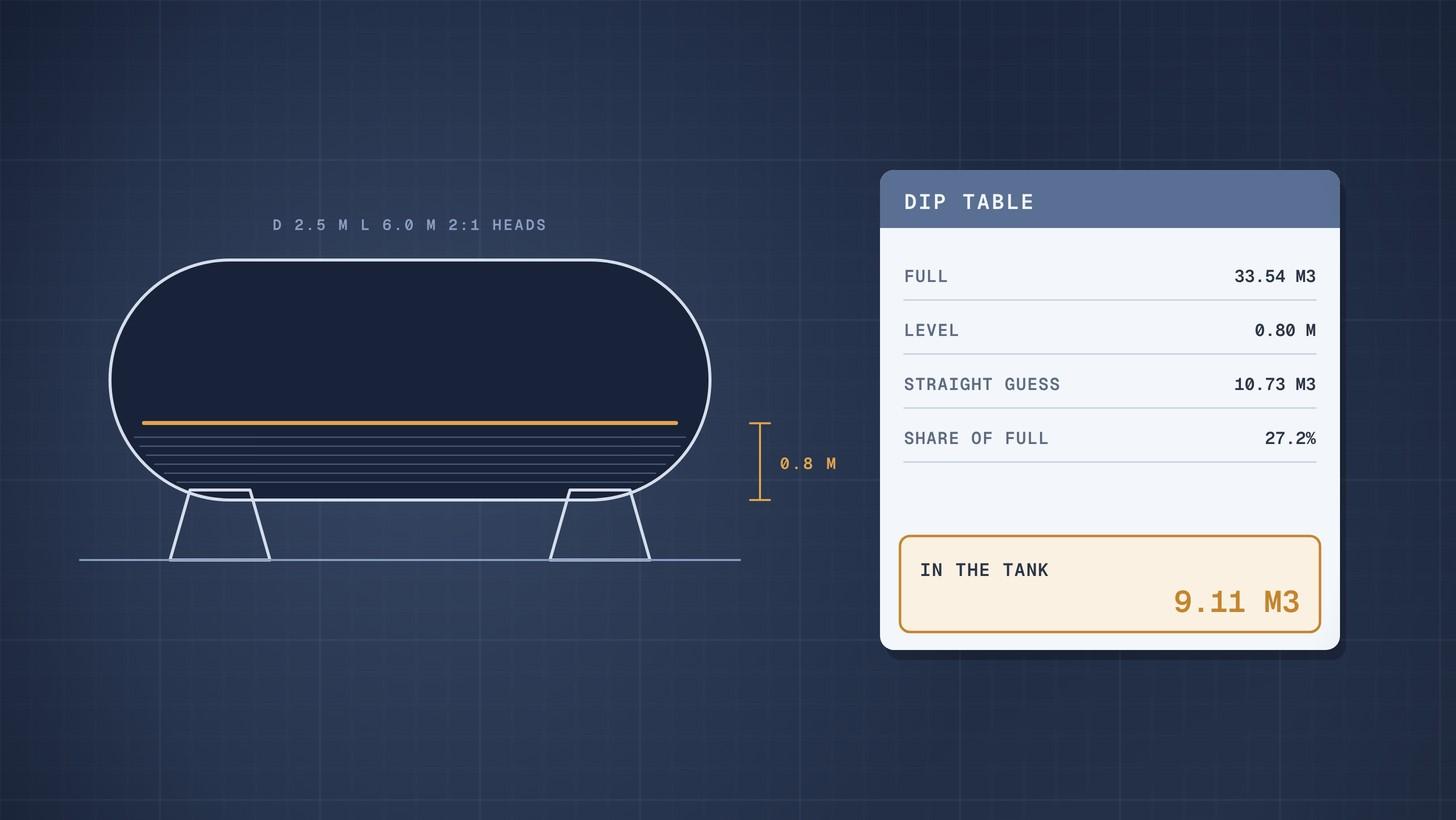
Horizontal Tank Volume When Partly Filled: Worked Example
How to calculate the volume of a partly filled horizontal tank with dished heads, with a worked example and a full dip table you can rebuild in a spreadsheet.
Cooling Water Flow Calculation: Worked Example
How to calculate cooling water flow from heat duty and temperature rise, then size the cooling tower circulation, evaporation and make up water.