
Types of Industrial Dryers: Fluid Bed, Rotary, Vacuum, Spray and More
Direct and indirect dryers compared: tray, fluid bed, rotary, flash, spray, drum, paddle, vacuum and filter dryers by feed, solvent, explosion risk and the data a vendor needs.
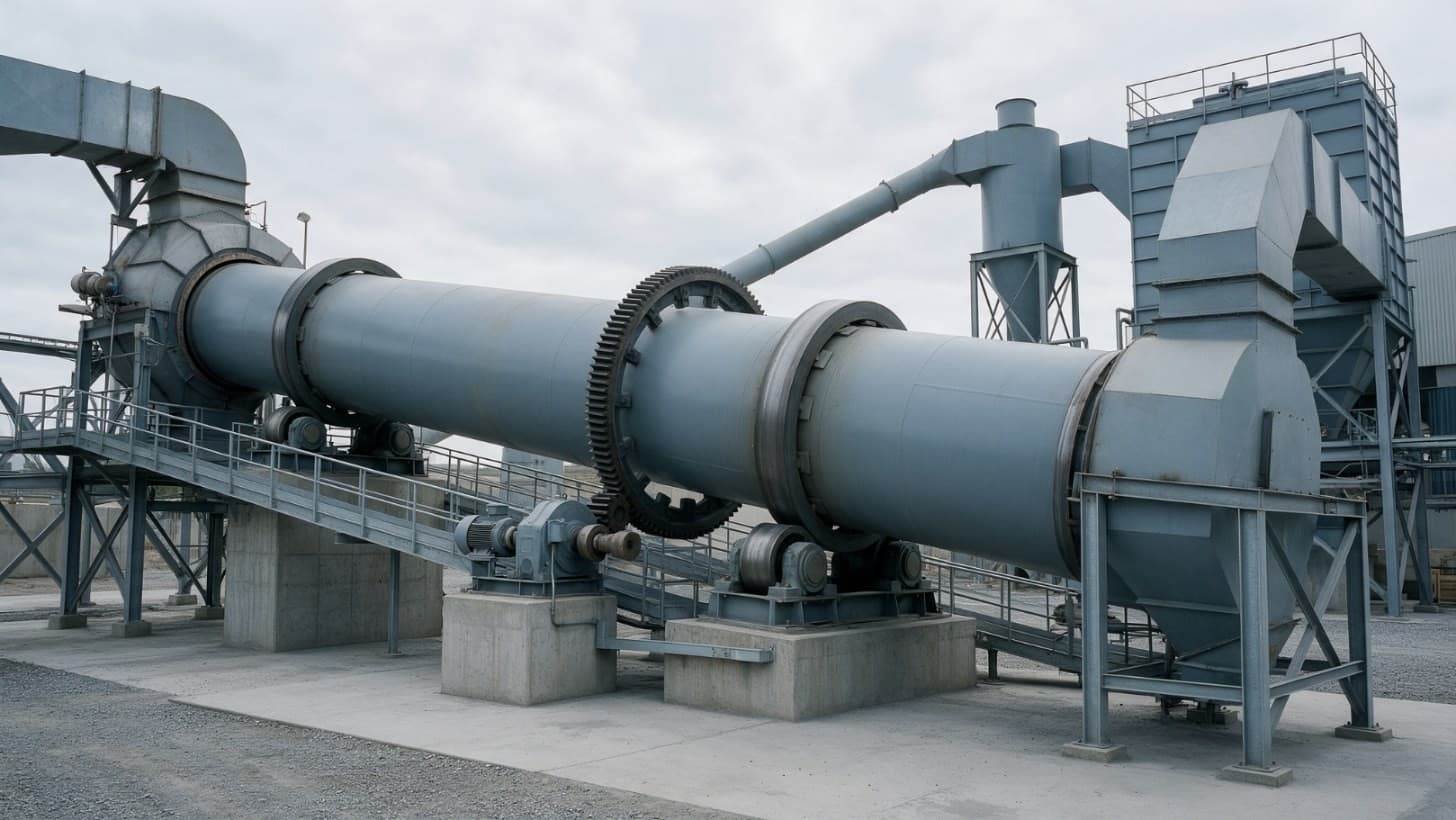
Industrial dryers fall into two families. Direct, or convective, dryers bring hot air or gas into contact with the wet product, and that gas carries the vapour away: hot air tray dryers, fluid bed, rotary, flash and spray dryers [1, 2]. Indirect, or contact, dryers pass heat through a heated wall, jacket or plate, often under vacuum: vacuum tray and agitated vacuum dryers [1], paddle dryers [4], conical vacuum dryers [5] and filter dryers with a heated filter plate [8]. Some machines combine the two [1].
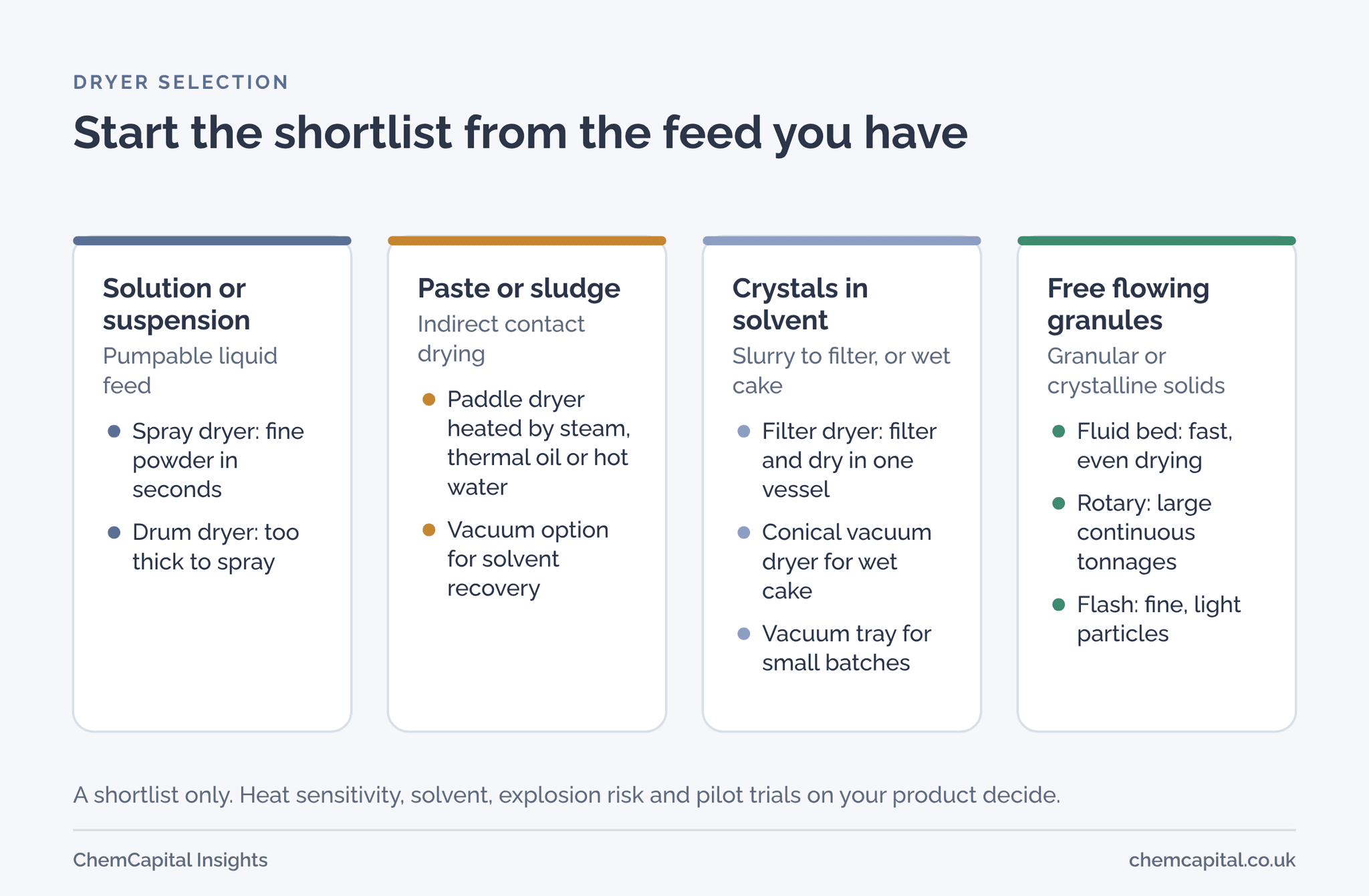
The choice starts from the feed: a pumpable solution or suspension, a paste or sludge, a wet cake from a filter or centrifuge, or free flowing granules. Then come heat sensitivity, solvent, explosion risk, containment and throughput.
Why this matters now
Vendors size a dryer from your moisture figures and, ideally, from tests on your material. If two read the same RFQ (request for quotation) differently, their bids describe different machines, and the cheaper one may simply be smaller.
In pharma and fine chemicals, the end point is often a residual solvent limit. The ICH Q3C guideline accepts up to 0.5% (5,000 ppm, under its Option 1) of a low toxicity Class 3 solvent such as ethanol or acetone without justification, but sets Class 2 limits of 3,000 ppm for methanol and 890 ppm for toluene under the same option [9]. This is the R9 revision of January 2024; check for later revisions. In Great Britain (England, Wales and Scotland), drying a solvent wet or dusty product also brings duties under DSEAR [7].
Create and manage RFQs in minutes
ChemCapital handles the entire procurement cycle, from structured RFQs and supplier comparisons to formal purchase orders and delivery tracking.
Direct and indirect drying: the first split
In a direct dryer, hot gas supplies the heat [1]. While the particle surface is still wet, it stays near the wet bulb temperature (Glatt calls it the cooling limit temperature), far cooler than the incoming air, so hot air can still dry gently [2]. If the air is too hot, a crust can form and trap moisture inside [2]. Direct dryers are generally cheaper to buy than indirect ones despite lower thermal efficiency, but the large gas flow carries dust, and dust collection may add as much again as the dryer's own price [1].
In an indirect dryer, heat passes through a wall [1]. ANDRITZ's paddle dryer, heated by steam, thermal oil or hot water, admits no additional air, so very little gas leaves it [4]. A small vapour stream is easy to condense, which suits solvent recovery, and vacuum lowers the drying temperature for heat sensitive products [1, 4]. Hosokawa's conical Nauta vacuum mixer works the same way, with a jacket heated by steam or hot water, a condenser and a vacuum pump [5].
The main dryer types and what each suits
| Dryer | Heating | Mode | Feed it suits | Points for the buyer |
|---|---|---|---|---|
| Tray (cabinet) | Hot air, or heated plates under vacuum | Batch | Wet solids spread on trays | Small rates and valuable products; several hours a batch [1] |
| Fluid bed | Direct | Batch or continuous | Granular and crystalline solids, wet granules [1, 2] | Fast, even drying; Glatt claims about 20 times faster than a drying oven [2] |
| Rotary | Direct, hot gas | Continuous | Wet solids at high tonnage | Solids stay 5 minutes to 2 hours [1] |
| Flash | Direct | Continuous | Fine, light particles; heat sensitive or easily oxidised [1] | A few seconds in the dryer; not for large or heavy particles [1] |
| Spray | Direct | Continuous | Solutions, suspensions and emulsions [2] | Droplets dry within seconds to a fine powder [2] |
| Drum | Thin film on a rotating drum | Continuous | Too thick to spray, too thin for a rotary dryer [1] | Liquid or slurry fed as a film |
| Paddle | Indirect | Continuous (ANDRITZ Gouda) | Sludges, powders, polymers and salts [4] | 2.2 m² to 300 m² of drying surface, up to 300 °C; vacuum for solvent recovery [4] |
| Agitated vacuum, such as conical | Indirect, vacuum | Batch | Wet cake and powders | Agitation substantially shortens drying time [1]; jacket, condenser and vacuum pump [5] |
| Filter dryer | Heated filter plate, optional heated agitator; vacuum or convection drying [8] | Batch | Slurry filtered, washed and dried in one vessel [6, 8] | Closed system with no product transfer; solvent recovered [6, 8] |
As a rough rule, batch dryers suit rates below about 150 to 200 kg/h of dried product, continuous dryers above 1 or 2 t/h [1].
Solvents, containment and explosion risk
Indirect vacuum dryers suit solvent recovery: ANDRITZ offers its paddle dryer for this at low temperature under vacuum, and 3V Tech's systems can purify recovered solvent for reuse [4, 6]. A fluid bed can handle solvent too if it recirculates its gas: GEA offers closed loop options on its CONTACT FLUIDIZER, which also has heating panels in the bed, for toxic or hazardous products, with organic solvent recycling [3].
For potent APIs (active pharmaceutical ingredients), a filter dryer keeps the product in one closed vessel from slurry to dry powder, and glove boxes are available for highly potent APIs [6, 8]. Our agitated nutsche filter dryer guide covers it in depth.
Solvent vapour and fine powder can both form explosive atmospheres. Under DSEAR, employers must assess the risks from dangerous substances, eliminate or reduce them, and classify places where explosive atmospheres may occur into zones [7]. For flammable vapours the zones are 0, 1 and 2, and for dusts 20, 21 and 22, needing at least category 1, 2 and 3 equipment respectively; dust layers and deposits count as a source too [7]. Ask each vendor which zone they assumed inside and around the dryer, the equipment category, and how the design protects against an explosion. This is general information, not legal advice.
What a vendor needs to quote
Give every bidder the same data:
- feed form and rate: slurry, paste, wet cake or granules, in kg/h or kg per batch
- moisture or solvent in and out, stating wet or dry basis, and how LOD (loss on drying, the weight a sample loses when dried under set conditions) is measured
- the solvent, its residual limit and whether it must be recovered; ICH Q3C allows a nonspecific test such as LOD when only Class 3 solvents are present, provided the method is properly validated with the solvent's volatility in mind [9]
- particle size, bulk density, and whether the product is sticky, friable or forms lumps
- maximum product temperature and any sensitivity to oxygen
- batch or continuous, batch size and operating hours a year
- containment level, cleaning method and materials of construction
- utilities: steam, hot water, thermal oil, vacuum, nitrogen
- hazardous area zones and any explosion test data you hold
- test work: sample quantity, who pays and what will be measured
Our URS guide shows how to turn this list into a specification.
Why pilot trials matter
A wet solid dries at a constant rate until it reaches its critical moisture content, then the rate falls [1]. For heat sensitive materials, much of what slows drying is moisture moving out from inside the solid [1], so more surface heat does little for speed and can harm quality. Dryer makers such as 3V Tech therefore run customer samples through pilot units to find a workable drying time and give a basis for the full size machine, and rent pilot units out for tests at the customer's site [6]. Budget for trials before ordering, and base the performance guarantee on the results.
Practical example
Take an illustrative duty: 500 kg/h of wet cake at 25% moisture, to be dried to 0.5%. The RFQ meant wet basis, water as a share of the wet material, but did not say so. Bid A read 25% as dry basis, kilograms of water per kilogram of dry solid. On a dry basis the same cake would be 33.3%.
| Item | Bid A (read as dry basis) | Bid B (wet basis, as meant) |
|---|---|---|
| Dry solids | 400 kg/h | 375 kg/h |
| Water in | 100 kg/h | 125 kg/h |
| Water left at 0.5% | 2.0 kg/h | 1.9 kg/h |
| Water to evaporate | 98.0 kg/h | 123.1 kg/h |
| Heat to evaporate the water, at an illustrative 2,300 kJ/kg | 62.6 kW | 78.7 kW |
| Price (illustrative) | £180,000 | £205,000 |
| Price per kg/h of water evaporated | £1,837 | £1,665 |
Real heat demand is higher once solids heating, losses and, for a direct dryer, exhaust gas heat are added.
Bid A looks 12% cheaper, but it is sized for 20% less evaporation. On the real feed, each kilogram of wet cake needs 0.246 kg of water removed, so Bid A's dryer could take only about 398 kg/h of wet cake, giving about 300 kg/h of dry product instead of 377 kg/h. Per unit of real duty, Bid B is the cheaper machine. Four words in the RFQ, "moisture on wet basis", would have prevented the mismatch. Our technical bid evaluation guide shows how to put bids on one basis.
Build your dryer supplier shortlist
Supplier Discovery searches the web for suppliers from a plain text description, a pasted RFQ or an uploaded specification. It extracts each supplier's published parameters with source links and gives a fit verdict: Strong, Partial, Information Missing or Rejected. Nothing is sent to a supplier automatically. You can try three searches free without signing up, then attach the suppliers you choose to an RFQ.
Ready to build your dryer supplier shortlist? Start a free 14 day ChemCapital trial, with no credit card needed.
Frequently asked questions
What are the main types of industrial dryers?
They split into direct dryers, where hot air or gas touches the product and carries the vapour away, such as tray, fluid bed, rotary, flash and spray dryers, and indirect dryers, where heat passes through a wall, such as vacuum tray, paddle and conical vacuum dryers, and filter dryers with a heated filter plate. Drum dryers dry a thin film of liquid or slurry on a rotating drum. The feed form, heat sensitivity, solvent and throughput decide which type suits.
What is the difference between a fluid bed dryer and a rotary dryer?
Both are direct dryers. A fluid bed suspends granular or crystalline solids in hot gas for fast, even drying and can run in batch or continuously, while a rotary dryer is a continuous machine in which solids stay for 5 minutes to 2 hours, according to NPTEL's course notes.
When should you use a vacuum dryer?
When the product is heat sensitive or wet with solvent: vacuum lowers the drying temperature, and an indirect vacuum dryer gives off only a small vapour stream that a condenser can recover. Agitated versions, such as conical and filter dryers, also shorten drying time, and a filter dryer keeps potent products contained.
What information does a dryer supplier need to quote?
Feed form and rate, moisture or solvent in and out with the basis stated, the solvent and its residual limit, particle size, maximum product temperature, batch or continuous operation, containment, utilities and the hazardous area zones. Makers such as 3V Tech test customer samples in pilot units, so agree trials before you fix the design.
Continue reading
Informational only, not procurement or legal advice. Cited names, frameworks, and statistics belong to their respective owners.
Create and manage RFQs in minutes
ChemCapital handles the entire procurement cycle, from structured RFQs and supplier comparisons to formal purchase orders and delivery tracking.
Start for freeRelated articles
Where to Find Pharma and Chemical Plant Projects Before They Go to Tender: the 2027 Pipeline
Twenty pharma and chemical plant projects checked against owner or government announcements, the buying timeline on each, and where to watch for the next ones for free.
TEMA Heat Exchanger Types: How to Read AES, BEM and AEU
How to decode the three letter TEMA type, what AES, BEM, AEU and other common types mean for cleaning, expansion, leaks and cost, and how to compare bids that differ.
Safety Valve vs Relief Valve vs Bursting Disc: How to Choose
How safety valves, relief valves and bursting discs differ, when to fit a disc under a valve, the pressure terms that matter, GB duties and what to put in the RFQ.