
Motor Full Load Current: Three Phase Calculation Worked Example
How to calculate a three phase motor's full load current from output, voltage, power factor and efficiency, checked against a real 15 kW data sheet, plus starting current by starting method.
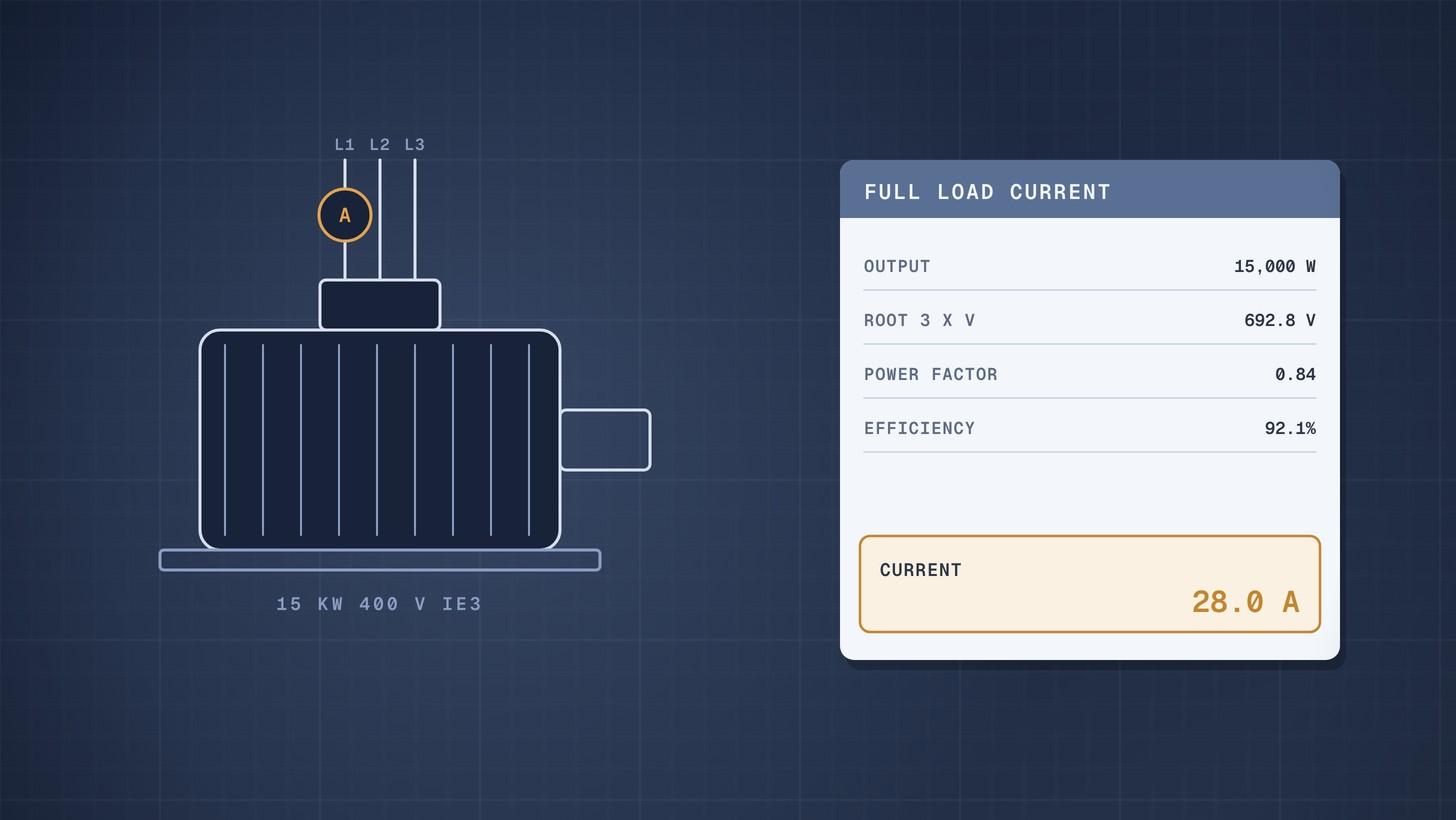
The full load current of a three phase motor is its rated output divided by √3 × line voltage × power factor × efficiency. For a 15 kW, four pole IE3 motor at 400 V with a power factor of 0.84 and an efficiency of 92.1%, that gives 28.0 A, against 27.8 A on the maker's data sheet.
The formula is simple. The useful part is knowing which numbers to put in, why the nameplate wins, and what happens to the current when the motor starts.
Why this matters now
Full load current sizes the cables, the starter or drive, the overload setting and the share of the site's supply a new motor takes. Get it wrong in an RFQ and the electrical contractor prices the wrong switchgear, or the package arrives with a starter that does not suit your supply.
It also differs more between motors than buyers expect. A more efficient motor can draw more current, not less, if its power factor is lower. Comparing two motor offers on current alone can mislead.
Create and manage RFQs in minutes
ChemCapital handles the entire procurement cycle, from structured RFQs and supplier comparisons to formal purchase orders and delivery tracking.
The formula and what goes in it
Electrical input power of a three phase motor is √3 × V × I × power factor, and efficiency is output divided by input; ABB's guide to dimensioning drive systems sets out both relationships [1]. Rearranged for current:
- I = P ÷ (√3 × V × pf × η)
where P is rated output in watts, V is the line to line voltage, pf is the power factor and η is the efficiency, both at full load.
Voltage. In Great Britain, a low voltage supply is declared at 230 V between phase and neutral unless agreed otherwise, which is about 400 V between phases (230 × √3 = 398 V). The supply may vary by up to 10% above or 6% below the declared voltage [2], so roughly 376 V to 440 V between phases.
Power factor and efficiency. Take both from the motor maker's data sheet at full load. Efficiency classes set minimum values: an IE3 four pole 15 kW motor must reach at least 92.1% [3]. Power factor has no class and varies by design.
Worked example: a 15 kW four pole motor
ABB's data sheet for an IE3 cast iron motor, type M3GP 160MLB 4, gives these values at 400 V and 50 Hz [4]:
- Rated output 15 kW, efficiency 92.1%, power factor 0.84
- Rated current 27.8 A, locked rotor current 7.9 times rated
Calculated full load current: I = 15,000 ÷ (1.732 × 400 × 0.84 × 0.921) = 15,000 ÷ 536 = 28.0 A.
That is within 1% of the data sheet. The small gap comes from rounding of power factor and efficiency on the sheet. Always use the nameplate or data sheet current for protection settings; the formula is for checking and for early estimates before a motor is chosen.
Now compare an IE4 motor of the same frame size and output. ABB lists the M3BP 160MLC 4 at 93.9% efficiency but a power factor of 0.76, and a rated current of 30.3 A [5]. The formula gives 15,000 ÷ (1.732 × 400 × 0.76 × 0.939) = 30.3 A. The more efficient motor draws about 9% more current because its power factor is lower. It still uses less real power, and so less energy, but its cables and starter may need to be a size larger.
| Motor | Efficiency | Power factor | Full load current at 400 V | Locked rotor current |
|---|---|---|---|---|
| 15 kW IE3, M3GP 160MLB 4 | 92.1% | 0.84 | 27.8 A | 7.9 × In, about 220 A |
| 15 kW IE4, M3BP 160MLC 4 | 93.9% | 0.76 | 30.3 A | 8.3 × In, about 251 A |
Low voltage case. If the supply sits at the bottom of its permitted band, about 376 V, the same 15 kW output needs roughly 27.8 × 400 ÷ 376 = 29.6 A. This simple scaling ignores small changes in power factor and efficiency with voltage, but it shows why protection and cable sizing allow some headroom.
Starting current: the number that trips supplies
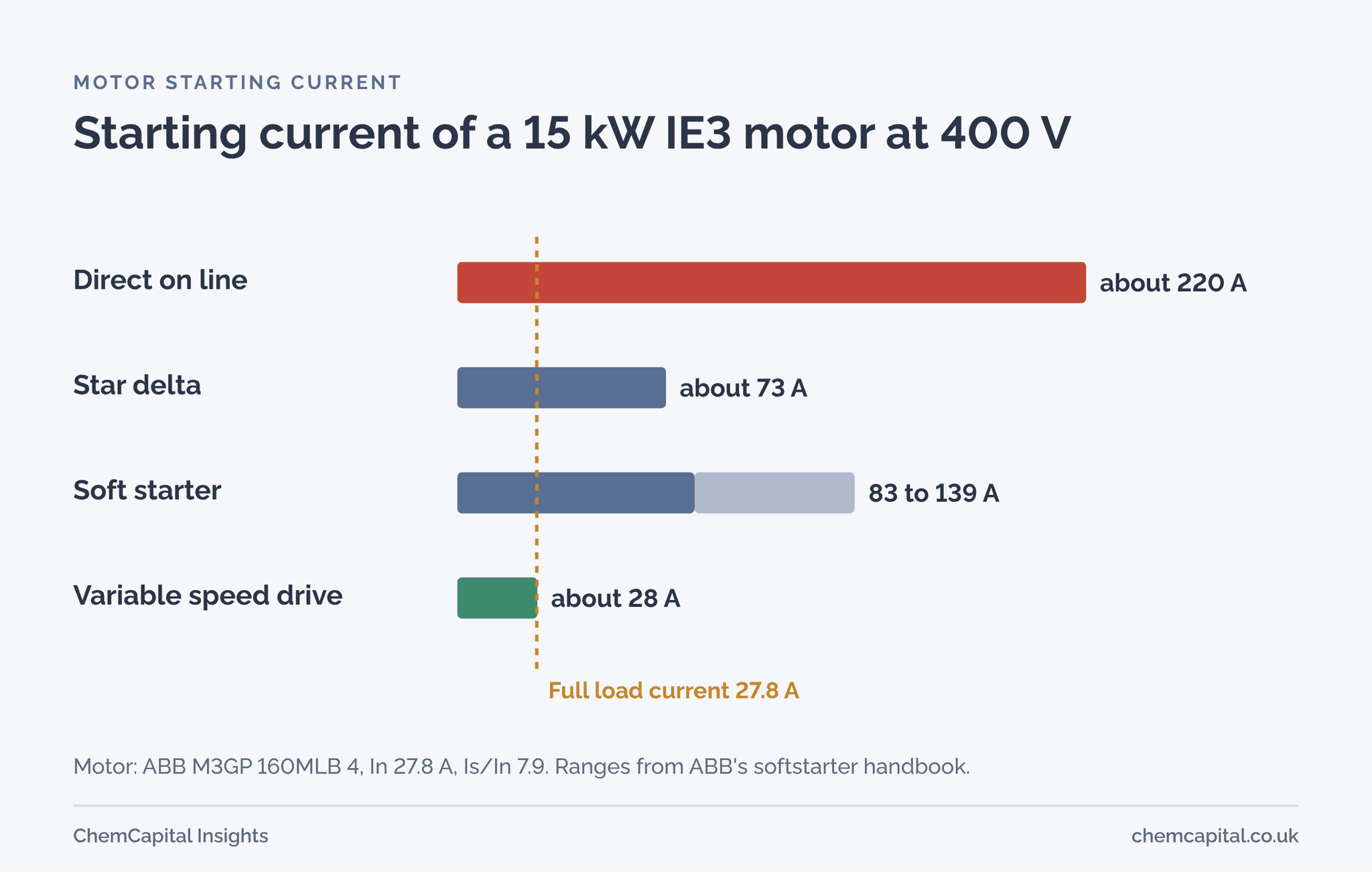
A motor started direct on line draws its locked rotor current until it gets up to speed. ABB's softstarter handbook gives 6 to 8 times rated current as normal, and notes that higher values exist [6]. For the IE3 motor above, 7.9 × 27.8 A is about 220 A.
The starting method changes that:
| Starting method | Starting current, per ABB | For the 15 kW IE3 motor |
|---|---|---|
| Direct on line | 6 to 8 × rated, motor specific | about 220 A (7.9 × In) |
| Star delta | star current about a third of delta [6] | about 73 A |
| Soft starter | 3 to 5 × rated, adjustable [6] | about 83 A to 139 A |
| Variable speed drive | around rated current [6] | about 28 A |
On a weak site supply, or a generator, starting current can matter more than running current. It is the reason many pump and fan packages arrive with a soft starter or a drive.
What to put in the RFQ
For any package with motors, ask for, or state:
- Supply. 400 V, three phase, 50 Hz, and the fault level if you know it.
- Motor data. Rated output, efficiency class, full load current, power factor, locked rotor current and starting method, per motor.
- Who supplies what. Starter or drive in the package, or in your motor control centre.
- Total load. The sum of full load currents and the largest starting current, so you can check the supply before award.
Our guide to IE3 vs IE4 motors explains the efficiency rules, and the centrifugal pump datasheet guide shows where the motor data sits on a pump datasheet. ChemCapital's structured RFQs send every supplier the same motor and supply questions, so the answers come back in a form you can compare.
Ready to send equipment RFQs with the electrical questions already in them? Start a free 14 day ChemCapital trial, with no credit card needed.
Frequently asked questions
How do you calculate the full load current of a three phase motor?
Divide the rated output in watts by √3 times the line voltage times the power factor times the efficiency. A 15 kW motor at 400 V with a power factor of 0.84 and efficiency of 92.1% draws about 28 A. Use the nameplate current for protection settings.
What is the full load current of a 15 kW motor at 400 V?
Typically around 28 A to 30 A for a four pole motor, depending on its power factor and efficiency. One IE3 design lists 27.8 A and an IE4 design of the same output lists 30.3 A because of its lower power factor.
Why does an IE4 motor sometimes draw more current than an IE3?
Current depends on power factor as well as efficiency. A higher efficiency motor with a lower power factor can draw more current while using less real power, so check both figures before sizing cables and starters.
How much current does a motor draw when starting?
Started direct on line, typically 6 to 8 times its rated current until it reaches speed. A star delta starter cuts this to about a third, a soft starter to about 3 to 5 times, and a variable speed drive to around rated current.
Continue reading
Informational only, not procurement or legal advice. Cited names, frameworks, and statistics belong to their respective owners.
Create and manage RFQs in minutes
ChemCapital handles the entire procurement cycle, from structured RFQs and supplier comparisons to formal purchase orders and delivery tracking.
Start for freeRelated articles
Pipe Thermal Expansion: Worked Example
How to calculate pipe thermal expansion for carbon and stainless steel, what restrained expansion does, and how loops and expansion joints absorb it.
Horizontal Tank Volume When Partly Filled: Worked Example
How to calculate the volume of a partly filled horizontal tank with dished heads, with a worked example and a full dip table you can rebuild in a spreadsheet.
Cooling Water Flow Calculation: Worked Example
How to calculate cooling water flow from heat duty and temperature rise, then size the cooling tower circulation, evaporation and make up water.