
IE3 vs IE4 Motors: What EU 2019/1781 and the GB Rules Require
Which motor efficiency class the EU and GB ecodesign rules require by power and date, the exclusions that matter on chemical plants, and the running cost of IE3 against IE4.
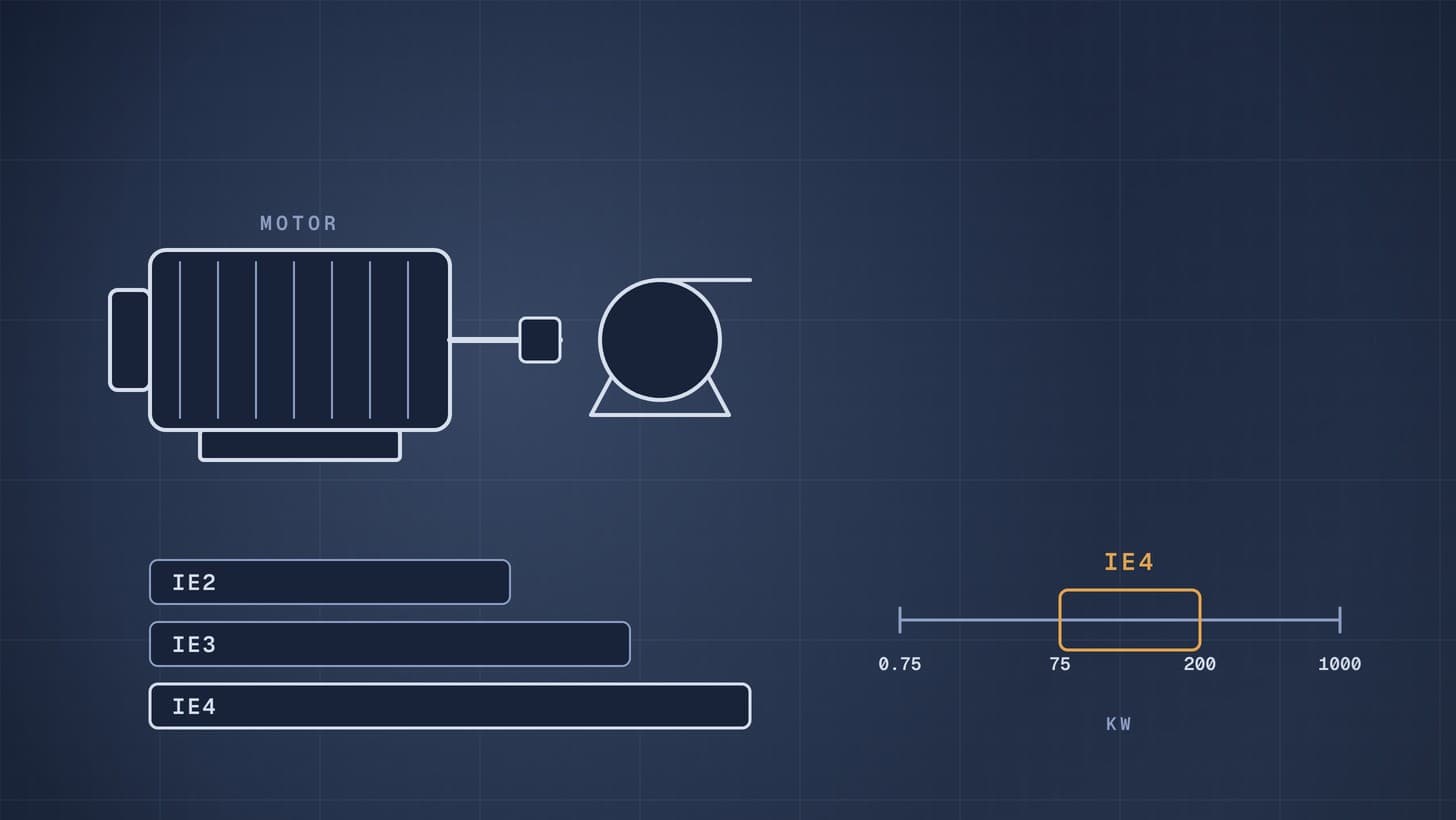
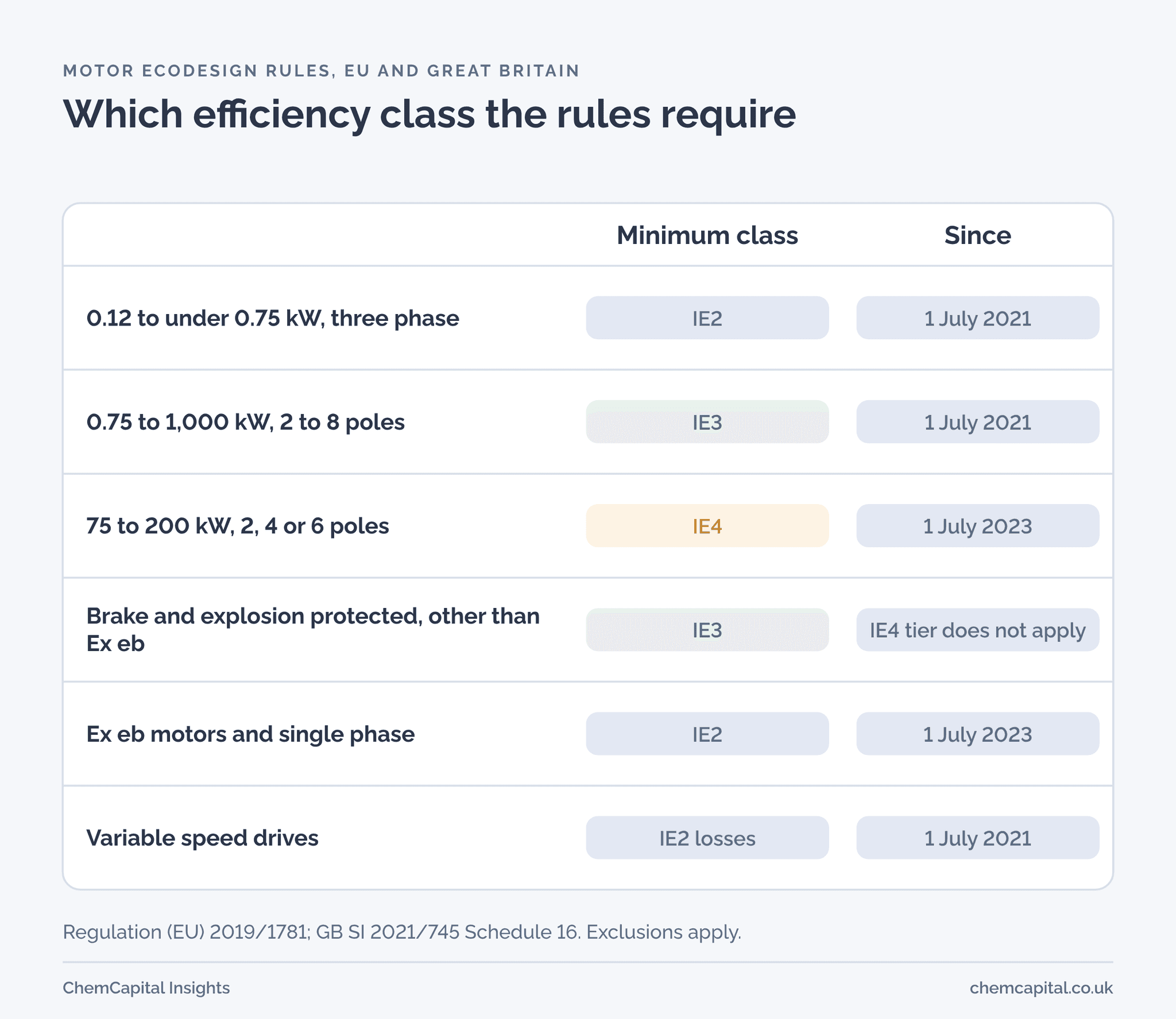
Under the EU ecodesign rules for motors, Regulation (EU) 2019/1781, and the matching Great Britain rules, most three phase motors from 0.75 to 1,000 kW must be at least IE3, and since 1 July 2023 two, four and six pole motors from 75 to 200 kW must be at least IE4. So for many pump and fan drives the choice between IE3 and IE4 is made for you; below 75 kW, above 200 kW and for explosion protected motors, it is still a buying decision.
This guide sets out what the rules require by power range and date, the main exclusions, and a worked example of the running cost difference between IE3 and IE4 on a pump motor.
Why this matters now
Motors run most of the rotating equipment on a process plant, and electricity is usually their main lifetime cost. The European Commission estimates the motor regulation saved 52 TWh of electricity in 2020 and projects savings of about 106 to 107 TWh a year by 2030 [1]. For a buyer, the practical questions are simpler. Which efficiency class can a supplier legally offer for this motor? And when the rules leave a choice, is the better class worth paying for?
Packages complicate it. A pump skid or compressor package arrives with motors chosen by the packager, often to the minimum class. If your RFQ says nothing, that is what you get. Our centrifugal pump datasheet for RFQs has a place for the motor line.
Create and manage RFQs in minutes
ChemCapital handles the entire procurement cycle, from structured RFQs and supplier comparisons to formal purchase orders and delivery tracking.
What the rules require
In Great Britain the requirements sit in Schedule 16 of SI 2021/745, which mirrors the EU regulation [2]. The EU regulation has applied since 1 July 2021 and replaced the earlier Regulation 640/2009 [1].
| From | Motors | Minimum class |
|---|---|---|
| 1 July 2021 | Three phase, 2, 4, 6 or 8 poles, 0.75 kW to 1,000 kW (not Ex eb) | IE3 |
| 1 July 2021 | Three phase, 2, 4, 6 or 8 poles, 0.12 kW to below 0.75 kW (not Ex eb) | IE2 |
| 1 July 2021 | Variable speed drives for motors of 0.12 kW to 1,000 kW | IE2 losses |
| 1 July 2023 | Three phase, 2, 4 or 6 poles, 75 kW to 200 kW, not brake motors or other explosion protected motors | IE4 |
| 1 July 2023 | Ex eb increased safety motors, 0.12 kW to 1,000 kW | IE2 |
| 1 July 2023 | Single phase motors of 0.12 kW and above | IE2 |
Source: SI 2021/745, Schedule 16 [2], consistent with the EU text as summarised by motor makers [3] [4].
The IE4 tier excludes brake motors and explosion protected motors; those stay at IE3, or IE2 for Ex eb [3] [5]. That matters on chemical plants, where many pump motors in zone 1 or zone 2 are flameproof (Ex d or Ex db). See our guide to ATEX and DSEAR equipment.
The regulation also stopped the old route of meeting the requirement with a lower class motor plus a variable speed drive. Motors intended for use with drives now meet the same rules as direct on line motors [4].
Main exclusions. These include wound rotor, DC and permanent magnet motors, motors for full immersion in water, multi speed motors, motors of 10 poles or more, motors above 1,000 V, intermittent duty, altitudes above 4,000 m and some extreme ambient temperatures. There is also a transitional allowance for identical replacement motors [4].
This is general information, not legal advice; check the current text before you rely on it.
IE3 and IE4 in numbers
IEC 60034 Part 30 Part 1 defines the classes: IE1 standard, IE2 high, IE3 premium and IE4 super premium efficiency [6]. The minimum efficiencies for four pole motors at 50 Hz show how small the gap looks on paper [6]:
| Rated output, 4 pole, 50 Hz | IE2 | IE3 | IE4 |
|---|---|---|---|
| 75 kW | 94.0% | 95.0% | 96.0% |
| 90 kW | 94.2% | 95.2% | 96.1% |
| 110 kW | 94.5% | 95.4% | 96.3% |
One percentage point sounds trivial. It is not, because what you pay for is the losses. At 90 kW, an IE3 motor at its minimum efficiency loses 4.8% of its input; an IE4 loses 3.9%. That is about a fifth less waste heat, every hour the motor runs.
Practical example: a flameproof pump motor
Illustrative figures. A process pump needs a 90 kW, four pole motor in a zone 1 area. Because it is explosion protected (Ex db), the IE4 tier does not apply and IE3 is the legal minimum [5]. Two quotes: IE3 at £9,000 and IE4 at £11,000.
Assumptions: the motor delivers 80 kW at the shaft, runs 8,000 hours a year, electricity costs £0.20 per kWh, and efficiency at that load equals the class minimum (95.2% and 96.1%). Real part load efficiency differs; ask for the maker's data.
| IE3 | IE4 | |
|---|---|---|
| Electrical input at 80 kW shaft | 84.03 kW | 83.25 kW |
| Annual energy | 672,269 kWh | 665,973 kWh |
| Annual energy cost | £134,454 | £133,195 |
| Annual saving with IE4 | £1,259 | |
| Price premium | £2,000 | |
| Simple payback | 1.6 years |
Over a 15 year life the IE4 motor saves about £18,900 in energy for a £2,000 premium, before any change in electricity price. The energy bill dwarfs the purchase price in both columns, which is why a life cycle cost comparison beats a lowest price award for motors.
When IE4 does not pay. Run the same numbers for the standby pump, P101B, which runs about 500 hours a year. The saving falls to roughly £79 a year, and the payback stretches to about 25 years, longer than the motor will last. For standby and intermittent drives, the legal minimum is usually the sensible choice. Running hours decide the answer, not the class.
When the bids arrive, ChemCapital's AI quotation comparison puts each supplier's motor class, rated efficiency and price side by side, so a package that quietly downgrades the motor stands out.
What to write in the RFQ
- Efficiency class. "Motors IE4 minimum where permitted by the motor type; IE3 minimum otherwise." For larger or long running drives, consider IE4 even where IE3 is legal.
- Data. Rated efficiency at 100%, 75% and 50% load from the maker's data sheet, tested to the IEC method.
- Variable speed drives. IE2 class losses as a minimum, and losses at the operating points.
- Hazardous areas. Protection concept, gas group and temperature class.
- Packages. Make the motor line apply to every motor in a skid, not only the main drive.
What to check at delivery
The rules also require makers to publish efficiency data at several load and speed points [1], so there is no reason to accept a motor without it. At goods in or the factory acceptance test, check:
- Nameplate. The IE class and rated efficiency match the offer, and the rated power and poles match the datasheet.
- Data sheet. Efficiency at 100%, 75% and 50% load, from the maker, for the exact model supplied.
- Hazardous area marking. If a lower class was accepted because the motor is explosion protected, the Ex marking should confirm it.
- Replacements. An identical replacement for an older motor may fall under a transitional allowance that runs to 1 July 2029 for qualifying motors [4]. Ask the supplier to state which rule they are relying on.
If you are the supplier
State the IE class and efficiency figures for every motor, and say where an exclusion lets you offer a lower class. A buyer who discovers a downgrade at the factory acceptance test remembers it. If the RFQ is silent on efficiency, quote the legal minimum as the base offer and the higher class as a priced option with its efficiency data. The buyer can then make the life cycle choice, and your bid shows you know the rules.
Where ChemCapital fits
Motor efficiency is one line on a datasheet and the biggest cost on the bill. Put it in the RFQ, compare it in the bids and check it on the nameplate. See also how to read a pump curve to size the motor right in the first place.
Ready to compare motor bids on running cost, not only price? Start a free 14 day ChemCapital trial, with no credit card needed.
Frequently asked questions
Is IE4 mandatory?
Since 1 July 2023, in the EU and Great Britain, three phase motors with 2, 4 or 6 poles from 75 kW to 200 kW must be at least IE4, excluding brake motors and explosion protected motors. Most other three phase motors from 0.75 kW to 1,000 kW must be at least IE3.
What is the difference between IE3 and IE4 motors?
IE3 is premium efficiency and IE4 super premium under IEC 60034 Part 30 Part 1. For a 90 kW four pole motor at 50 Hz the minimum efficiencies are 95.2% and 96.1%, which means about a fifth less loss for IE4.
What does Regulation (EU) 2019/1781 require?
From 1 July 2021, IE3 for most three phase motors from 0.75 kW to 1,000 kW, IE2 for smaller motors from 0.12 kW and IE2 losses for variable speed drives. From 1 July 2023, IE4 for 2, 4 and 6 pole motors from 75 kW to 200 kW, and IE2 for Ex eb and single phase motors.
Do explosion proof motors need to be IE4?
No. The IE4 tier excludes explosion protected motors. Flameproof and similar motors stay at IE3 minimum, and Ex eb increased safety motors at IE2. You can still specify IE4 where it is available and pays back.
Continue reading
Informational only, not procurement or legal advice. Cited names, frameworks, and statistics belong to their respective owners.
Create and manage RFQs in minutes
ChemCapital handles the entire procurement cycle, from structured RFQs and supplier comparisons to formal purchase orders and delivery tracking.
Start for freeRelated articles
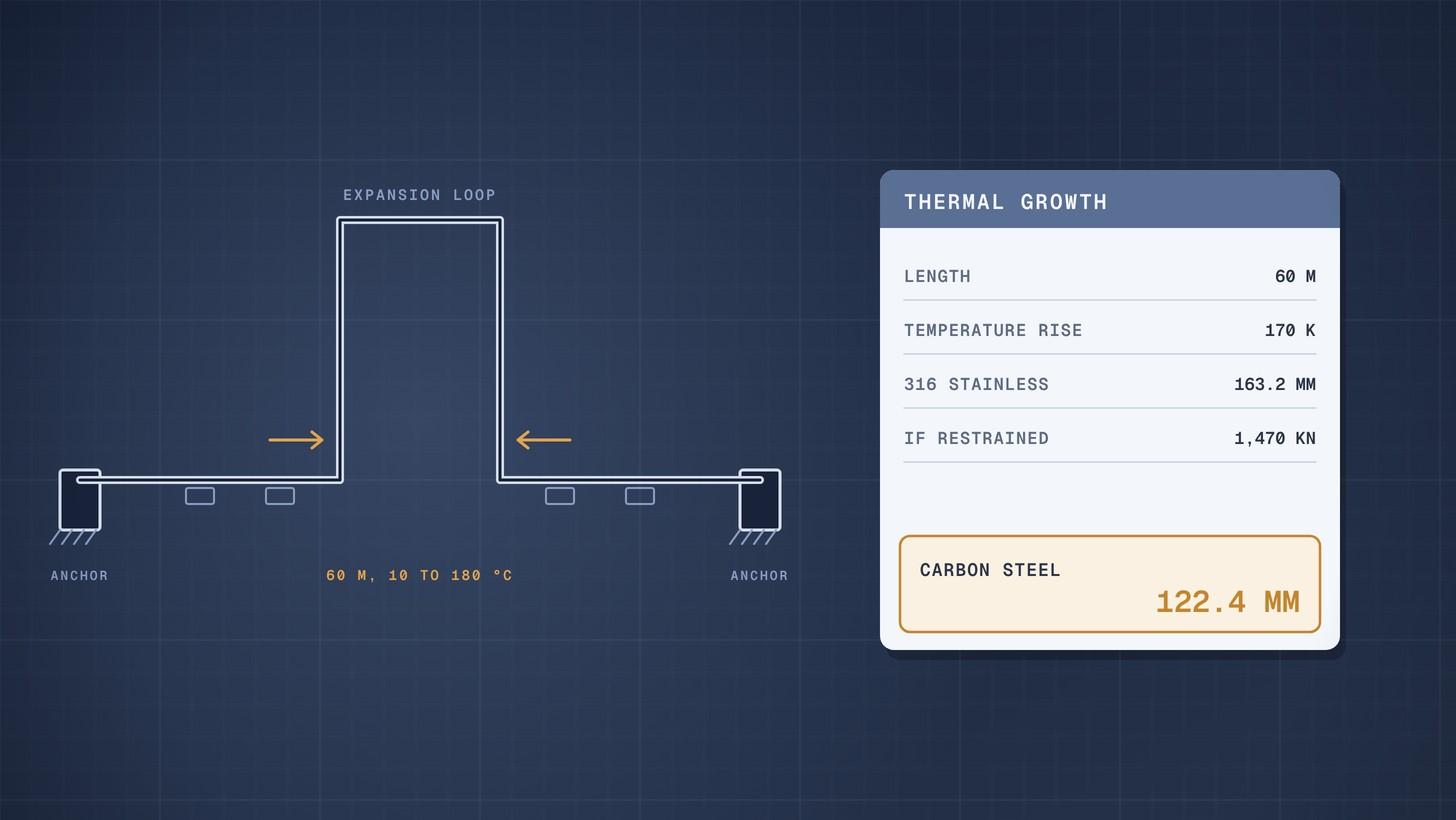
Pipe Thermal Expansion: Worked Example
How to calculate pipe thermal expansion for carbon and stainless steel, what restrained expansion does, and how loops and expansion joints absorb it.
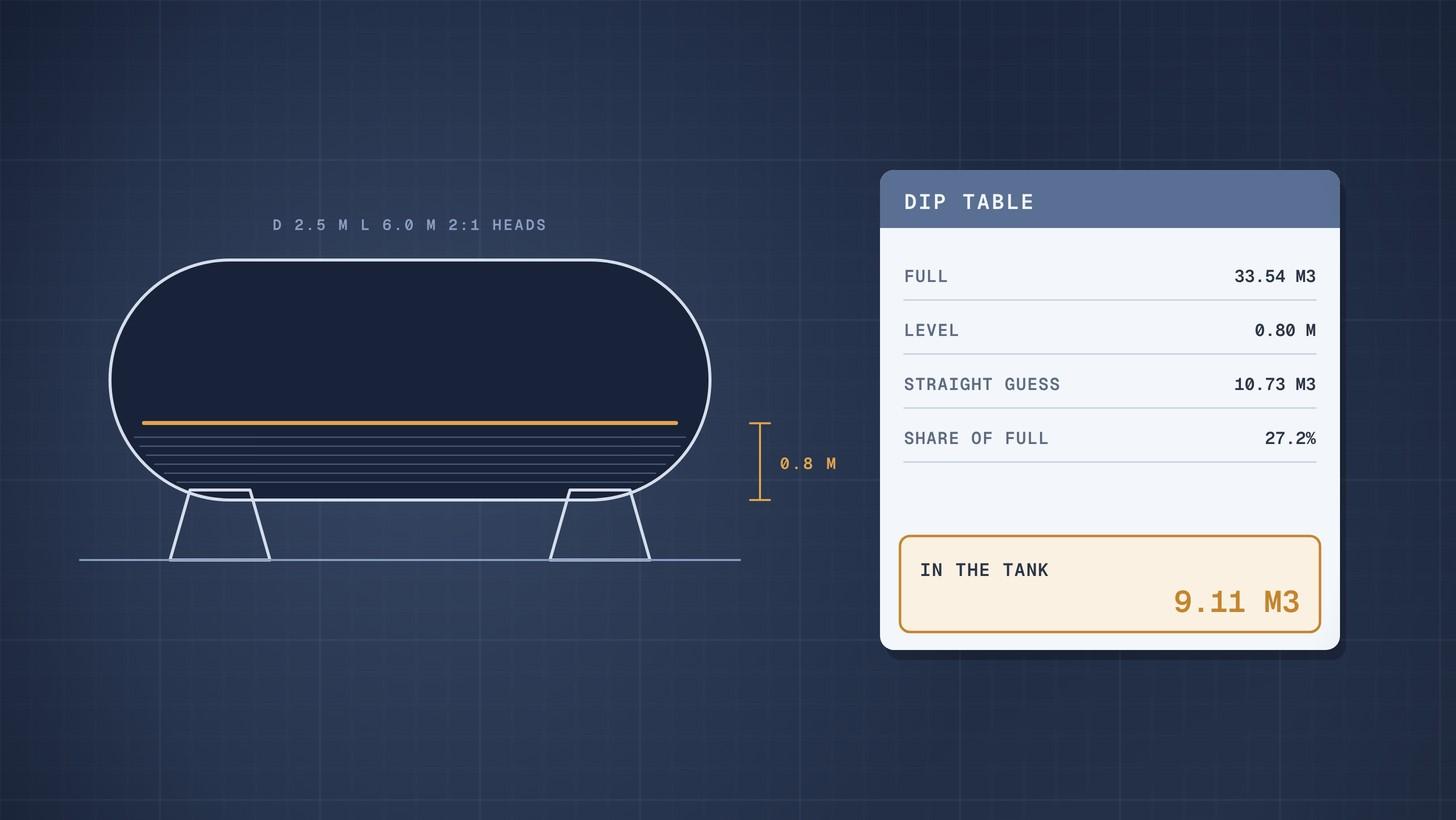
Horizontal Tank Volume When Partly Filled: Worked Example
How to calculate the volume of a partly filled horizontal tank with dished heads, with a worked example and a full dip table you can rebuild in a spreadsheet.
Cooling Water Flow Calculation: Worked Example
How to calculate cooling water flow from heat duty and temperature rise, then size the cooling tower circulation, evaporation and make up water.