
Packing and Shipping Specification for Process Equipment: Seaworthy Crates, ISPM 15 and Marking
What a packing specification for process equipment should say: packing levels, ISPM 15 wood, barrier foil and desiccant, lifting points, shipping marks and documents. With a worked crate example.
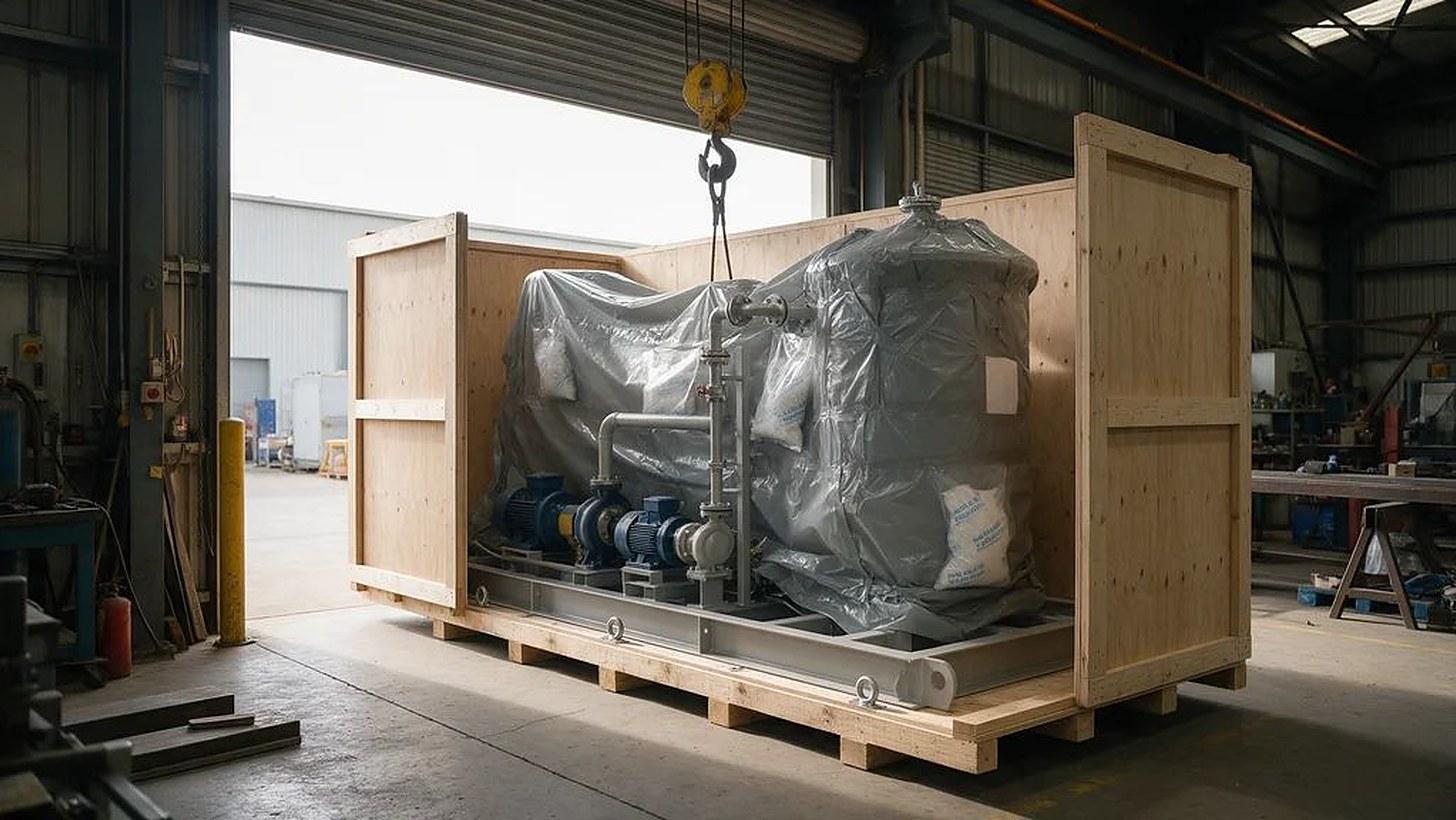
A packing and shipping specification tells the supplier how to pack equipment so it arrives undamaged and dry: the packing level for the journey, treated and marked wood under ISPM 15, preservation inside the crate such as barrier foil, desiccant and blanked openings, marked lifting points and centre of gravity, shipping marks, and packing lists inside and out. Put it in the purchase order, because "seaworthy packing" on its own means whatever the cheapest packer thinks it means.
Why this matters now
A damaged or corroded skid can cost more in delay than in repair. Long lead items often wait months between factory and installation, and sea freight is harsh: deck stowage can reach about 52 °C and 99% relative humidity, and ships roll up to 30 degrees with lateral accelerations of 0.5 to 0.8 g [1]. The packing has to survive that and the storage that follows.
Wood packaging also catches people out at the border. Solid wood packaging coming into Great Britain must meet ISPM 15 from any country, including the EU, and non compliant packaging can be rejected or destroyed with the goods held at the border [2].
Create and manage RFQs in minutes
ChemCapital handles the entire procurement cycle, from structured RFQs and supplier comparisons to formal purchase orders and delivery tracking.
Packing levels
Most large buyers and packers use a graded system, from unpacked to sealed export cases. One manufacturer's packing standard runs from category 0, unpacked, through crates and lined seaworthy crates, to category 9, a seaworthy crate with lining and aluminium foil, and category 10 for the shipper's own container [3]. Industry packing guidelines distinguish closed cases, crates with partly open sides, and partial packaging such as skids and bundles, and code each with its construction and preservation period [1].
| Journey | Typical packing | Preservation |
|---|---|---|
| Road, same country, installed within weeks | Skid or pallet with shrink wrap, openings blanked | Light: plugged nozzles, wrapped instruments |
| Road or short sea, stored under cover | Crate with waterproof lining | Barrier film and desiccant for loose parts |
| Deep sea or long storage | Closed seaworthy case, barrier foil sealed | Desiccant sized for the period, humidity indicator |
| Oversized items | Shipped open with saddles and covers | Coated surfaces, blinds on every opening |
State the expected storage period as well as the journey. Barrier film with desiccant protects for a stated period: up to 12 months with polyethylene film and up to 24 months with aluminium film under the German HPE guidelines [1].
What the specification should cover
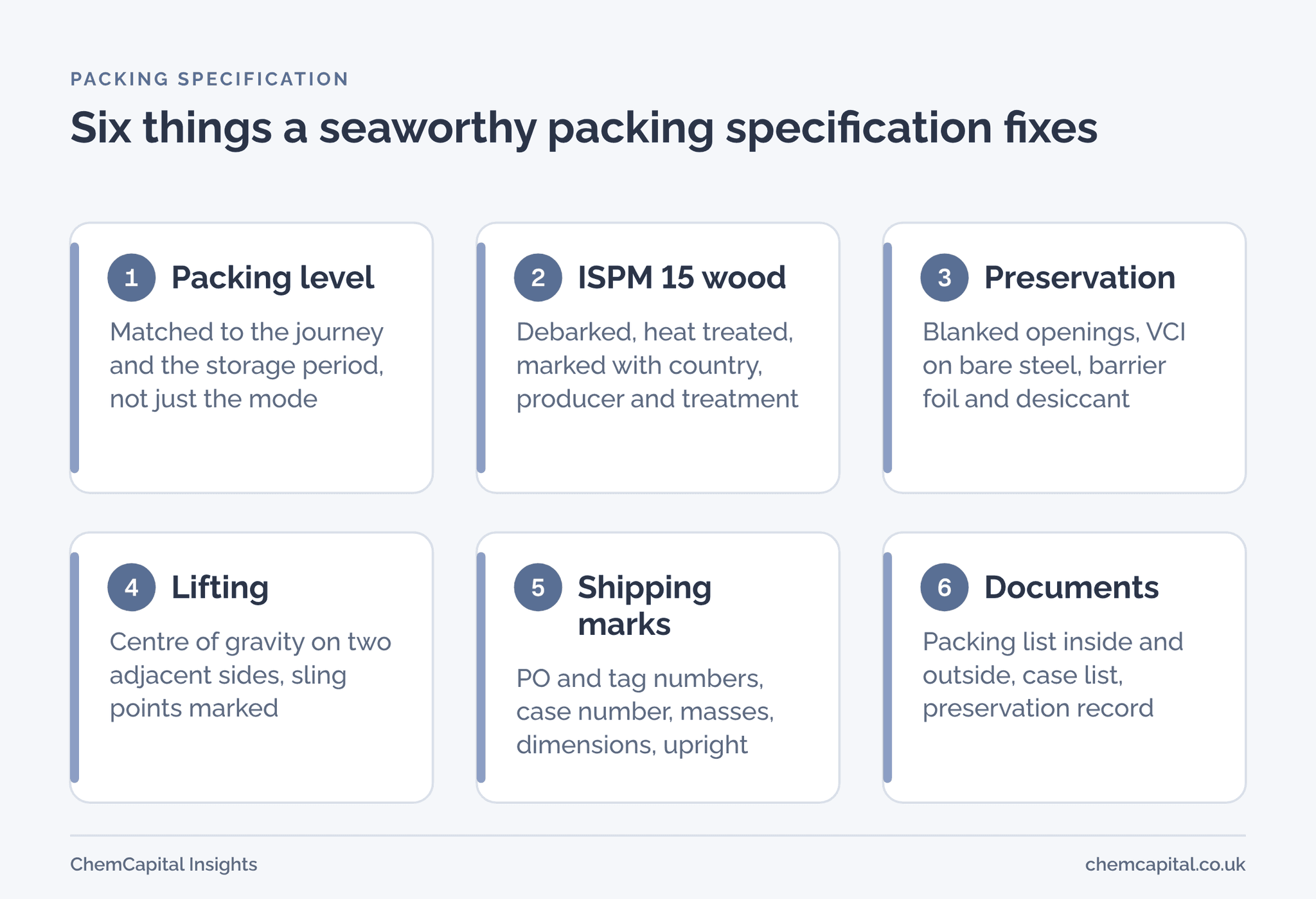
Wood. All solid wood, including crates, skids and dunnage, debarked, heat treated to 56 °C for 30 minutes through the core or otherwise treated, and carrying the ISPM 15 mark with country code, producer and treatment [2]. Plywood and other processed wood are outside the rule [2].
Construction. Skid and floor sizes for the weight, and a stacking load: the HPE guidelines use 1 tonne per square metre as the standard static stacking load for sea freight [1]. Say if the crate must not be stacked.
Preservation inside the crate.
- Blank every opening: flanges, threaded connections and cable entries [4].
- Wrap bare steel in volatile corrosion inhibitor (VCI) paper, but not on copper, brass, aluminium or zinc parts [4].
- Seal sensitive items in barrier foil with desiccant placed in the upper third of the enclosure, away from metal, sized to keep humidity at 40% or below [1].
- No hygroscopic packing such as wood wool or cardboard against the equipment [3] [4].
- Remove or secure loose and fragile parts, such as instruments, separately and list them.
Our guide to equipment preservation and storage covers what happens after delivery.
Lifting and marking.
- Centre of gravity established by the supplier, who knows the mass distribution, and marked on at least two adjacent sides; one manufacturer requires this on every package over 500 kg [3] [1].
- Sling points and "lift here" marks, with the centre of gravity shown in the standard handling symbols, for example to ISO 780 [1].
- Shipping marks: purchase order and tag numbers, case number, net and gross mass, dimensions, upright arrows and destination [4].
Documents. A packing list inside each case in a waterproof envelope, and a second copy outside in a protected pocket [4]. A case list for the whole shipment, matching the commercial invoice. Preservation records and any humidity indicator readings.
Containers. For goods packed into containers, require packing and securing in line with the IMO, ILO and UNECE Code of Practice for Packing of Cargo Transport Units, the non mandatory industry code for packing and securing cargo in containers [5].
Practical example
Illustrative figures. A dosing skid, 4 m³ in volume, ships to the Middle East in a closed case 4.0 × 2.0 × 1.5 m internal, then waits six months for installation.
| Item | Calculation | Result |
|---|---|---|
| Case internal volume | 4.0 × 2.0 × 1.5 | 12 m³ |
| Air volume around the skid | 12 minus 4 | 8 m³ |
| Silica gel at one published base rate of 15 units of 35 g per m³ of air [4] | 8 × 15 × 35 g | 4.2 kg |
| VCI paper at about 7 m² per m³ of packed item [4] | 7 × 4 | 28 m² |
| Static stacking load at 1 t/m² [1] | 4.0 × 2.0 × 1 | Lid designed for 8 t |
Because the case will be sealed in barrier foil, the desiccant quantity should be calculated for the foil area and the six month period by the packer, using its own method, so treat 4.2 kg as a sense check rather than the answer. The point is to ask for the calculation in the packing procedure, so you can see it was done.
Common packing failures
Most packing claims trace back to a handful of causes, and each one can be written out of the specification:
- Open nozzles. A missing blind or plug lets water and dirt into a vessel or pump casing. Specify blanks on every opening, with the blank material stated.
- Foil damaged during closing. Barrier foil torn by a nail or a sharp edge stops working, and the desiccant saturates within weeks. Require edge protection and a check before the lid goes on.
- Wrong centre of gravity. A crate lifted off balance can tip or swing. The packer can only mark what the supplier tells it.
- Loose parts not listed. Instruments, spares and anchor bolts packed separately and never matched to the packing list are the items found missing at site.
- Untreated dunnage. Treated crates braced with untreated timber in the container still fail the ISPM 15 check.
Receiving inspection on arrival
Inspect on arrival, before the packing is removed and before anyone signs the delivery note clean. Examine every case for damage, check the contents against the packing list, and report shortages or damage straight away [4]. Read any humidity indicators and photograph them. A saturated indicator on arrival means the desiccant is spent and the equipment needs drying and checking before storage. If the equipment goes into storage, decide whether to reseal the case or move it into the preservation regime for site storage, and record which.
If you are the supplier
Write your own packing procedure and send it with your offer. It shows the buyer you have priced proper export packing, and it protects you: if the specification and the procedure are agreed before the order, a later argument about whether the packing was adequate is much shorter. Photograph every case before it is closed, with the packing list and the humidity indicator in the frame. Keep those photographs with the shipping records for at least the warranty period, because they are your best evidence if damage is found months later at site.
Who pays and who decides
Packing is usually in the supplier's price, so specify it at RFQ stage, not after award. Incoterms decide who carries the risk in transit; our guide to Incoterms for process equipment explains the split. Add a packing inspection to the inspection and test plan for expensive or long lead items, with photographs before the case is closed.
Where ChemCapital fits
Packing requirements belong in the RFQ, alongside the datasheets. ChemCapital's structured RFQs carry them to every bidder, and the AI quotation comparison shows which bids exclude export packing or price it separately.
Ready to stop paying for packing surprises? Start a free 14 day ChemCapital trial, with no credit card needed.
Frequently asked questions
What is seaworthy packing?
Packing designed for sea freight and storage: a closed case or lined crate strong enough for stacking and ship motions, with barrier foil, desiccant and blanked openings to keep the equipment dry, plus clear lifting and shipping marks.
Does ISPM 15 apply to plywood crates?
No. ISPM 15 covers solid wood packaging such as crates, skids, pallets and dunnage. Plywood and other processed wood are excluded, but any solid timber battens or skids still need treating and marking.
What does the ISPM 15 mark show?
The country code, the producer's registration and the treatment used, such as HT for heat treatment. The mark replaces the need for a separate certificate.
Who should mark the centre of gravity on a crate?
The supplier, because it knows the mass distribution of the equipment. It should be marked on at least two adjacent sides, together with the sling points.
Continue reading
Informational only, not procurement or legal advice. Cited names, frameworks, and statistics belong to their respective owners.
Create and manage RFQs in minutes
ChemCapital handles the entire procurement cycle, from structured RFQs and supplier comparisons to formal purchase orders and delivery tracking.
Start for freeRelated articles
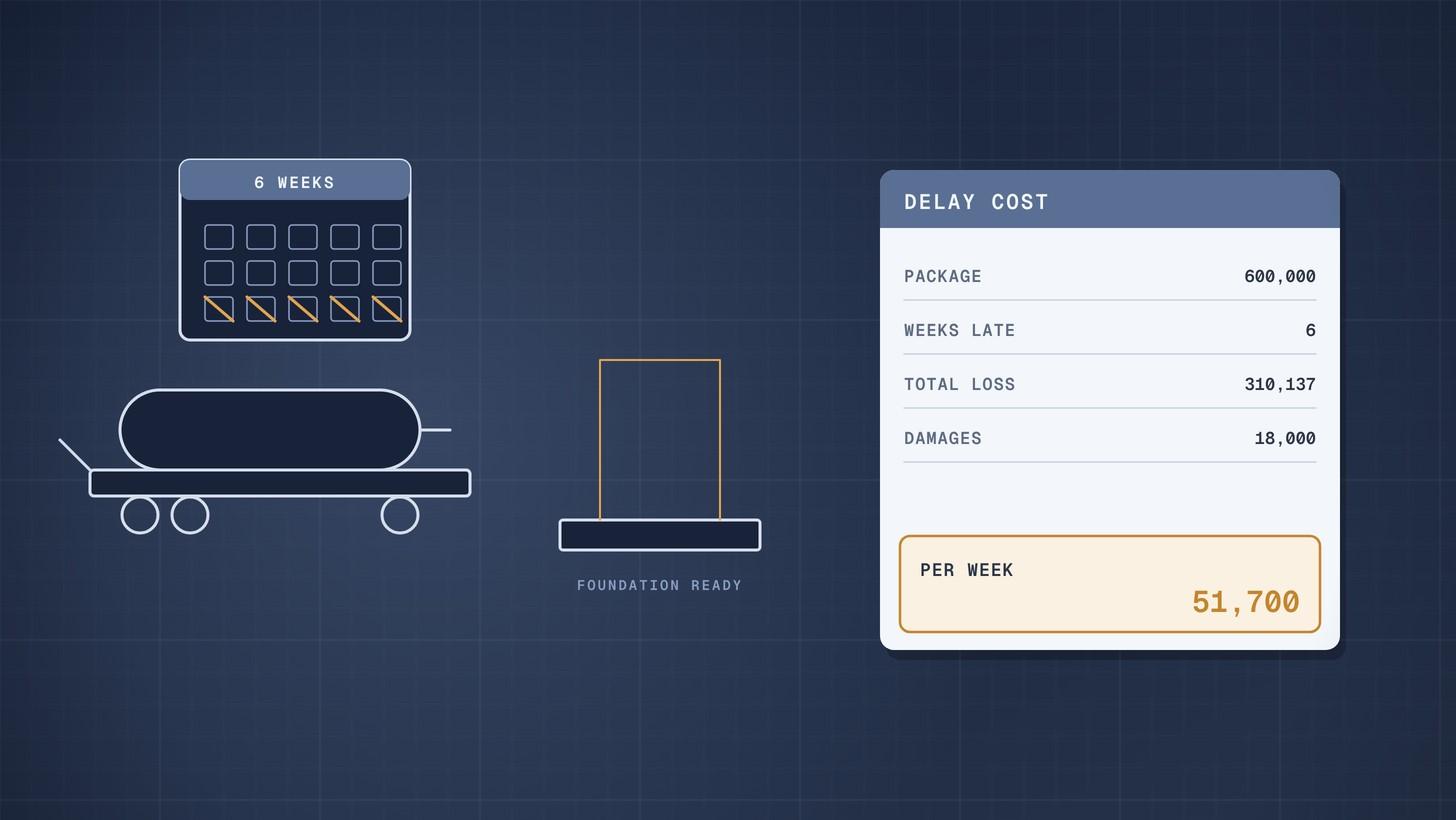
Cost of Late Equipment Delivery: Worked Example
How to calculate the weekly cost of late equipment delivery, compare it with liquidated damages and use it to set a damages rate a supplier can accept.
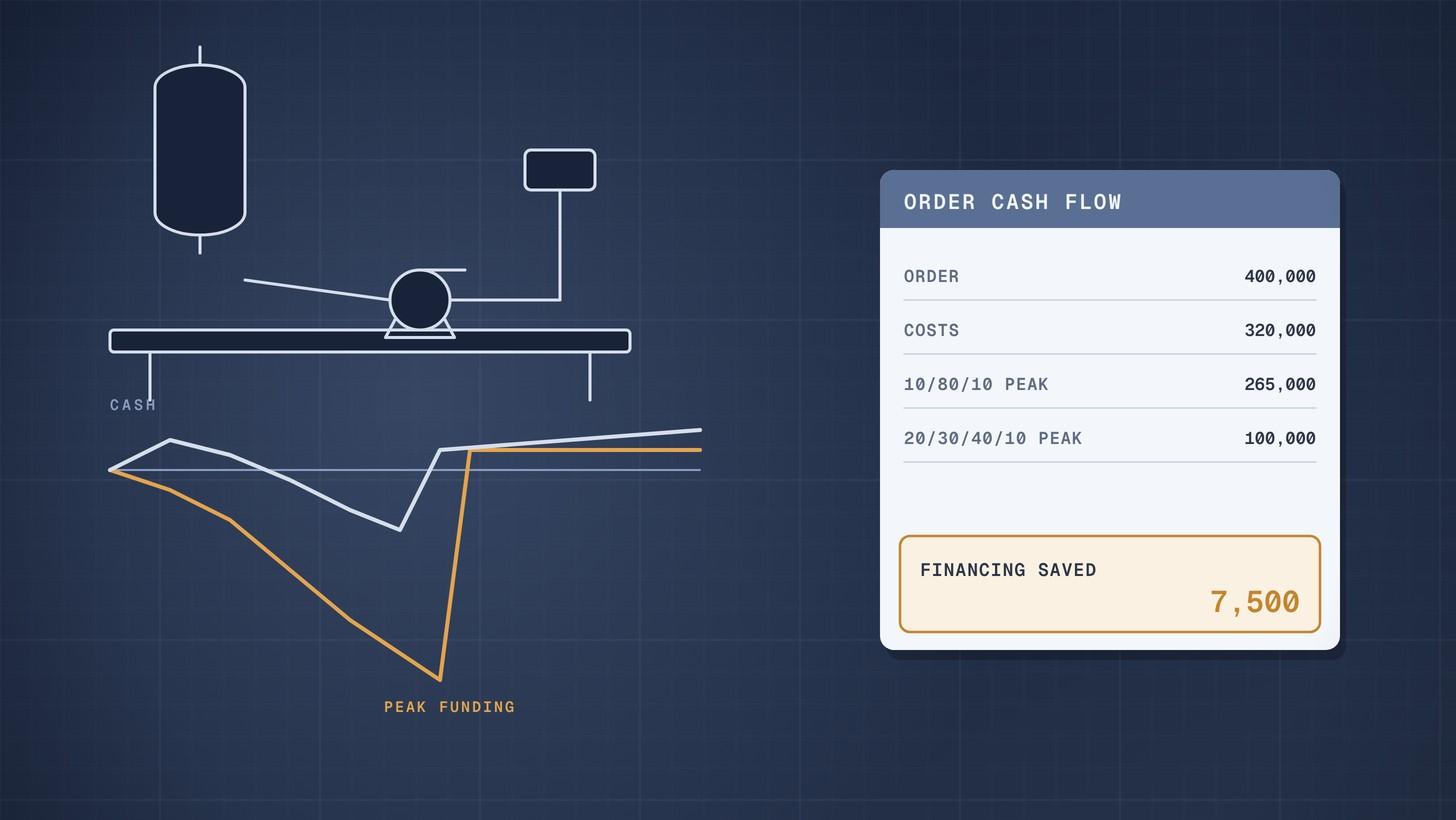
Payment Milestones and Supplier Cash Flow: Worked Example
How payment milestones, bonds and retention shape an equipment supplier's cash curve, with a worked example comparing two schedules on a £400,000 order.

Performance Guarantees and Performance Tests for Process Packages
What a process package supplier should guarantee, how the performance test is run, and what happens when the plant falls short, with a worked example of performance liquidated damages.