
Pharmaceutical Freeze Dryers: What to Specify Before You Buy
A production freeze dryer is one of the most expensive and longest lead items in a sterile plant. Here is what to specify in the URS, what Annex 1 changed, and how to compare bids.
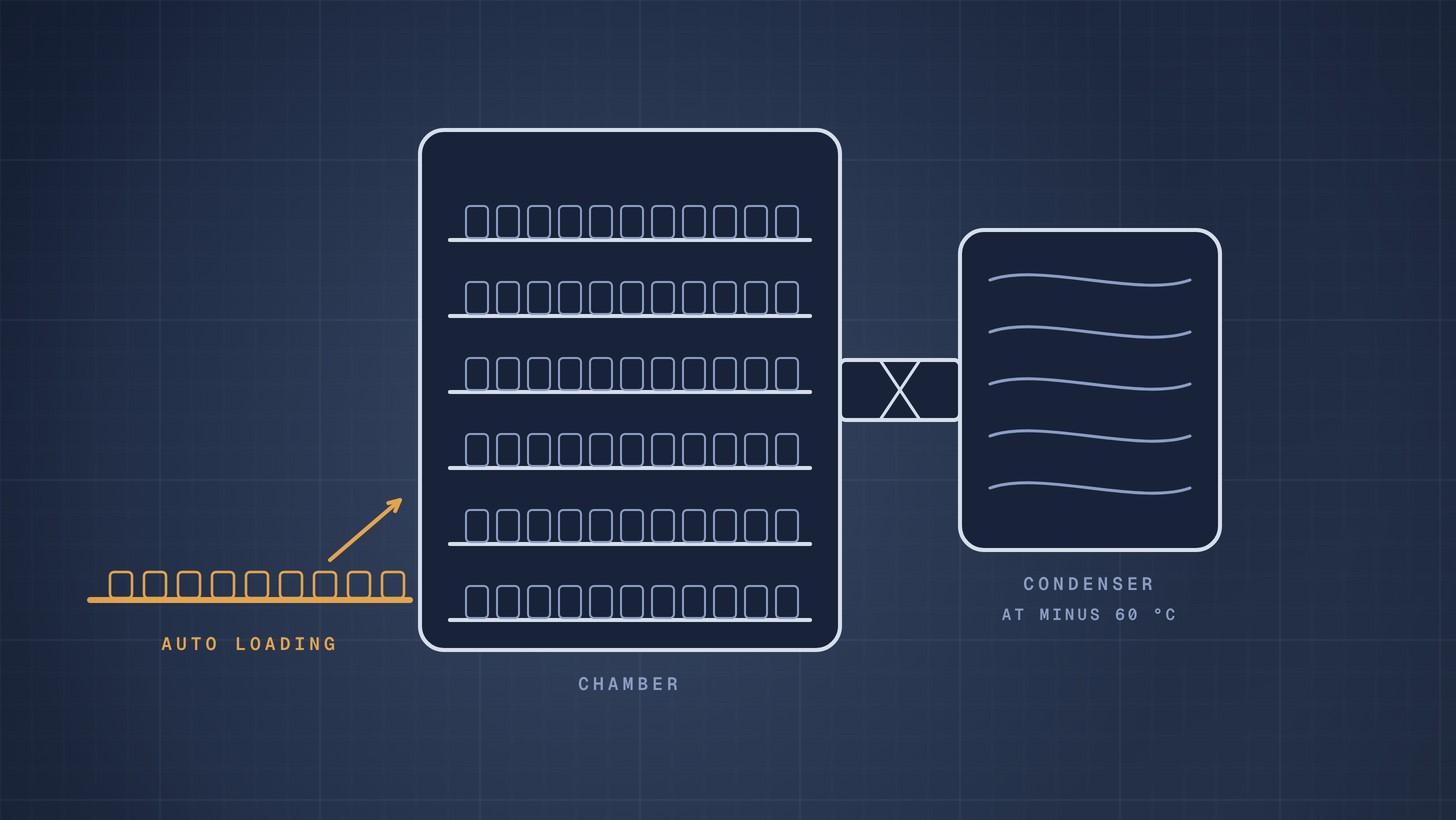
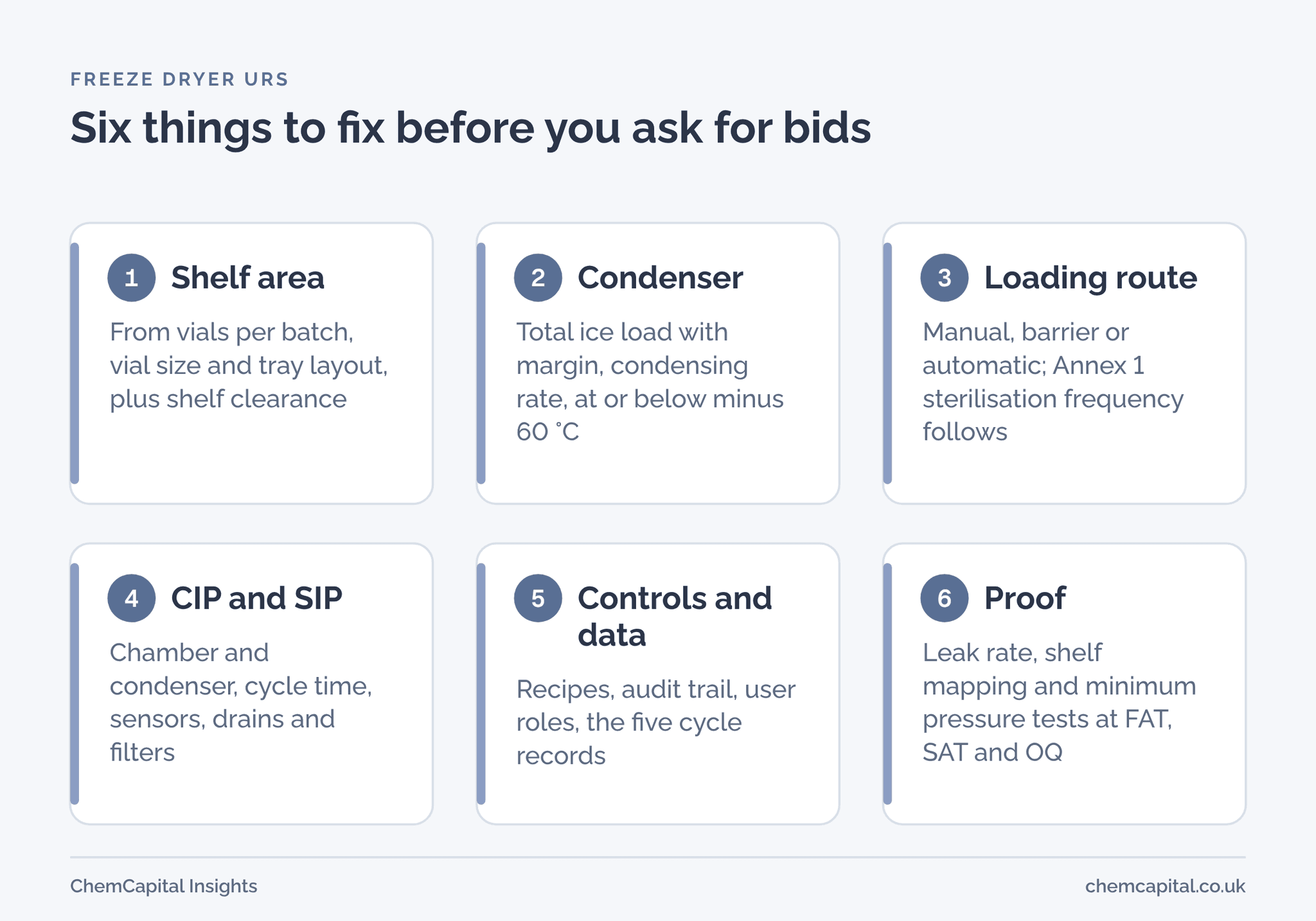
Before you buy a pharmaceutical freeze dryer, fix five things in the user requirement specification: the shelf area your batch needs, the condenser capacity and temperature, how vials are loaded and unloaded, how the chamber and condenser are cleaned and sterilised, and how performance will be proved at FAT, SAT and qualification. Get those right and bids become comparable; leave them open and every supplier will quote a different machine.
This guide works through each point, shows what EU GMP Annex 1 changed for lyophilisation, gives a sizing example, and lists the questions to put to bidders.
Why this matters now
The revised EU GMP Annex 1 was published on 25 August 2022 and most of it applied from 25 August 2023. Paragraph 8.123, on lyophilisers, applied a year later, from 25 August 2024 [1] [2]. It requires lyophilisers that are loaded or unloaded by hand, with no barrier separation, to be sterilised before each load. Where loading is automated or protected by a closed barrier, the sterilisation frequency must be justified and documented in the contamination control strategy [2].
That single paragraph changes the business case. A manual load lyophiliser now carries a steam cycle every batch, with the utility load, wear and lost hours that brings. An automatic loading system costs more up front but may let you justify a lower frequency. The decision belongs in the URS, not after the order.
A production freeze dryer is also a long lead, high value item, and qualifying one properly takes time. A 2023 best practice paper by an industry and academic working group notes that end to end qualification can take years, and estimates that standard protocols could save six to nine months [3]. Specify well and you save that time on your own project.
Create and manage RFQs in minutes
ChemCapital handles the entire procurement cycle, from structured RFQs and supplier comparisons to formal purchase orders and delivery tracking.
Shelf area: size from the batch, not the brochure
Start from the product: vial size, fill volume, batch size in vials, and whether you want one batch per cycle. Shelf area follows from how many vials fit per square metre, with an allowance for tray edges and rails. Then check the shelf clearance suits your tallest vial with a stopper sitting partly in. Ask each bidder for a tray and rail layout drawing showing the vial count per shelf, so you compare real capacity rather than nominal area.
Makers quote shelf area and shelf count as the headline. One manufacturer's standard production range runs from 6.7 to 41.2 m² of shelf area, with shelf temperatures from minus 55 to plus 70 °C and 120 mm shelf clearance [4]. Treat such ranges as a check that your size is standard, which usually means faster delivery and proven designs.
Condenser: capacity, temperature and the duct
The condenser traps the water vapour sublimed from the product and protects the vacuum pumps [5]. Specify three things:
- Ice capacity. The total ice it can hold for your largest batch, with margin. Makers quote capacity in different ways; one range above is quoted from 100 to 800 kg per 24 hours [4]. Ask each bidder to state total ice load and maximum condensing rate separately.
- Temperature. The working group paper found condenser temperatures at or below minus 60 °C were enough to trap vapour even at maximum sublimation rates, and that going much colder gave uneven ice build up rather than better performance [3].
- Capability. Ask for the minimum controllable chamber pressure at a range of shelf temperatures with a full load. That test shows where the duct between chamber and condenser chokes, and therefore the fastest cycle the machine can really run [3].
Loading and unloading: the Annex 1 decision
Vials leave the filling line open or partly stoppered, so the route to the shelves must keep Grade A conditions throughout [6]. The RSSL white paper on Annex 1 notes that vials must be in sealed containers if there is no automated loading system [6]. The FDA's inspection guide made a similar point decades earlier: transport and loading need a primary barrier such as laminar flow, and the media fill must cover filling, transport and loading [5].
| Option | What it means | Annex 1 consequence | Points for the URS |
|---|---|---|---|
| Manual or trolley loading, no barrier | Operators load trays through the door | Sterilise before each load (8.123) [1] | SIP cycle time, steam capacity, cycle count in the life cycle cost |
| Manual loading through a RABS or isolator | Barrier separation, gloves for interventions | Frequency justified in the contamination control strategy [2] | Glove ports, barrier interface, cleaning of transfer zone |
| Automatic loading and unloading | Conveyors and a loading mechanism, often in an isolator | Frequency justified in the contamination control strategy [2] | Throughput, format changes, interface with the filling line, footprint |
Our comparison of RABS and isolators covers the barrier choice in more depth. Whatever you choose, write it into the URS as a requirement with a reason, so suppliers quote the same scope.
Cleaning and sterilisation
Specify CIP and SIP for both chamber and condenser, with the validated cycle you expect. The FDA guide lists points that still make a good checklist: moist steam under pressure as the normal method; two independent temperature sensors, one at the cold spot; a condenser that can itself be sterilised; drains with an air break; integrity testing for the vent and gas filters; and removal of condensate while the chamber is still under pressure [5].
Ask how long a full SIP cycle takes, including cool down and leak test, and how often you will run it. With manual loading under 8.123 that time is lost on every batch.
Leak rate and shelf performance
Two performance specifications cause most arguments at qualification:
- Leak rate. Many URS documents copy a figure of 2 × 10⁻² mbar·L/s. The working group paper says that number has no scientific basis and suggests calculating the maximum allowable air ingress from the dryer's void volume and the room's measured bioburden, then converting it to a pressure rise over the test time [3]. At the least, state the test method and the acceptance figure in the URS, so the FAT result means something.
- Shelf temperature uniformity. The same paper suggests a process relevant criterion: shelf probes within 2 °C of each other across the whole stack at any instant, measured with defined tests empty and loaded [3]. Say which test, which set points and which load.
The FDA guide adds that leak testing is advisable after sterilisation, that the pressure rise accepted at validation becomes the production limit, and that any leak of shelf fluid into the chamber is grounds for batch rejection [5].
Controls, data and the rest of the URS
Treat the control system like any GMP computerised system: user roles, audit trail, electronic records and recipe management. Record shelf temperature, product temperature, condenser temperature and chamber and condenser pressure for every cycle; the FDA guide lists exactly those [5]. Our article on the user requirement specification gives a structure for the whole document. Also cover utilities (refrigeration, steam, nitrogen, cooling water), room layout and maintenance access, spare parts, and the documentation package. Utilities deserve numbers: peak steam demand during SIP, refrigeration load at the lowest shelf and condenser temperatures, and nitrogen for backfill and stoppering. Ask bidders to state them, because your building services design depends on them and a late surprise here delays installation as surely as a late machine.
FAT, SAT and lead time
Plan the tests in the URS. At FAT, witness the empty performance tests: pump down, leak rate, shelf mapping, condenser cool down, minimum controllable pressure and SIP. At SAT and qualification, repeat what transport and installation could affect. The working group paper recommends doing performance qualification at the manufacturing site, or at least at the installation site, before production [3]. Our FAT checklist for process skids shows how to structure the witness plan.
Treat the freeze dryer as a long lead item from day one. Traditional delivery involves building and testing in the workshop, dismantling, shipping and reassembling on site. One maker in 2008 promoted a fast track approach aiming to cut construction start to first production to a year or less, which tells you the usual route takes longer [7]. Ask each bidder for a dated programme to FAT, delivery, SAT and OQ, and lock the URS before the order.
Practical example
Illustrative figures. A plant fills 10R vials, 24 mm diameter, with 3 mL of a mainly aqueous solution, and wants 40,000 vials per batch.
| Step | Calculation | Result |
|---|---|---|
| Area per vial, close packed | 0.866 × 24 mm × 24 mm | 499 mm² |
| Net shelf area | 40,000 × 499 mm² | 20.0 m² |
| Allowing 90% usable area for tray edges and rails | 20.0 ÷ 0.9 | 22.2 m² |
| Ice per batch, assuming about 2.9 g water per vial | 40,000 × 2.9 g | 116 kg |
| Condenser ice capacity with 1.5 times margin | 116 × 1.5 | 174 kg |
| Average sublimation rate over 40 hours of primary drying | 116 kg ÷ 40 h | 2.9 kg per hour |
So the URS asks for at least 22 m² of usable shelf area and at least 174 kg of condenser ice capacity, with the condenser at or below minus 60 °C. The average rate, 2.9 kg per hour or about 0.13 kg per hour per m², sits well inside the range the working group paper suggests checking, which is a linear sublimation curve up to at least 1 kg per hour per m² [3]. Your own cycle data replaces every one of these assumptions.
The loading decision also shows up in available hours. Illustrative figures again: suppose 150 batches a year and a full SIP, cool down and leak test of about 6 hours.
| Loading route | SIP frequency | SIP hours a year |
|---|---|---|
| Manual, no barrier | Before every load, 150 cycles | 900 |
| Automatic, frequency justified as weekly in the contamination control strategy | 52 cycles | 312 |
| Difference | 588 hours, about 25 days of dryer time |
Whether a weekly frequency can be justified depends on your own contamination control strategy and data, not on the equipment alone. But putting the hours in front of the project team turns a vague debate about automation into a number you can weigh against the extra capital cost.
Questions to ask every bidder
- What usable shelf area and shelf clearance do you offer for our vial and tray format?
- What is the total condenser ice capacity, the maximum condensing rate and the working condenser temperature?
- What minimum controllable chamber pressure do you guarantee with a full load, and at which shelf temperatures?
- Which leak rate test and acceptance figure do you propose, and why?
- How do you meet Annex 1 8.123 with the loading system you offer?
- How long is a full SIP cycle, including cool down and leak test?
- What is the dated programme to FAT, delivery, SAT and OQ?
Then compare the answers line by line. A cheaper machine with a smaller condenser or a slower SIP may cost more over its life.
If you are the supplier
Answer the seven questions above in your offer without being asked, with test methods and figures you will demonstrate at FAT. Buyers comparing three bids will trust the one that states its minimum controllable pressure, SIP time and leak test method plainly, and they will remember who left them to chase it.
Where ChemCapital fits
There are only a limited number of makers of production freeze dryers, and fewer still for automatic loading. ChemCapital's AI Supplier Discovery helps you build a qualified long list by capability and region, then send one structured RFQ to all of them so the answers above come back in the same format.
Ready to put a freeze dryer URS in front of the right makers? Start a free 14 day ChemCapital trial, with no credit card needed.
Frequently asked questions
What should a freeze dryer URS include?
Shelf area and clearance from your batch size and vial, condenser ice capacity and temperature, the loading and unloading method, CIP and SIP, leak rate and shelf uniformity tests with acceptance criteria, controls and data integrity, utilities, and the FAT, SAT and qualification plan.
What does Annex 1 require for lyophilisers?
Paragraph 8.123, applying since 25 August 2024, requires lyophilisers loaded or unloaded by hand without barrier separation to be sterilised before each load. With automated loading or a closed barrier, the frequency must be justified and documented in the contamination control strategy.
How do you size a freeze dryer condenser?
From the ice load of your largest batch, which is roughly the water in all the vials, plus a margin. Also check the condensing rate against your fastest primary drying and ask for the minimum controllable chamber pressure with a full load.
What is a typical leak rate specification for a freeze dryer?
Many specifications use 2 × 10⁻² mbar·L/s, but a 2023 best practice paper says that figure lacks a scientific basis and recommends calculating an allowable leak from void volume and room bioburden instead. Always state the test method.
How cold should a freeze dryer condenser be?
Published qualification work found condenser temperatures at or below minus 60 °C were enough to trap vapour even at maximum sublimation rates. Much colder condensers did not improve performance and built ice unevenly.
Continue reading
Informational only, not procurement or legal advice. Cited names, frameworks, and statistics belong to their respective owners.
Create and manage RFQs in minutes
ChemCapital handles the entire procurement cycle, from structured RFQs and supplier comparisons to formal purchase orders and delivery tracking.
Start for freeRelated articles
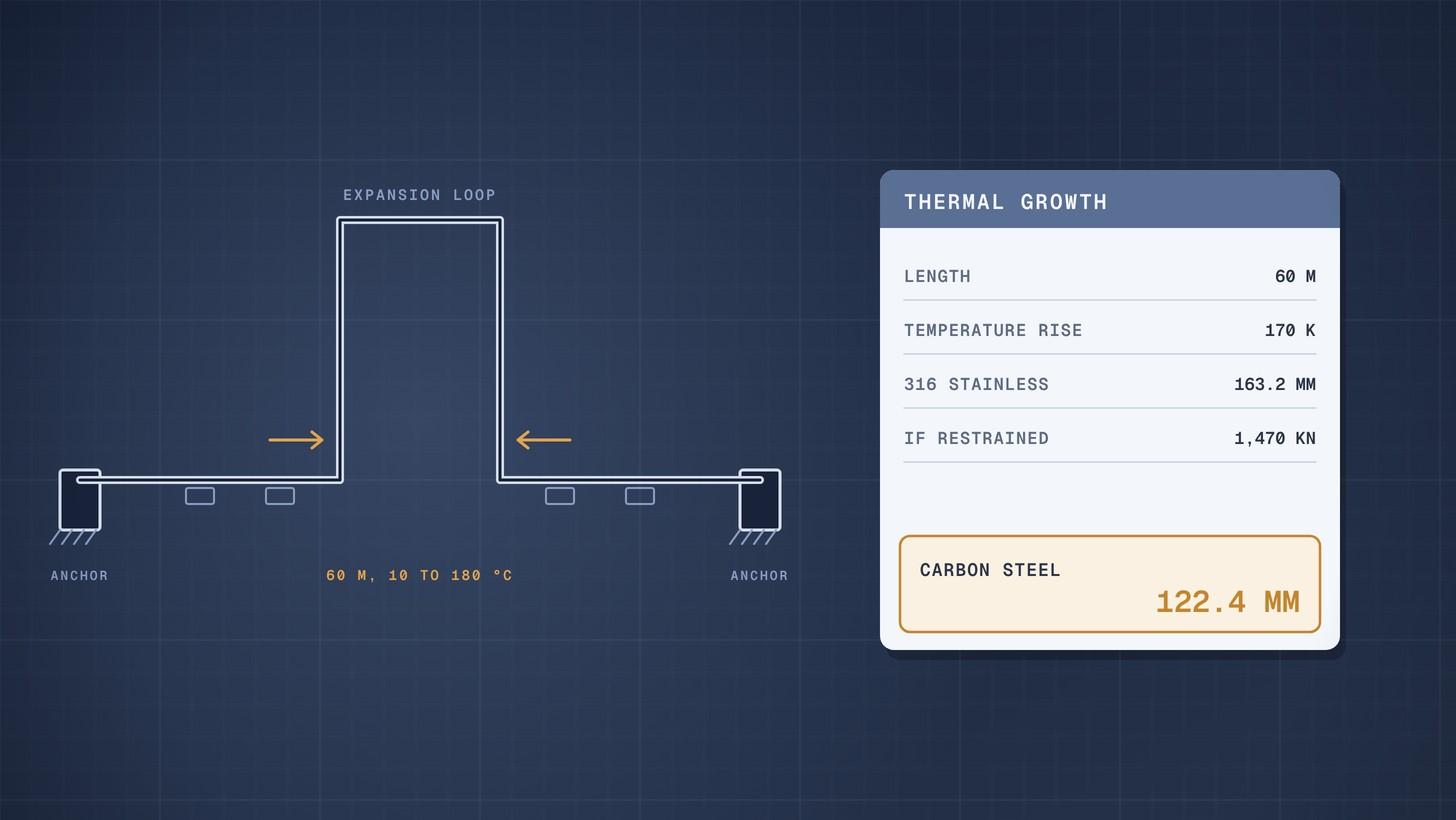
Pipe Thermal Expansion: Worked Example
How to calculate pipe thermal expansion for carbon and stainless steel, what restrained expansion does, and how loops and expansion joints absorb it.
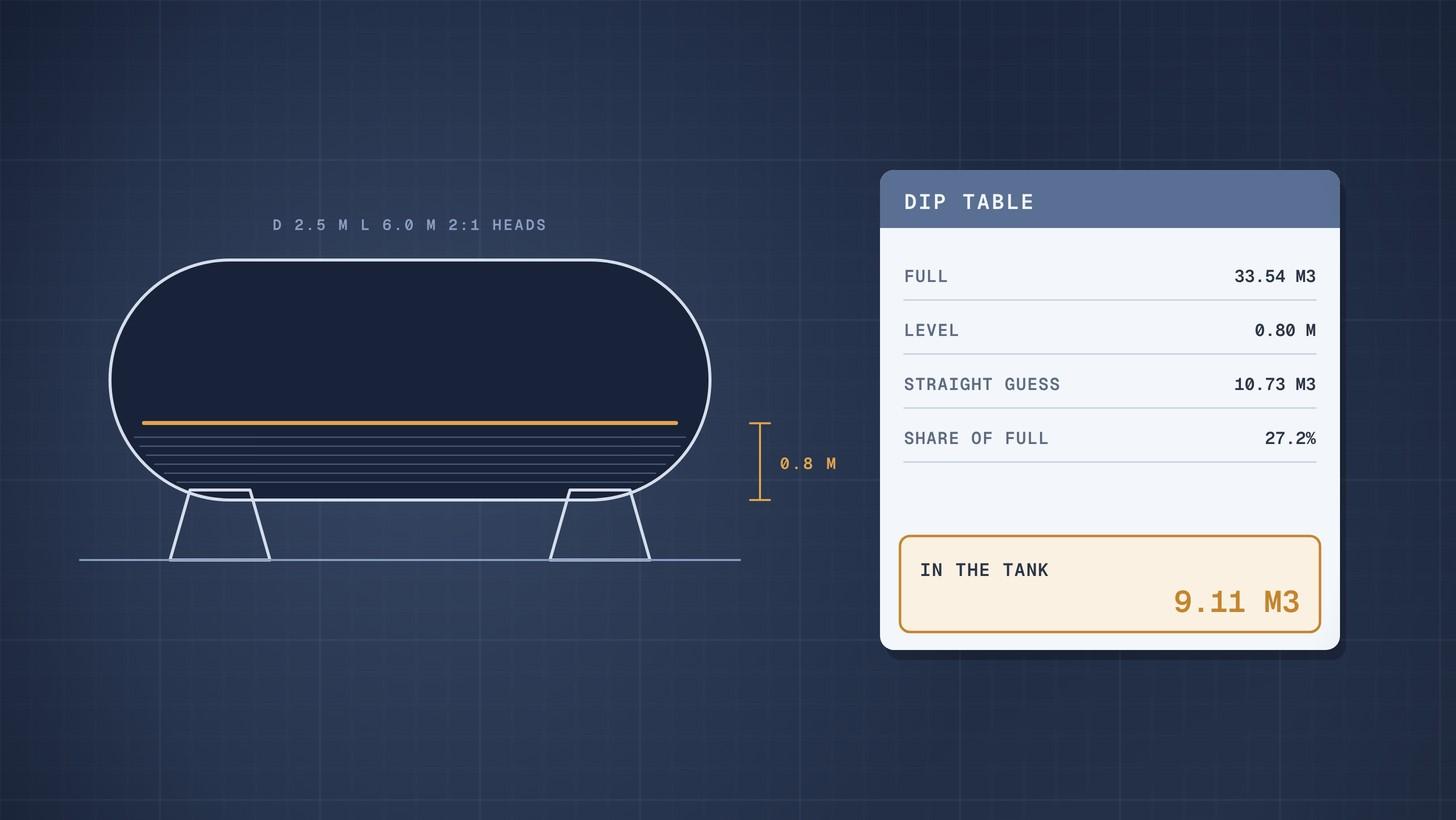
Horizontal Tank Volume When Partly Filled: Worked Example
How to calculate the volume of a partly filled horizontal tank with dished heads, with a worked example and a full dip table you can rebuild in a spreadsheet.
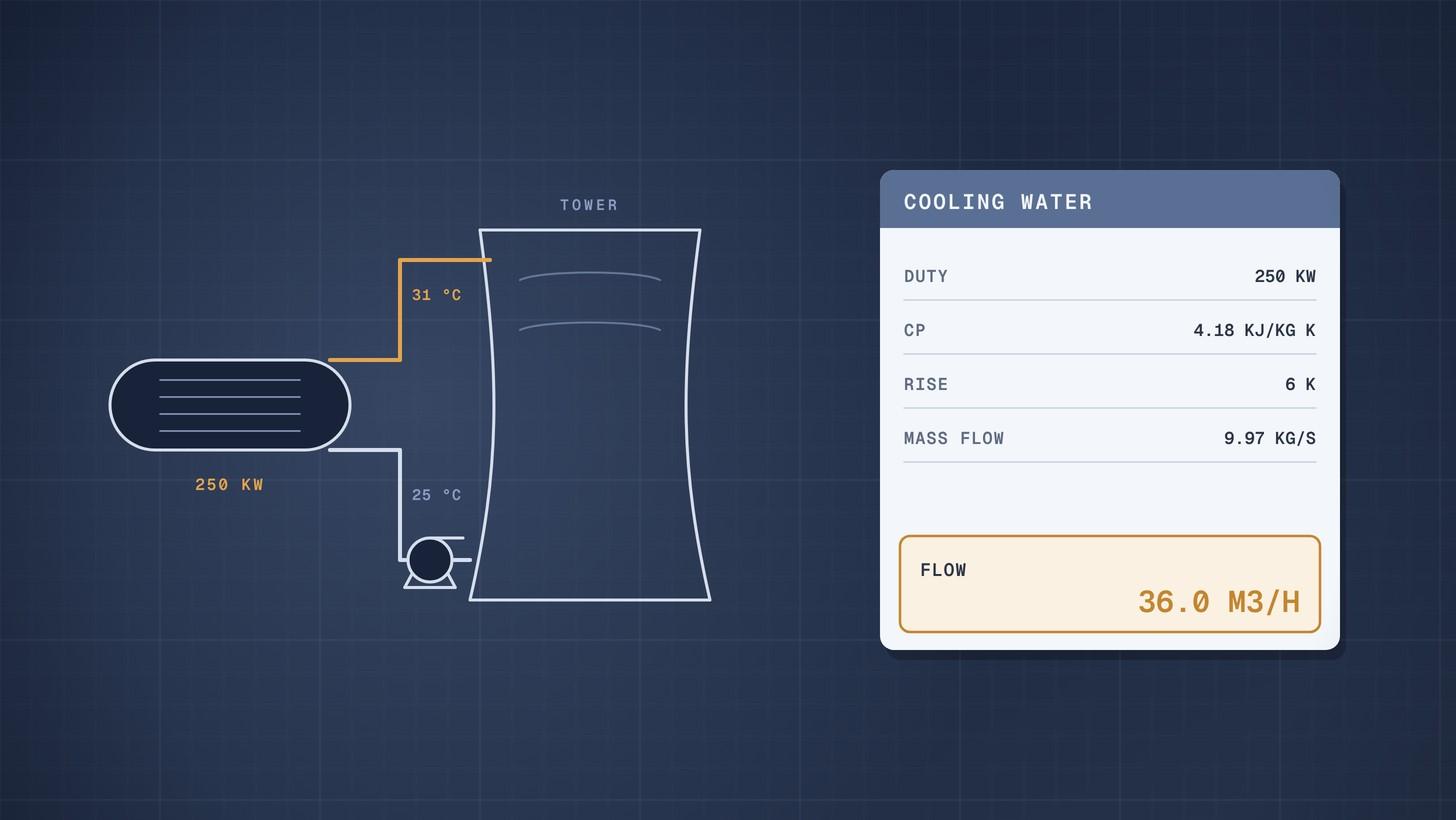
Cooling Water Flow Calculation: Worked Example
How to calculate cooling water flow from heat duty and temperature rise, then size the cooling tower circulation, evaporation and make up water.