
SIL Certificates: What to Check Before You Buy Safety Instruments and Valves
A SIL certificate says a device can be used in a safety function up to a stated level, under conditions. It does not make your loop SIL 2. Here is what to check before you buy.
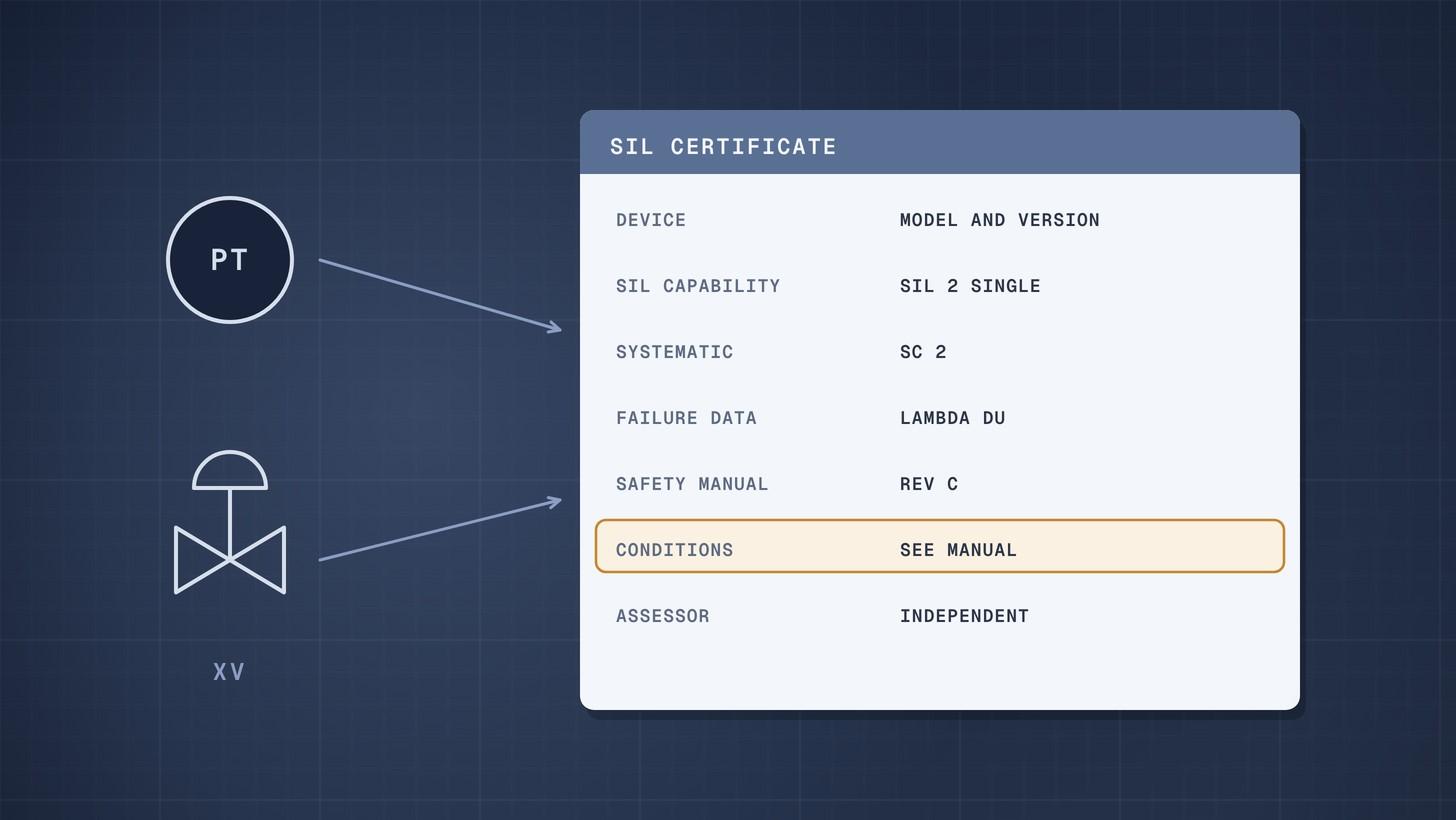
A SIL certificate for a transmitter, logic solver or valve says that the device, in a stated version and under stated conditions, can be used in a safety function up to a given safety integrity level. It does not say your safety function achieves that level. Before you buy, check the device and version match, the SIL capability and systematic capability, the failure data, the safety manual and its conditions, and who assessed it.
Why this matters now
Safety instrumented systems in UK process plants are judged against BS EN 61511, which HSE describes as the benchmark for managing functional safety in the process industries, built on BS EN 61508 as the general benchmark of good practice [1]. Buyers increasingly receive SIL certificates with bids for transmitters, valves and actuators, and few procurement teams know what to check. A wrong assumption here is not a commercial mistake; it can leave a safety function weaker than the hazard study requires.
Create and manage RFQs in minutes
ChemCapital handles the entire procurement cycle, from structured RFQs and supplier comparisons to formal purchase orders and delivery tracking.
What a SIL is, and is not
A safety integrity level is one of four levels for the integrity required of a safety function, SIL 1 the lowest and SIL 4 the highest. IEC describes SIL as a property of a safety function, set from the tolerable risk, with higher levels giving greater risk reduction [2]. In low demand mode the bands correspond to risk reduction factors of more than 10 up to 100 for SIL 1, more than 100 up to 1,000 for SIL 2, and more than 1,000 up to 10,000 for SIL 3 [2].
So a device does not have a SIL; the safety function does. A device has a SIL capability: the highest level it can support when used as the certificate and safety manual describe [3].
Certification itself is not mandatory. Neither IEC 61508 nor IEC 61511 requires certified devices; IEC 61511 asks for evidence that a device is suitable and reliable enough, and an end user can justify a device by its own documented prior use instead [3]. A certificate is simply the most common way suppliers provide that evidence.
What to check on the certificate
| Check | What to look for | Why it matters |
|---|---|---|
| Device and version | Exact model, options, firmware and hardware revision | A certificate for one variant does not cover another |
| SIL capability | The maximum SIL, and for which architecture | Capability may differ for single use and redundant use |
| Systematic capability | SC 1 to SC 4 | Confidence the device is free of design faults for that SIL |
| Failure data | Dangerous failure rates, diagnostic coverage, proof test assumptions | Your engineers need these to calculate the loop |
| Safety manual | Referenced by number and revision | The conditions of use live here |
| Route | How compliance was shown: design to the standard or proven in use | Tells you what the evidence rests on |
| Assessor and date | Who assessed it, their independence, and when | Expired or self issued claims carry less weight |
Systematic capability. It measures, on a scale of SC 1 to SC 4, the confidence that a device's systematic safety integrity meets a given SIL, provided it is used as the safety manual says. SC n corresponds to SIL n. The device's SIL capability is limited by the lower of its systematic capability and its hardware architectural constraints [4].
Redundancy has rules. Two devices of SC 2 combined can be credited at most one level higher, SC 3, and only with sufficient, justified independence between them [4]. A buyer cannot buy two SIL 2 transmitters and assume a SIL 3 loop.
Independent assessment. Systematic capability must be assessed through a functional safety assessment by an independent assessor [4]. A supplier's own declaration is not the same thing. Check the assessor's name, their accreditation, and the certificate's date and validity.
What the certificate does not tell you
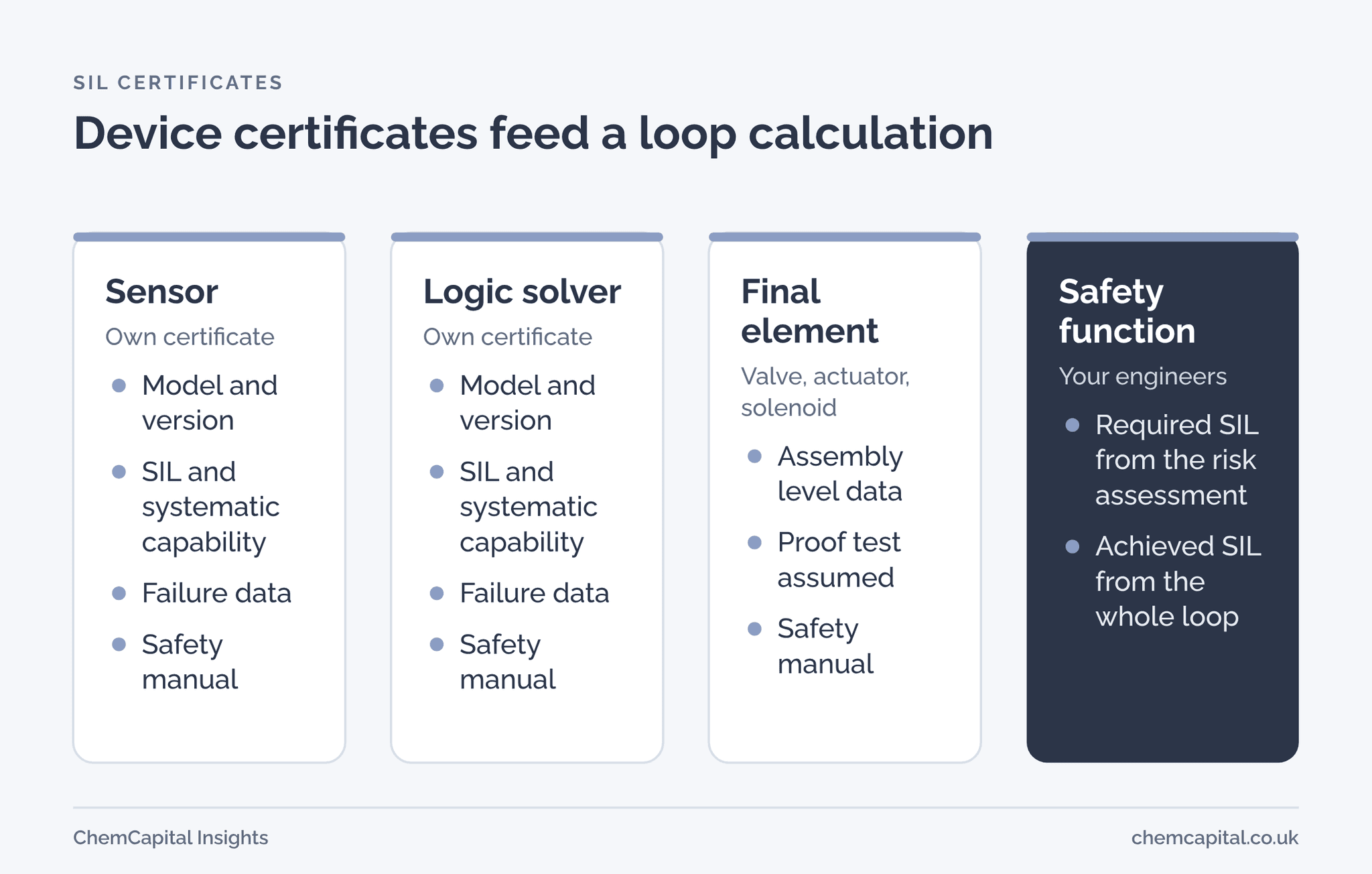
- That your loop meets its SIL. The required SIL comes from your risk assessment, and the achieved SIL depends on every element, the architecture, the proof test interval and how it is maintained [3] [5].
- That your application matches the assumptions. Process fluid, temperature, proof test method and installation all appear as conditions in the safety manual. Break one and the claim may not hold.
- That the supplier manages functional safety well. The 61508 Association reminds directors that a certified expert is not proof of functional safety management, and that suppliers and their supply chains should demonstrate it [6].
- Anything about systematic failures in your own design. Specification errors, software mistakes and maintenance errors are controlled by your own procedures, not by the device certificate [5].
Red flags in a SIL certificate
- A product family, not a model. "Series X, SIL 3" with no model codes or options leaves you guessing whether your variant is covered.
- No safety manual reference. Without it, nobody can check the conditions of use.
- SIL capability with no systematic capability. The two go together; one without the other tells you half the story.
- Failure data missing or only on request. Your engineers cannot calculate the loop without it.
- A self declaration presented as a certificate. Check that an independent assessor issued it.
- An old date and no statement of validity. Ask whether the assessment still covers the current hardware and firmware.
None of these automatically rules a device out. Each is a question to raise in technical clarification before award, not after the device is installed and the loop is already in service.
Valves need extra care
A final element is usually an assembly: valve, actuator, solenoid and sometimes a positioner, often from different makers. Each may carry its own certificate, with its own assumptions. Ask who has assessed the assembly as a whole, who provides the combined failure data, and which proof test, such as a full or partial stroke test, the figures assume. Final elements often dominate the loop's failure probability, as the example below shows. Note that an instrumented trip is a different layer of protection from mechanical relief; our guide to safety valves, relief valves and bursting discs covers the mechanical side.
Practical example
Illustrative figures. A SIL 2 high pressure trip uses one pressure transmitter, one logic solver and one shutdown valve assembly. The engineers calculate each element's average probability of failure on demand, using certificate failure data and a one year proof test interval.
| Element | Average probability of failure on demand |
|---|---|
| Pressure transmitter | 0.0004 |
| Logic solver | 0.0001 |
| Valve assembly | 0.0035 |
| Total for the function | 0.0040 |
| Risk reduction factor | 1 ÷ 0.0040 = 250, within SIL 2 (100 to 1,000) |
Now suppose the plant wants a two year proof test interval for the valve. With the simplified approximation that average failure probability is about the dangerous undetected failure rate times half the test interval, the valve's figure doubles to about 0.0070, the total becomes 0.0075, and the risk reduction factor falls to about 133. It is still SIL 2, but with far less margin, and the result depends on the valve certificate's failure rate. Your safety engineers do the real calculation; procurement's job is to make sure the certificates and safety manuals they need arrive with the bids.
What to put in the RFQ
- The safety function's required SIL and whether the device is in a safety loop.
- A request for the SIL certificate, the safety manual and the failure data for the exact model and options offered.
- The assessor's identity and the certificate's validity.
- For valves, assembly level data covering valve, actuator and solenoid, and the proof test assumed.
- Confirmation that the offered version matches the certificate.
When bids arrive, ChemCapital's AI quotation comparison lines up each bid's certificates, versions and exclusions side by side, so a missing safety manual or a mismatched model stands out before award. Our instrument datasheet template shows where SIL requirements sit on the datasheet.
Where ChemCapital fits
Safety devices are where a missing document matters most. Structured RFQs that ask for the same evidence from every bidder make the check routine instead of a scramble at FAT.
Ready to buy safety instruments and valves with the right evidence in every bid? Start a free 14 day ChemCapital trial, with no credit card needed.
Frequently asked questions
What does a SIL certificate mean?
That a device, in a stated version and under the conditions of its safety manual, can be used in a safety function up to a stated SIL. It does not mean the safety function achieves that SIL; that depends on the whole loop.
Is SIL certification mandatory?
No. IEC 61508 and IEC 61511 do not require certified devices. IEC 61511 requires evidence that a device is suitable, which can come from a certificate or from the user's documented prior use.
What is systematic capability?
A rating from SC 1 to SC 4 of confidence that a device's design is free enough of systematic faults for use at that SIL, provided it is used as its safety manual says. SC 2 corresponds to SIL 2.
Can two SIL 2 devices make a SIL 3 loop?
Not automatically. Combining elements can raise systematic capability by at most one level, and only with sufficient, justified independence between them. The whole loop must still be calculated.
What should I ask a valve supplier for in a SIL application?
Certificates and failure data for the valve, actuator and solenoid as an assembly, the safety manual, the proof test assumed, and the assessor's details.
Continue reading
Informational only, not procurement or legal advice. Cited names, frameworks, and statistics belong to their respective owners.
Create and manage RFQs in minutes
ChemCapital handles the entire procurement cycle, from structured RFQs and supplier comparisons to formal purchase orders and delivery tracking.
Start for freeRelated articles
Design Qualification (DQ) for GMP Equipment: What It Is and What the Vendor Provides
Design qualification is the documented check that a proposed equipment design meets the URS and GMP before it is built. Here is where DQ sits in EU GMP Annex 15, what evidence the vendor supplies, and a DQ checklist.
Requirements Traceability Matrix for GMP Equipment: From URS to PQ
A requirements traceability matrix links every URS line to the design document that meets it and the test that proves it, from DQ through FAT, SAT, IQ, OQ and PQ. Here is how to build one, with a template.
How to Prepare for a Customer Quality Audit as an Equipment Manufacturer
A practical guide for equipment makers facing a customer or vendor audit: the documents to have ready, how to run the walk through, the findings auditors raise most often and how to close them properly.