
Steam Consumption for Heating a Vessel: Worked Example
How to calculate the steam needed to heat a jacketed vessel: heat load, latent heat, mean and peak steam demand and holding load, with what they mean for valves and traps.
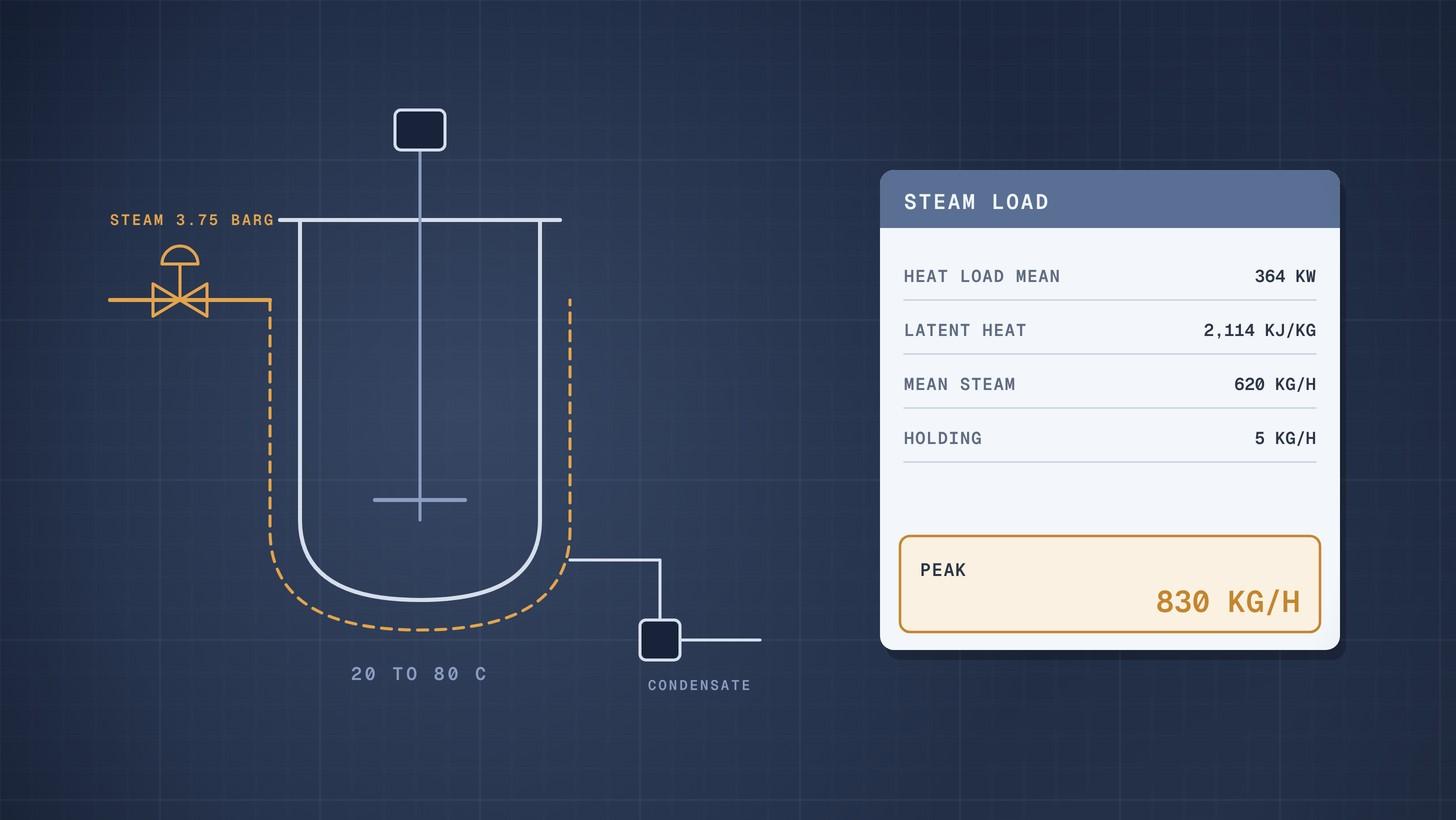
Steam consumption for heating a vessel is the heat load in kW divided by the latent heat of the steam in kJ/kg, times 3,600 to give kg/h. In the worked example below, heating 5,000 kg of water from 20 °C to 80 °C in one hour in a steam jacketed vessel takes a mean 364 kW, about 620 kg/h of steam at 3.75 barg. The peak at the start of the heat up is much higher, about 830 kg/h, and that is the figure the steam supply, control valve and trap must handle.
The mean figure tells you the energy per batch. The peak tells you what to buy.
Why this matters now
Steam is still the main heating medium on most chemical and food sites, and every new jacketed vessel or reactor adds to the boiler load. Undersize the steam supply or the condensate removal and the batch takes longer than planned, the jacket floods and control becomes erratic. Oversize everything and you pay for valves, traps and pipe that never work hard.
Equipment suppliers often quote a heat transfer area and a U value, but not the steam load across the batch. Working out the mean and peak yourself lets you check the vessel offer and size the utilities at the same time.
Create and manage RFQs in minutes
ChemCapital handles the entire procurement cycle, from structured RFQs and supplier comparisons to formal purchase orders and delivery tracking.
What makes up the heat load
Spirax Sarco lists the parts of the heat requirement for a heated tank: the liquid, the vessel material, losses from the sides and the liquid surface, and anything dipped into it [1]. For a closed, jacketed process vessel, the first three matter:
- Heating the contents: m × cp × ΔT, spread over the heat up time.
- Heating the vessel: the mass of steel in contact with the jacket, times its specific heat, times the same temperature rise.
- Heat losses: small for an insulated vessel. Spirax notes that heat loss calculations are less accurate than heating load calculations [1].
Steam consumption follows from the heat transfer rate [2]. Each kilogram of steam that condenses gives up its latent heat (the enthalpy of evaporation, hfg), so steam flow in kg/h = heat load in kW ÷ hfg × 3,600. TLV's steam table gives a saturation temperature of 150 °C and an hfg of 2,114 kJ/kg at 374.78 kPa gauge, about 3.75 barg [3]. Spirax's examples use 2,133.4 kJ/kg at 3 barg [2]. The lower the pressure, the higher the latent heat, but the lower the temperature driving the heat transfer.
Mean load and peak load are different
With steam in the jacket at a fixed pressure, the heat transfer rate is U × A × (steam temperature minus product temperature). When the product is cold, the temperature difference is large and the jacket condenses steam fast. As the product warms up, the rate falls.
Spirax makes the same distinction between the start up load, which includes heating the liquid and the vessel, and the running load once the tank is hot [1]. It also suggests extending the start up period where possible to cut the peak demand [1].
Worked example: heating a jacketed vessel
A stainless steel jacketed vessel holds 5,000 kg of water based product. It must heat from 20 °C to 80 °C in one hour. Steam is supplied to the jacket at 3.75 barg (150 °C). The vessel mass, losses and U value are illustrative; the steam and water properties are sourced.
Step 1: product heat. With cp of 4.181 kJ/kg K at around 50 °C [4]: 5,000 × 4.181 × 60 ÷ 3,600 = 348.4 kW mean.
Step 2: vessel heat. Take 1,500 kg of steel in contact with the jacket and a specific heat of 0.5 kJ/kg K, the figure Spirax uses for mild steel [1]: 1,500 × 0.5 × 60 ÷ 3,600 = 12.5 kW mean.
Step 3: losses. For an insulated vessel, allow 3 kW.
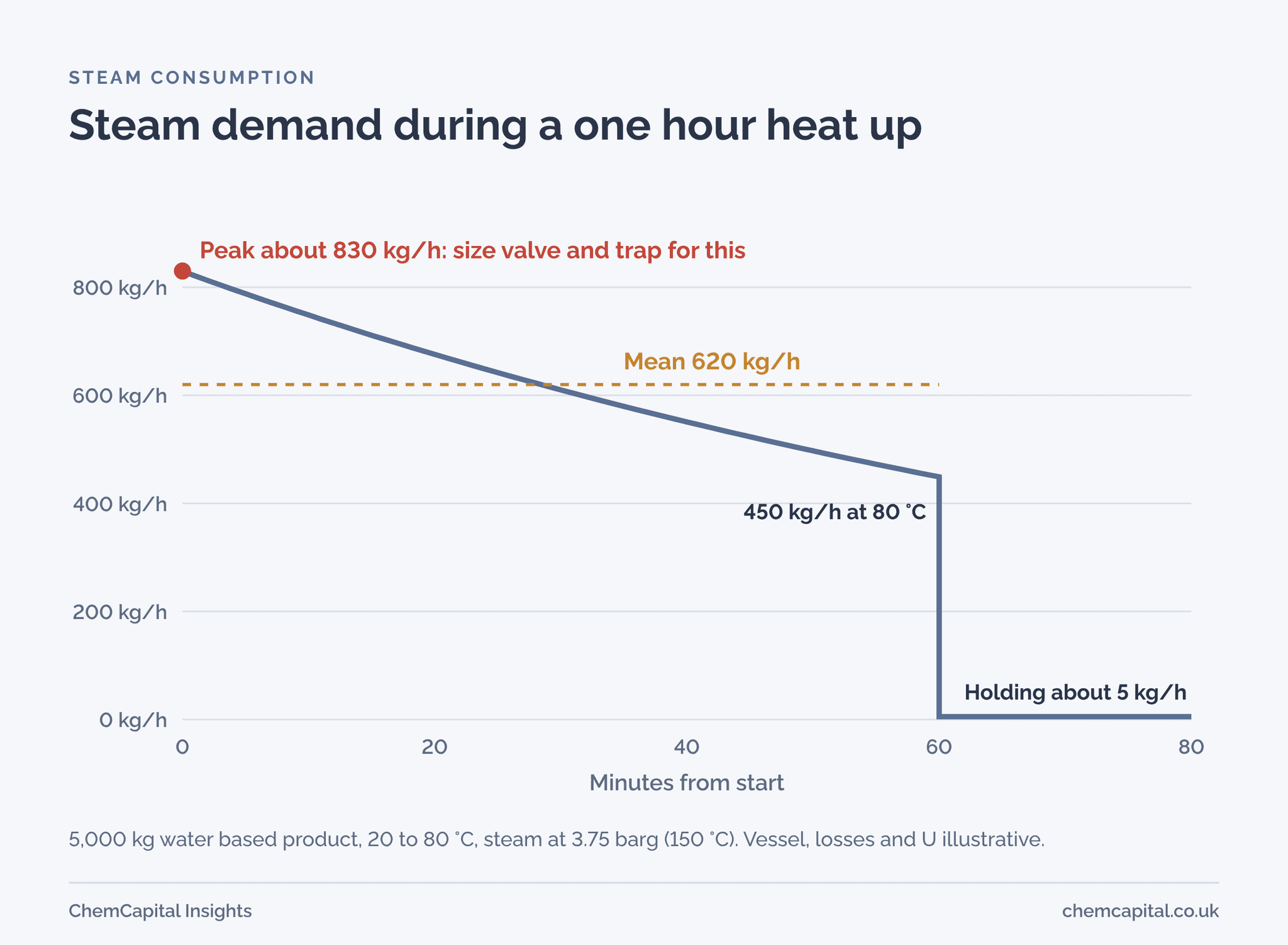
Step 4: mean steam load. 348.4 + 12.5 + 3.0 = 363.9 kW. Steam = 363.9 ÷ 2,114 × 3,600 = 620 kg/h. Over the one hour heat up, that is about 620 kg of steam per batch.
Step 5: peak steam load. The jacket sees a temperature difference of 150 minus 20 = 130 K at the start and 150 minus 80 = 70 K at the end. The log mean is (130 minus 70) ÷ ln(130 ÷ 70) = 96.9 K. Dividing the 360.9 kW heating load by 96.9 K gives a jacket capacity, U × A, of 3.72 kW/K. At the start, 3.72 × 130 + 3 = 487 kW, which is 830 kg/h of steam. At the end of heat up, 3.72 × 70 + 3 = 264 kW, or 450 kg/h.
Step 6: holding load. Once at 80 °C, only the losses remain: 3 kW, about 5 kg/h.
| Point in the batch | Heat load | Steam |
|---|---|---|
| Start of heat up | 487 kW | 830 kg/h |
| Mean over heat up | 364 kW | 620 kg/h |
| End of heat up | 264 kW | 450 kg/h |
| Holding at 80 °C | 3 kW | 5 kg/h |
Check the jacket. A U × A of 3.72 kW/K needs about 3.7 m² of jacket at a U of 1,000 W/m² K. Spirax gives 850 to 1,700 W/m² K for steam jackets on stainless vessels heating water with moderate agitation, and 400 to 570 W/m² K for glass lined steel [5]. The same duty in a glass lined vessel would need roughly twice the area, or a longer heat up.
What a lower steam pressure does
Many sites run a low pressure steam main. Keep the same vessel and jacket (U × A of 3.72 kW/K) and repeat the batch at lower pressures, using TLV's steam table [3]:
| Jacket steam | Saturation temperature | Latent heat | Heat up time, 20 to 80 °C | Peak steam | Mean steam |
|---|---|---|---|---|---|
| 3.75 barg | 150 °C | 2,114 kJ/kg | 60 minutes | 830 kg/h | 620 kg/h |
| 1.7 barg | 130 °C | 2,174 kJ/kg | 76 minutes | 683 kg/h | 474 kg/h |
| 1.0 barg | 120 °C | 2,202 kJ/kg | 89 minutes | 614 kg/h | 404 kg/h |
Heat up time is m × cp ÷ (U × A) × ln((Ts minus T₁) ÷ (Ts minus T₂)), with the vessel steel included in m × cp. Lower pressure steam carries a little more latent heat per kilogram, so the steam used per batch hardly changes, about 600 kg in each case. What changes is time: the batch takes half as long again at 1 barg. If the cycle time matters, either keep the higher pressure or buy more jacket area.
What the numbers mean for equipment
- Steam supply and control valve. Size for the peak, about 830 kg/h here, not the mean. If the boiler cannot spare that, extend the heat up time.
- Turndown. The valve must control from 830 kg/h down to 5 kg/h. That range may need two valves in parallel, which is how Spirax handles maximum and running loads in its coil example [5].
- Condensate removal. Spirax advises sizing the trap or pump trap for both the full load and the stall load, when jacket pressure falls to the condensate back pressure, and warns the stall load may be considerable [5].
- Area margin. Spirax adds 10% to the calculated heat transfer area for fouling and uncertainty in U [5].
Checking a vessel or reactor offer
Ask the supplier for jacket area, design U value and its basis, jacket design pressure, and the predicted heat up time at your steam pressure. With those you can rerun the steps above. Our guide to jacketed vessels and glass lined reactors covers jacket types, and the control valve sizing guide explains how to turn the peak flow into a valve size.
ChemCapital's structured RFQs ask every vessel supplier the same thermal questions, so jacket area, U value and heat up time come back on the same basis and can be compared.
Ready to get vessel quotes that include the numbers you need to size the steam? Start a free 14 day ChemCapital trial, with no credit card needed.
Frequently asked questions
How do you calculate steam consumption?
Work out the heat load in kW, then divide by the latent heat of the steam at its pressure in kJ/kg and multiply by 3,600 to get kg/h. For heating a batch, the heat load is mass times specific heat times temperature rise divided by the heat up time, plus the vessel and losses.
What is the latent heat of steam at 3 barg?
About 2,133 kJ/kg, the value Spirax Sarco uses in its examples. At about 3.75 barg, where steam is at 150 °C, TLV's steam table gives 2,114 kJ/kg.
Why is peak steam demand higher than the average?
With steam at a fixed pressure, the heat transfer rate is proportional to the temperature difference between steam and product. That difference is largest when the product is cold, so the jacket condenses steam fastest at the start of the heat up.
How much steam does a jacketed vessel use to hold temperature?
Only enough to cover heat losses, which for an insulated vessel is usually a few kilowatts, a few kilograms of steam an hour. That is why the control valve needs a wide turndown, or two valves in parallel.
Continue reading
Informational only, not procurement or legal advice. Cited names, frameworks, and statistics belong to their respective owners.
Create and manage RFQs in minutes
ChemCapital handles the entire procurement cycle, from structured RFQs and supplier comparisons to formal purchase orders and delivery tracking.
Start for freeRelated articles
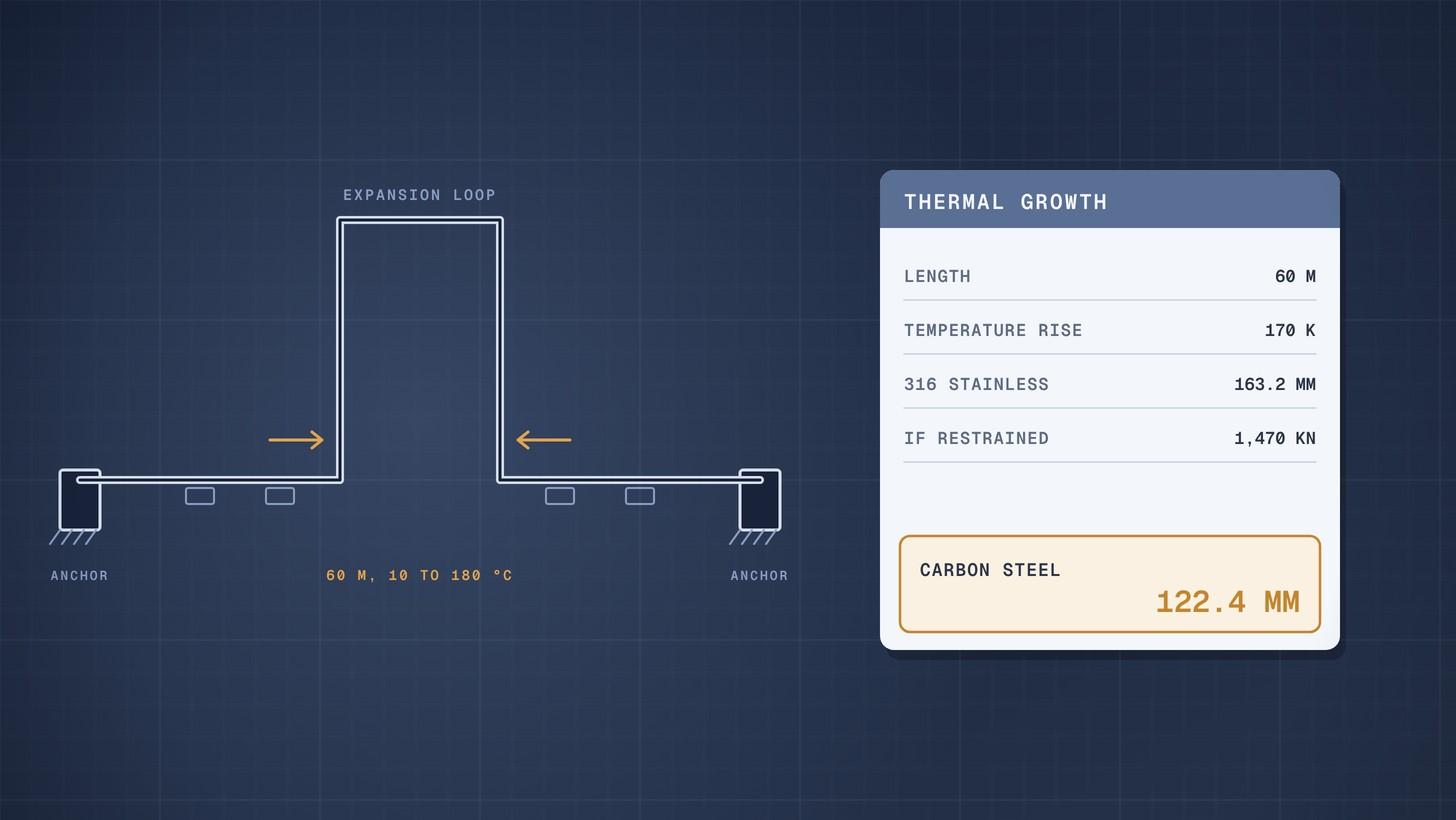
Pipe Thermal Expansion: Worked Example
How to calculate pipe thermal expansion for carbon and stainless steel, what restrained expansion does, and how loops and expansion joints absorb it.
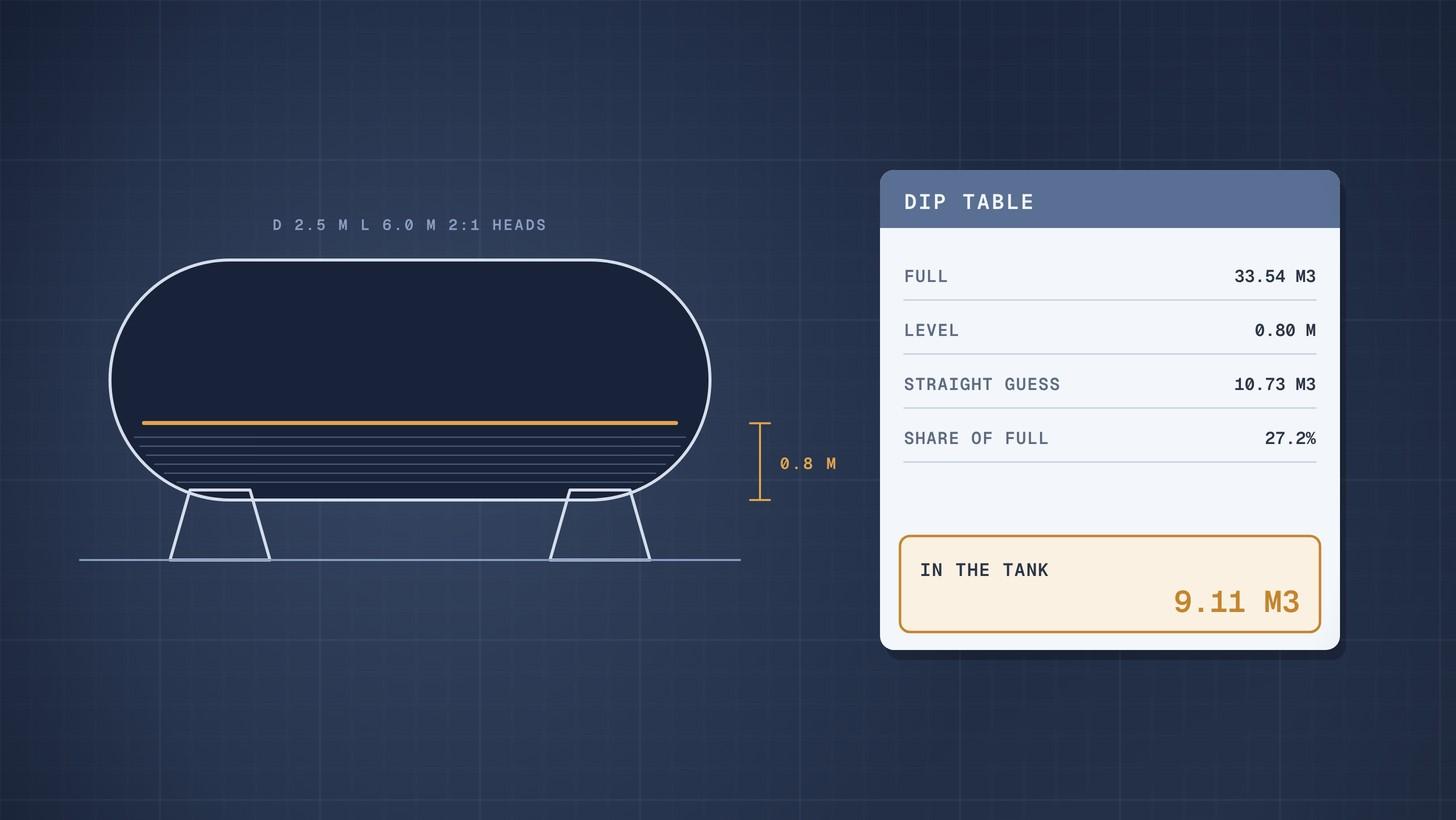
Horizontal Tank Volume When Partly Filled: Worked Example
How to calculate the volume of a partly filled horizontal tank with dished heads, with a worked example and a full dip table you can rebuild in a spreadsheet.
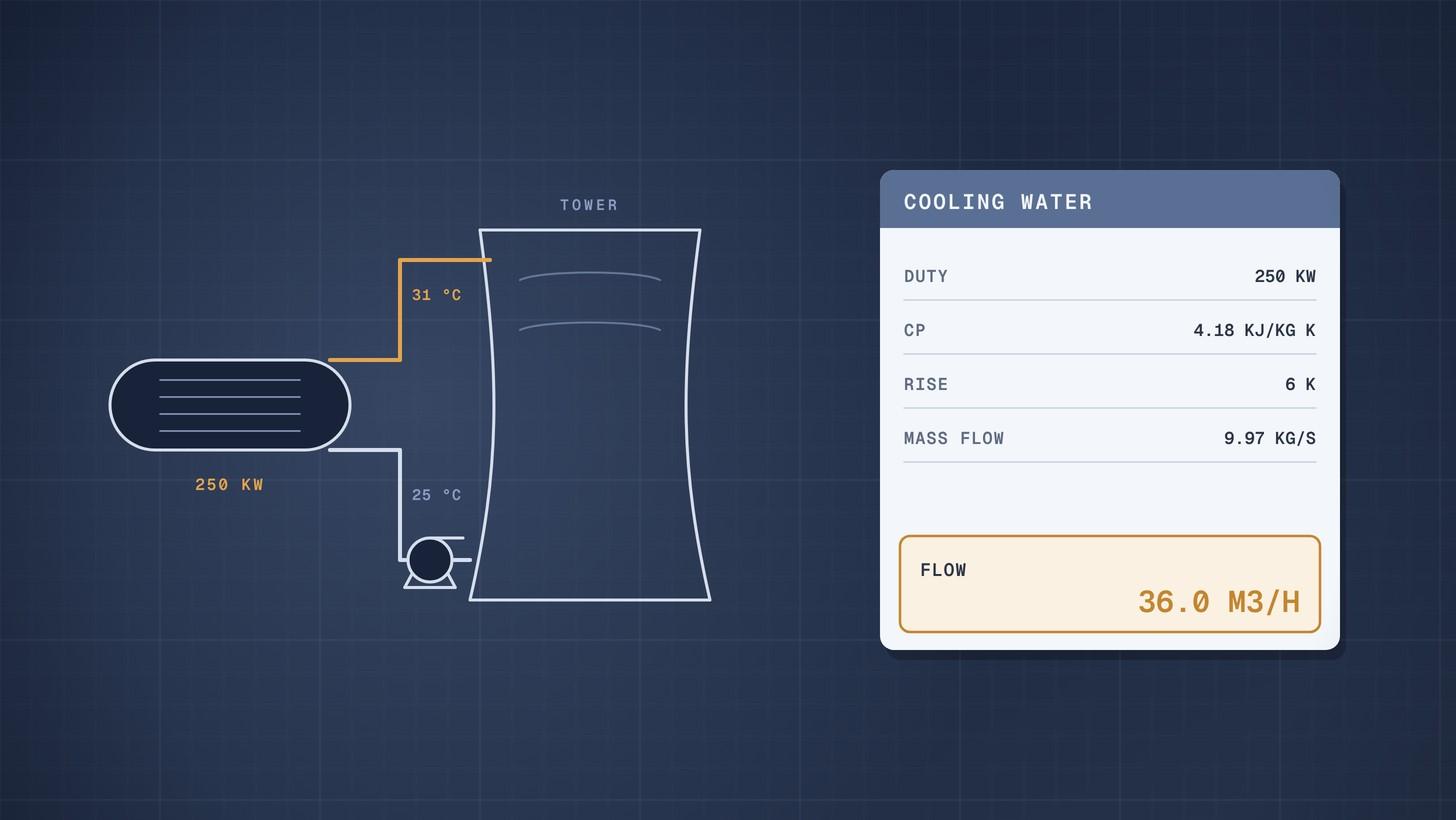
Cooling Water Flow Calculation: Worked Example
How to calculate cooling water flow from heat duty and temperature rise, then size the cooling tower circulation, evaporation and make up water.