
Selling Process Skids into the US: UL 508A Panels, NFPA 79 and the NEC
What a European skid maker needs for the US: a UL 508A listed panel, NFPA 79 wiring, NEC installation, a short circuit current rating, and field evaluation as the fallback.
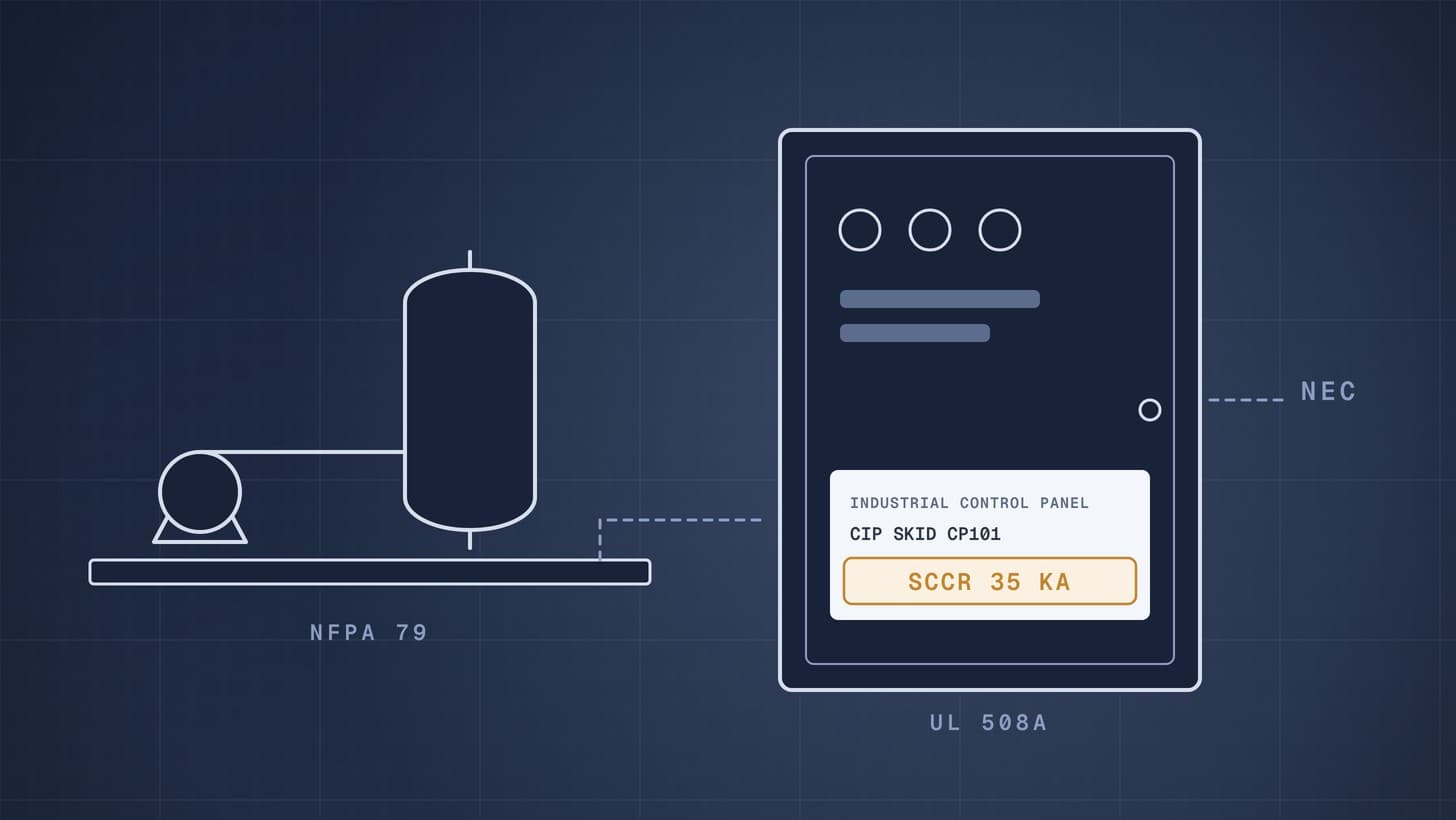
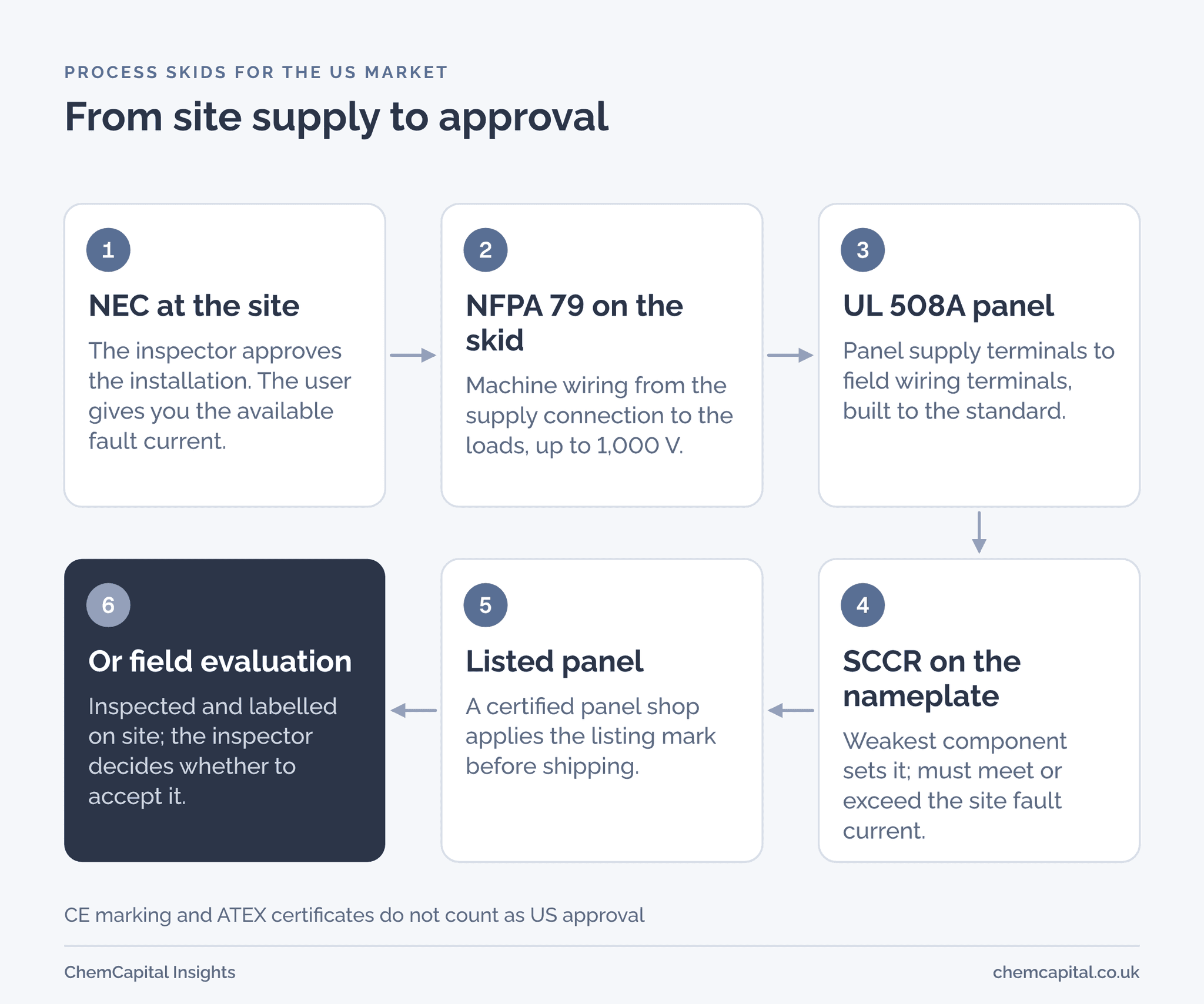
To sell a process skid into the US, its electrical equipment has to be acceptable to the local inspector. In practice that means a control panel listed to UL 508A by a certified panel shop, machine wiring to NFPA 79, installation to the National Electrical Code (NEC), and a short circuit current rating (SCCR) on the nameplate. Your CE marking does not count: OSHA says it is unrelated to US product safety requirements.
If the panel cannot be listed, a field evaluation by a recognised body at the installation site is the fallback. This guide explains each piece from the skid maker's side, what US buyers write into their RFQs, and how to decide between listing the panel and evaluating it in the field.
Why this matters now
US process and pharma projects buy skids from European and UK makers for the same reasons anyone else does: specialist know how and a shorter route to a working package. The trouble usually starts at the panel. A skid that passes a factory acceptance test in Europe can still fail the inspection on a US site, and then the fix happens on site, the most expensive place to do it.
The basic rule sits in US workplace safety law. OSHA's electrical standard, 29 CFR 1910.303, requires many types of workplace electrical equipment to be approved. Equipment counts as approved when a Nationally Recognized Testing Laboratory (NRTL) has certified, listed or labelled it [1]. OSHA does not approve products itself; it recognises the laboratories. It also says plainly that the CE mark is unrelated to US product safety requirements, and that ATEX certification does not replace an NRTL mark [1]. An NRTL does not have to be based in the US, so some European laboratories can certify for the US market, subject to OSHA's reciprocity rules [1].
Access real procurement opportunities from global buyers
Join ChemCapital to get discovered by verified procurement teams across pharmaceutical, chemical, and industrial manufacturing.
The standards that apply to a skid
Three documents do most of the work, and each covers a different boundary.
The NEC (NFPA 70) is the overriding code for electrical installations in the US, and the local authority having jurisdiction (AHJ) must approve equipment before it goes into service [2]. Article 409 covers industrial control panels and points to UL 508A. Article 670 covers industrial machinery and points to NFPA 79 [2].
NFPA 79, the Electrical Standard for Industrial Machinery, sets safeguards to protect operators, equipment, facilities and work in progress from fire and electrical hazards. The current edition is 2024 [3]. It runs from the machine's supply connection to the loads, and its 2018 edition raised the voltage limit from 600 V to 1,000 V to match the NEC [2].
UL 508A, the standard for industrial control panels, runs from the panel's supply terminals to its field wiring terminals. Both NFPA 79 and UL 508A can apply to the same panel; they rarely conflict, and where they differ the stricter requirement is the safe choice [2].
| Boundary | Standard | What it covers |
|---|---|---|
| Site installation | NEC (NFPA 70) | Supply, fault current, installation, inspection by the AHJ |
| Machine wiring | NFPA 79 | Supply connection to the loads on the skid |
| Control panel | UL 508A | Panel supply terminals to field wiring terminals |
| Approval | NRTL listing or field evaluation | Proof the equipment is acceptable |
If you are new to skid packages, our buyer's guide to modular process skids shows how buyers scope them.
UL 508A listing and the panel shop programme
UL's panel shop programme lets an approved shop apply UL marks for the US and Canadian markets to industrial control panels at its own factory, whether mass produced or custom built, without UL examining each design. Each manufacturing location must keep at least one qualified manufacturer's technical representative, after mandatory training on UL 508A [4].
For a European skid maker there are three ways to get a listed panel:
- Become a listed shop yourself. Worth it if you expect a steady flow of US work. You need trained staff, UL 508A compliant designs and components, and the laboratory's follow up inspections.
- Subcontract the panel to a shop that already holds the listing, in Europe or the US. You supply the design; they build, list and mark it.
- Ship the skid and have the panel field evaluated at the installation site (see below).
Component selection matters most. Components without US short circuit ratings take low default values in the SCCR calculation described below, so a panel built from them may not reach the rating the site needs and may need redesigning around components with US ratings. Agree the component list with the listing shop before you order anything.
Short circuit current rating: the number buyers check first
SCCR is the maximum fault current the panel or machine can withstand safely under short circuit conditions [5]. The NEC requires it on the nameplate of industrial control panels (section 409.110) and in the nameplate data of industrial machinery (section 670.3) [5]. Under section 409.22, a panel must not be connected where the available fault current exceeds its SCCR. The user calculates the fault current at the supply point and gives it to the manufacturer [6].
UL 508A Supplement SB gives the usual method. In short, the weakest component sets the rating [5] [6]:
- Find the SCCR of every power circuit component. Unmarked components get default values from Table SB4.1.
- Where a current limiting fuse, breaker or transformer protects a branch, the components downstream can take a higher rating.
- The panel SCCR is the lowest value left, and never higher than the lowest interrupting rating of an overcurrent device in the panel.
The default for an unmarked component can be as low as 5 kA, which Consulting Specifying Engineer describes as not adequate for most applications [5]. So ask the buyer for the available fault current at the skid's supply point at RFQ stage, and design to it.
ChemCapital's structured RFQs let buyers put questions like the site fault current, voltage and frequency into the RFQ itself, so the answer reaches you before you price, not at the factory acceptance test.
Motors, instruments and other bought in items
The panel is not the only electrical item on a skid. Motors, variable speed drives, instruments, solenoid valves, heaters and junction boxes all sit inside the machine boundary, and the inspector looks at them too.
For each one, check three things that OSHA lists for an acceptable certification. The product carries the laboratory's registered certification mark. The laboratory is recognised for the test standard that covers that product. The certification was issued from one of the laboratory's recognised sites [1]. A CE marked motor with no US mark fails the first test, however good it is.
Build this into your bill of materials early. Add a column for the US certification mark and file number beside the European data, and ask your component suppliers for both before you order. It costs nothing at design stage and saves a field evaluation later.
Field evaluation: the fallback
When equipment carries no listing, or has been modified after listing, the AHJ can accept a field evaluation instead. A field evaluation body inspects the equipment, normally at the installation site, and applies its field label. One certifier lists imported machinery with non US certification among the usual cases [7]. NFPA 790 sets the competency of field evaluation bodies, and NFPA 791 describes how the evaluation of unlabelled electrical equipment is done [8].
Field evaluation suits a one off skid. It has three drawbacks you should price in:
- It happens on site, after delivery, so any rework is done in the field.
- It covers the specific equipment evaluated [7], so the next identical skid needs its own evaluation.
- The AHJ decides whether to accept it. Ask the buyer to confirm with their inspector before you rely on it.
Questions to ask before you quote
A clear set of answers from the buyer turns a risky US bid into an ordinary one. Ask for these before you price:
- Site supply. Voltage, frequency and earthing arrangement at the skid's supply point.
- Available fault current. The figure your SCCR must meet or exceed, calculated by the user under the NEC [6].
- Hazardous locations. The US classification of each area the skid sits in, if any.
- Approval route. Whether the buyer requires a listed panel, and whether their inspector would accept a field evaluation as a fallback.
- Certification marks. Whether the buyer or site insurer prefers a particular laboratory's mark.
- Documents. Drawing standards, units and the language for manuals and labels.
Put the answers in your quotation as the basis of your offer. If any answer changes later, you have a clear reason to revise the price.
What US buyers ask for in the RFQ
Expect these lines in a US skid RFQ, and answer each one explicitly:
| RFQ line | What to offer |
|---|---|
| Control panel listed to UL 508A | Listed panel and the shop's file number, or a stated field evaluation plan |
| SCCR at the stated fault current | Nameplate SCCR equal to or above the site's available fault current |
| Machine electrical to NFPA 79 | Compliance statement and deviations list |
| NEC compliant installation | Field wiring terminals, conductor sizes and enclosure types as specified |
| NRTL listed components | Motors, drives and instruments with NRTL marks, not CE alone |
| Hazardous locations | Equipment certified for the US classification; ATEX alone is not accepted [1] |
| Documents | Electrical schematics, bill of materials with ratings, SCCR calculation, listing records |
Our FAT checklist for process skids is a good place to add a US electrical section, so the panel is checked before it ships.
Practical example
Illustrative figures. A UK maker quotes a clean in place skid for a US food plant. The RFQ says: panel listed to UL 508A, SCCR not less than 35 kA at the supply point, machine to NFPA 79.
The maker's standard panel uses European components. Working through Supplement SB, the weakest component in the motor circuits is rated 10 kA, and two unmarked terminal blocks would default to a low value. The panel SCCR comes out at 10 kA, well short of 35 kA.
Three options go to the buyer:
| Option | What changes | Effect |
|---|---|---|
| A | Redesign with components carrying US high fault ratings, built and listed by a UL 508A shop | Panel SCCR 35 kA or more; listed before shipping |
| B | Keep components; add current limiting fuses in the feeder to protect the branches | May raise SCCR; check let through values per Supplement SB |
| C | Ship unlisted; field evaluation on site | Inspector decides; risk of rework in the field |
The maker recommends option A, prices it in, and states option C as a fallback only if the buyer's inspector agrees in writing. The buyer can compare like with like, and the maker avoids a site fix.
If you are the buyer
Give bidders the available fault current at the supply point, the supply voltage and frequency, and any hazardous location classification. Ask each bidder to name the listing shop or the field evaluation body, and to send the SCCR calculation with the bid. Our guide to ATEX and DSEAR equipment explains why European hazardous area certificates do not transfer.
This is general information, not legal advice; check the current text before you rely on it.
Where ChemCapital fits
US buyers screen skid suppliers on whether they can deliver a listed panel with the right SCCR. Say what you can do, and how, in your listing and in every bid. Name your listing shop or certifier, and state the SCCR you normally design to, so buyers can see it before they send an enquiry.
Ready to reach buyers who need skids built for the US market? List your company on ChemCapital. It is free to start.
Frequently asked questions
What is UL 508A?
UL 508A is the US standard for industrial control panels. A shop in the UL panel shop programme can apply UL marks for the US and Canadian markets to panels it builds, without UL examining each design, provided it keeps a trained technical representative and follows the standard.
Is CE marking accepted in the US?
No. OSHA says the CE mark is unrelated to US product safety requirements, and ATEX certification does not replace a US certification mark. Workplace electrical equipment generally needs approval through a Nationally Recognized Testing Laboratory, or a field evaluation the local inspector accepts.
What is SCCR on a control panel?
The short circuit current rating is the maximum fault current the panel can withstand safely. The NEC requires it on the nameplate of industrial control panels and machinery, and a panel must not be connected where the available fault current exceeds it. UL 508A Supplement SB is the usual way to calculate it.
What is the difference between NFPA 79 and UL 508A?
NFPA 79 covers the electrical equipment of industrial machinery from the supply connection to the loads. UL 508A covers the control panel from its supply terminals to its field wiring terminals. Both can apply to the same skid panel, and where they differ the stricter requirement is the safe choice.
Can a skid be field evaluated instead of UL listed?
Yes, if the local authority having jurisdiction accepts it. A field evaluation body inspects the equipment at the installation site and applies a field label. It covers the specific equipment evaluated and happens after delivery, so any rework is done on site.
Continue reading
Informational only, not procurement or legal advice. Cited names, frameworks, and statistics belong to their respective owners.
Access real procurement opportunities from global buyers
Join ChemCapital to get discovered by verified procurement teams across pharmaceutical, chemical, and industrial manufacturing.
List your companyRelated articles
Design Qualification (DQ) for GMP Equipment: What It Is and What the Vendor Provides
Design qualification is the documented check that a proposed equipment design meets the URS and GMP before it is built. Here is where DQ sits in EU GMP Annex 15, what evidence the vendor supplies, and a DQ checklist.
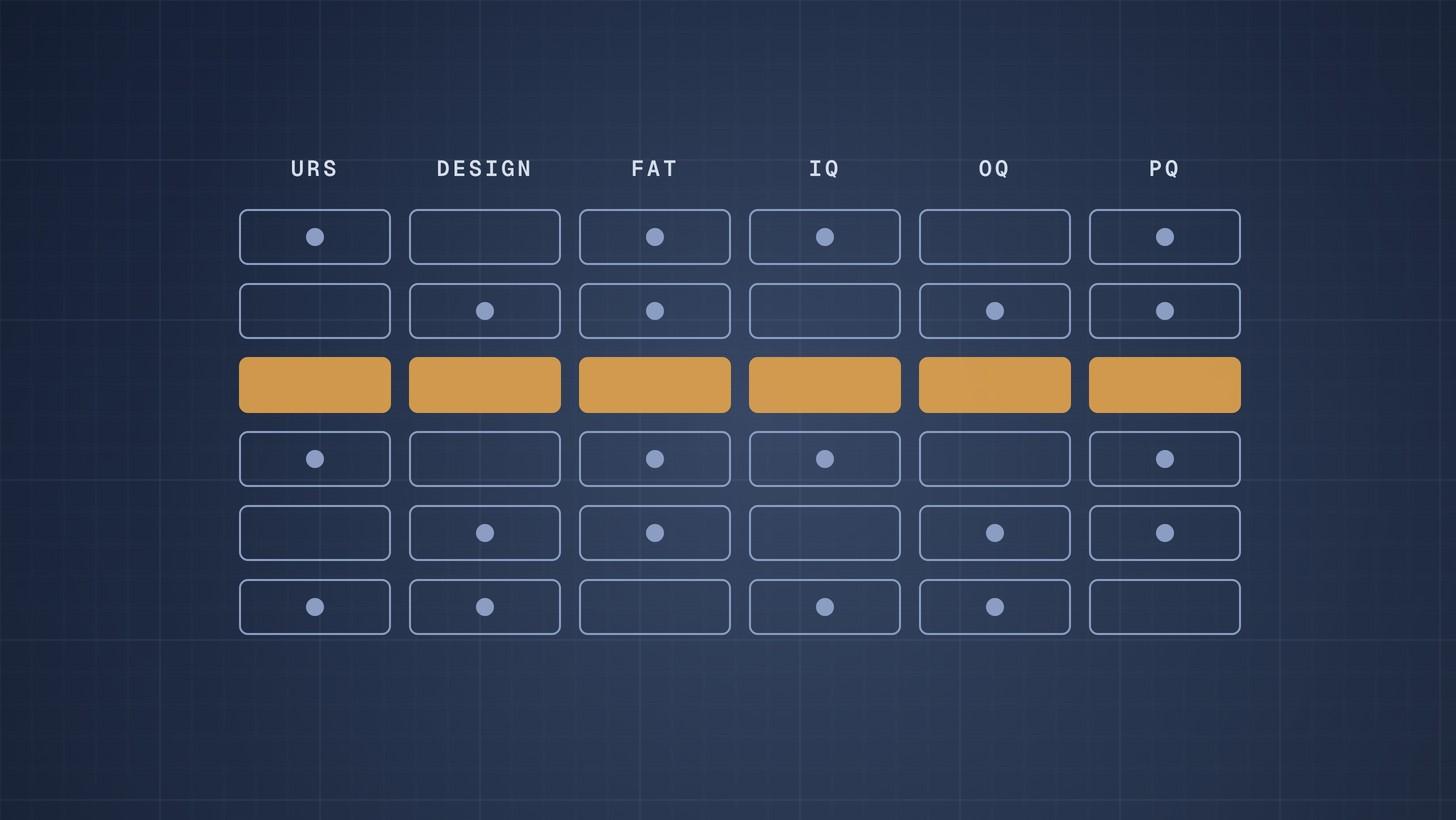
Requirements Traceability Matrix for GMP Equipment: From URS to PQ
A requirements traceability matrix links every URS line to the design document that meets it and the test that proves it, from DQ through FAT, SAT, IQ, OQ and PQ. Here is how to build one, with a template.
How to Prepare for a Customer Quality Audit as an Equipment Manufacturer
A practical guide for equipment makers facing a customer or vendor audit: the documents to have ready, how to run the walk through, the findings auditors raise most often and how to close them properly.