
Landed Cost of Imported Process Equipment: UK Worked Example
How to calculate the landed cost of imported equipment in the UK: customs value, duty, import VAT, freight and hidden costs, worked through for one skid quoted from the UK, Germany and Asia.
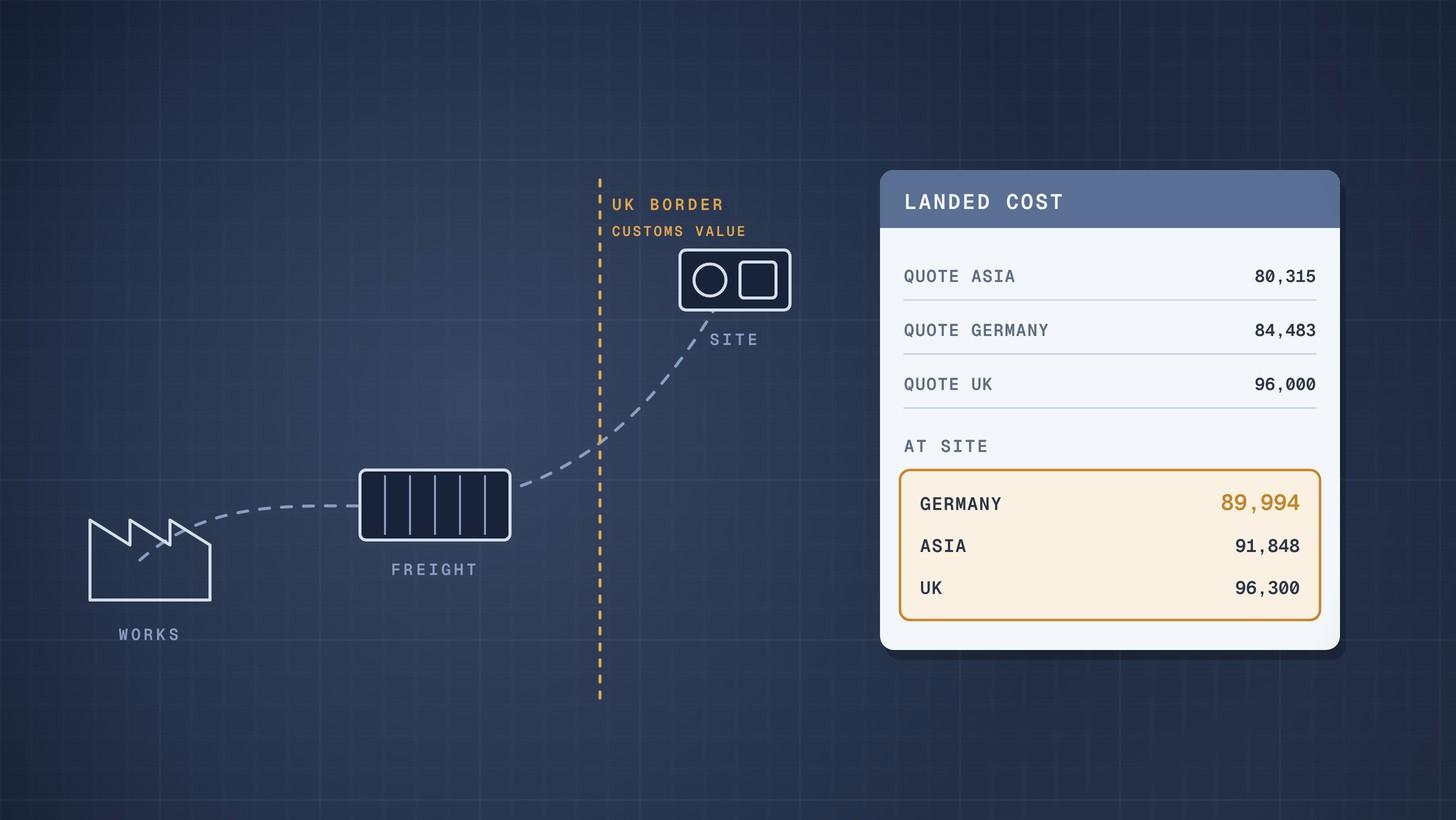
Landed cost is everything you pay to get imported equipment to your site, converted to pounds: the supplier's price, freight and insurance, customs duty, clearance and port charges, inland haulage and costs such as factory acceptance test travel. In the worked example below, an Asian skid quoted at £80,300 lands at £91,800, while a German skid quoted at £84,500 lands at £90,000 and beats it.
Import VAT is part of the cash you pay at the border, but a VAT registered business normally recovers it, so it sits outside the cost comparison. Duty does not come back.
Why this matters now
Quotes for engineered equipment arrive in euros, dollars and pounds, on different Incoterms, from suppliers who may or may not prove where the goods originate. Comparing the bottom line of each quote compares unlike things. The cheapest price at the supplier's gate is often not the cheapest at your site.
Trade rules have also shifted in the last few years. Goods from the EU come in duty free only if they qualify as originating under the UK and EU trade agreement [1]. Steel heavy equipment may soon carry carbon border costs as well; see our guide to CBAM and imported steel equipment. A landed cost sheet is the only way to see the real ranking.
Create and manage RFQs in minutes
ChemCapital handles the entire procurement cycle, from structured RFQs and supplier comparisons to formal purchase orders and delivery tracking.
What goes into landed cost
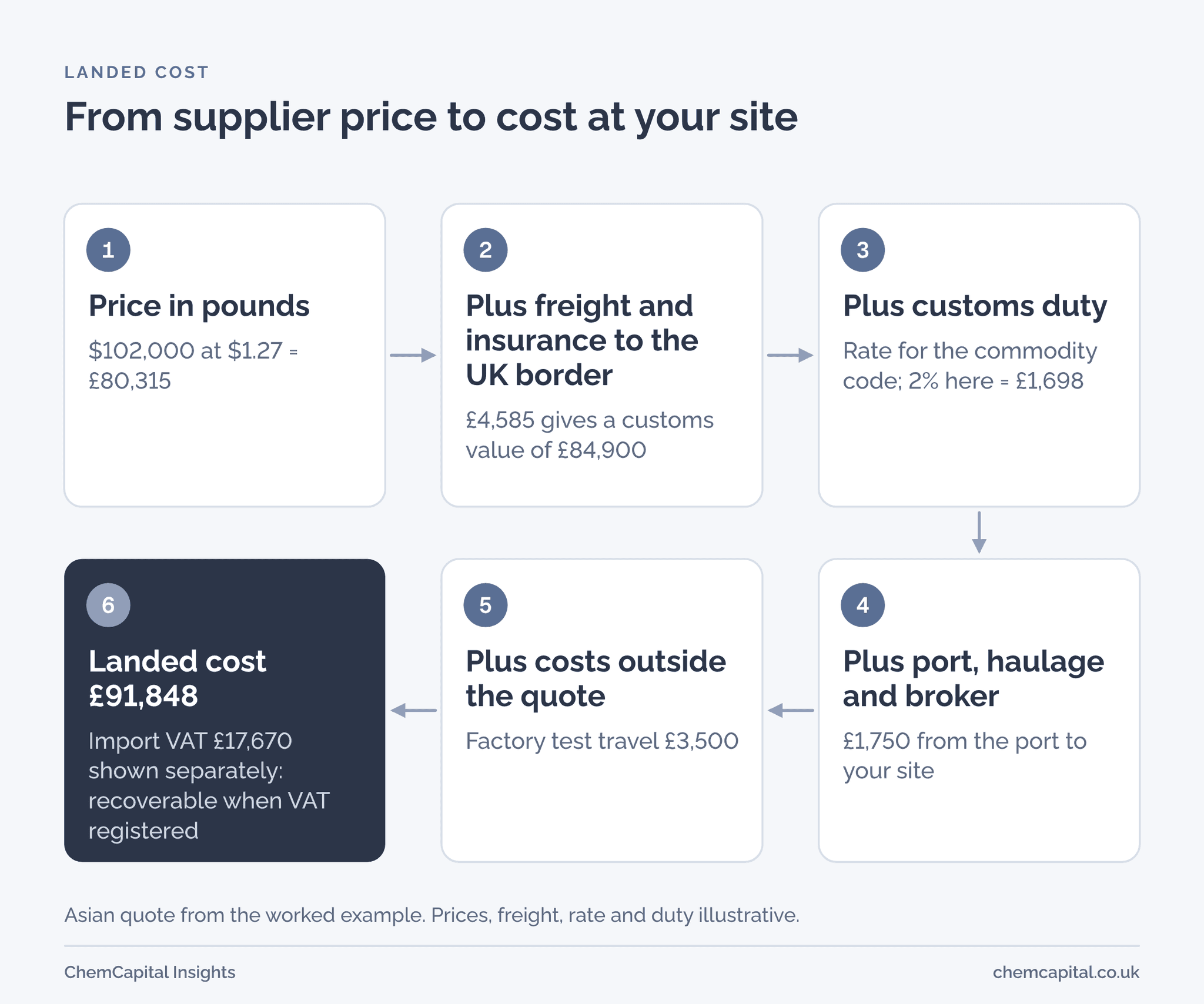
1. Price in pounds. Convert at the rate you expect to pay, not the rate on the day of the quote. Currency moves between order and payment are a cost too.
2. Customs value. For most imports, customs value starts from the price paid or payable for the goods when sold for export to the UK, known as Method 1. HMRC says this method is used for over 90% of imports liable to duty based on value [2]. The law then adds the cost of transport, insurance, loading and handling of the goods up to the time they are imported into the UK [3]. In practice, customs value is the price plus freight and insurance to the UK border.
3. Customs duty. Duty is the customs value times the rate for the goods' commodity code. Find the code and rate with the UK Trade Tariff tool, which also shows whether duty or VAT is payable and any reductions [4]. Goods that originate in the EU can claim preferential treatment under the Trade and Cooperation Agreement, which the UK government summarises as zero tariffs and quotas where goods meet the rules of origin [5]. The importer needs either a statement on origin made out by the exporter or its own knowledge that the goods originate [1].
4. Clearance, port and inland costs. Customs broker fees, port and terminal charges, and haulage from the port to your site.
5. Costs the quote leaves out. Travel for factory acceptance tests, extra inspection, packing upgrades for sea freight, and any spares you must stock because the supplier is far away. Our factory acceptance test checklist shows what a witnessed test involves.
Import VAT. Import VAT is charged at the same rate as for a UK supply [6], which for most goods is the standard 20% [7]. It is worked out on the customs value plus incidental costs to the first UK destination, such as transport, insurance and clearance, plus the duty [8]. A VAT registered business can use postponed VAT accounting to declare import VAT and reclaim it on the same VAT return [6], so it costs nothing in cash flow. A business that is not VAT registered pays it and cannot reclaim it [6].
Worked example: one skid, three quotes
A UK chemical plant needs a dosing skid. Three suppliers quote. All prices, freight, exchange rates and the duty rate are illustrative; check the commodity code and rate for your own goods.
| UK supplier | German supplier | Asian supplier | |
|---|---|---|---|
| Quoted price | £96,000 | €98,000 | $102,000 |
| Incoterm | DAP your site | FCA supplier's works | FOB Shanghai |
| Exchange rate used | not needed | €1.16 to £1 | $1.27 to £1 |
| Price in pounds | £96,000 | £84,483 | £80,315 |
German skid. Freight to the UK border is £2,600 and insurance 0.3% of price plus freight, £261. Customs value: 84,483 + 2,600 + 261 = £87,344. The supplier provides a statement on origin, so preferential duty of 0% applies. Add £1,200 inland haulage, £250 broker fees and £1,200 for a two day witnessed test visit.
Landed cost: 87,344 + 0 + 1,200 + 250 + 1,200 = £89,994.
Asian skid. Sea freight is $5,500, or £4,331, and insurance £254. Customs value: 80,315 + 4,331 + 254 = £84,900. Duty at an illustrative 2% is £1,698. Add £600 port charges, £900 inland haulage, £250 broker fees and £3,500 for test travel.
Landed cost: 84,900 + 1,698 + 600 + 900 + 250 + 3,500 = £91,848.
UK skid. Delivered price £96,000 plus £300 for a local test visit: £96,300.
| UK | Germany | Asia | |
|---|---|---|---|
| Price in pounds | £96,000 | £84,483 | £80,315 |
| Freight and insurance to UK border | included | £2,861 | £4,585 |
| Customs value | not applicable | £87,344 | £84,900 |
| Customs duty | none | £0 with origin proof | £1,698 |
| Port, haulage and broker | included | £1,450 | £1,750 |
| Test travel | £300 | £1,200 | £3,500 |
| Landed cost | £96,300 | £89,994 | £91,848 |
| Import VAT, recoverable | none at border | £17,759 | £17,670 |
The Asian quote was £4,168 cheaper than the German one at the supplier's gate, and £1,854 dearer at site.
What changes the ranking
- No proof of origin. If the German supplier cannot support a statement on origin, the same illustrative 2% duty would add about £1,747, and the gap almost closes. Ask for origin evidence in the RFQ.
- Currency. A 5% fall in the pound adds about £4,224 to the German quote and £4,016 to the Asian one. Fix the currency or the rate in the contract if the swing matters.
- Incoterm. An FCA or FOB price leaves freight, insurance and import risk with you. A DAP or DDP price moves some of that to the supplier, at a price. Our guide to Incoterms for process equipment compares the rules.
- Lead time and support. Six weeks more on the water, or a service engineer a flight away, has a cost even if it is not on an invoice. Weigh it with the life cycle cost of each quote.
- Tariffs elsewhere. If you export finished goods, or buy through a US parent, tariffs on the other side can matter too; see US tariffs on process equipment.
When each cost is paid
Landed cost is not paid in one go, and the timing matters for cash flow and for currency exposure.
| Cost | Usually paid |
|---|---|
| Supplier price | In milestones from order to delivery, often with a down payment at order |
| Freight and insurance | At or before shipment, by whoever the Incoterm makes responsible |
| Customs duty | At import, through your broker, or monthly if you hold a duty deferment account |
| Import VAT | Declared and reclaimed on the VAT return with postponed VAT accounting |
| Port, haulage and broker | On arrival, invoiced by the broker or forwarder |
| Test travel | Before shipment, when the factory acceptance test is witnessed |
Regular importers can set up a duty deferment account with HMRC, but it needs a bank guarantee [6]. If you import a few large items a year, it is usually simpler to let the broker pay and recharge you. Our guide to payment milestones and retention covers the supplier side of the timetable.
This is general information, not legal or tax advice; check the current HMRC guidance and the Trade Tariff before you rely on it.
Building landed cost into your bid comparison
Ask every bidder for the same data: price and currency, Incoterm and named place, country of origin and proof of origin, commodity code, packed weight and dimensions, and test and inspection arrangements. With that, a landed cost line takes minutes per bid.
ChemCapital's AI quotation comparison extracts price, currency, delivery terms and lead time from each quote, so you can see at a glance which bids need freight, duty and currency added before they can be compared with a UK delivered price.
Ready to compare UK and overseas quotes on the same landed basis? Start a free 14 day ChemCapital trial, with no credit card needed.
Frequently asked questions
How do you calculate the landed cost of imported equipment?
Convert the supplier's price to pounds, add freight and insurance to the UK border to get the customs value, add customs duty at the rate for the commodity code, then add clearance, port charges, inland haulage and costs such as test travel. Import VAT is usually recoverable for VAT registered businesses, so keep it out of the cost comparison.
Is UK customs duty charged on the price or on the CIF value?
On the customs value, which starts from the price paid for the goods and adds transport, insurance, loading and handling up to the time the goods are imported into the UK. In practice that is close to a CIF value at the UK border.
Do I pay import duty on equipment from the EU?
Goods that originate in the EU can claim preferential treatment under the UK and EU Trade and Cooperation Agreement, supported by a statement on origin from the exporter or the importer's own knowledge. Goods made elsewhere and shipped through the EU, or without origin evidence, pay the normal rate for their commodity code.
Can I reclaim import VAT on equipment?
A VAT registered business can normally reclaim import VAT as input tax, and with postponed VAT accounting it declares and reclaims it on the same VAT return, so no cash is paid at the border. A business that is not VAT registered cannot reclaim it.
Continue reading
Informational only, not procurement or legal advice. Cited names, frameworks, and statistics belong to their respective owners.
Create and manage RFQs in minutes
ChemCapital handles the entire procurement cycle, from structured RFQs and supplier comparisons to formal purchase orders and delivery tracking.
Start for freeRelated articles
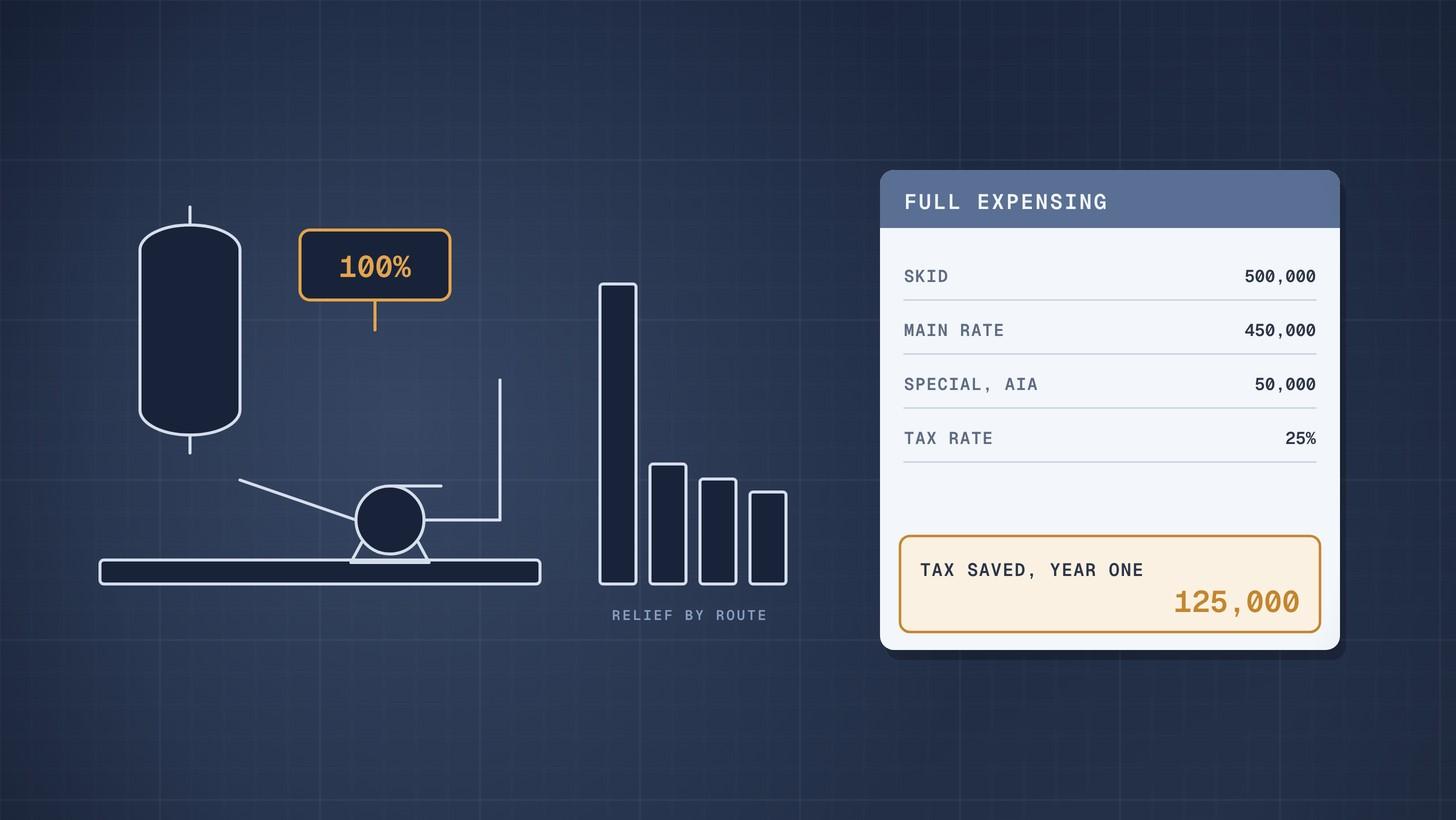
Full Expensing for Plant and Machinery: Worked Example (UK)
How full expensing, the annual investment allowance, first year allowances and writing down allowances apply to a £500,000 process skid, with the November 2026 rates.
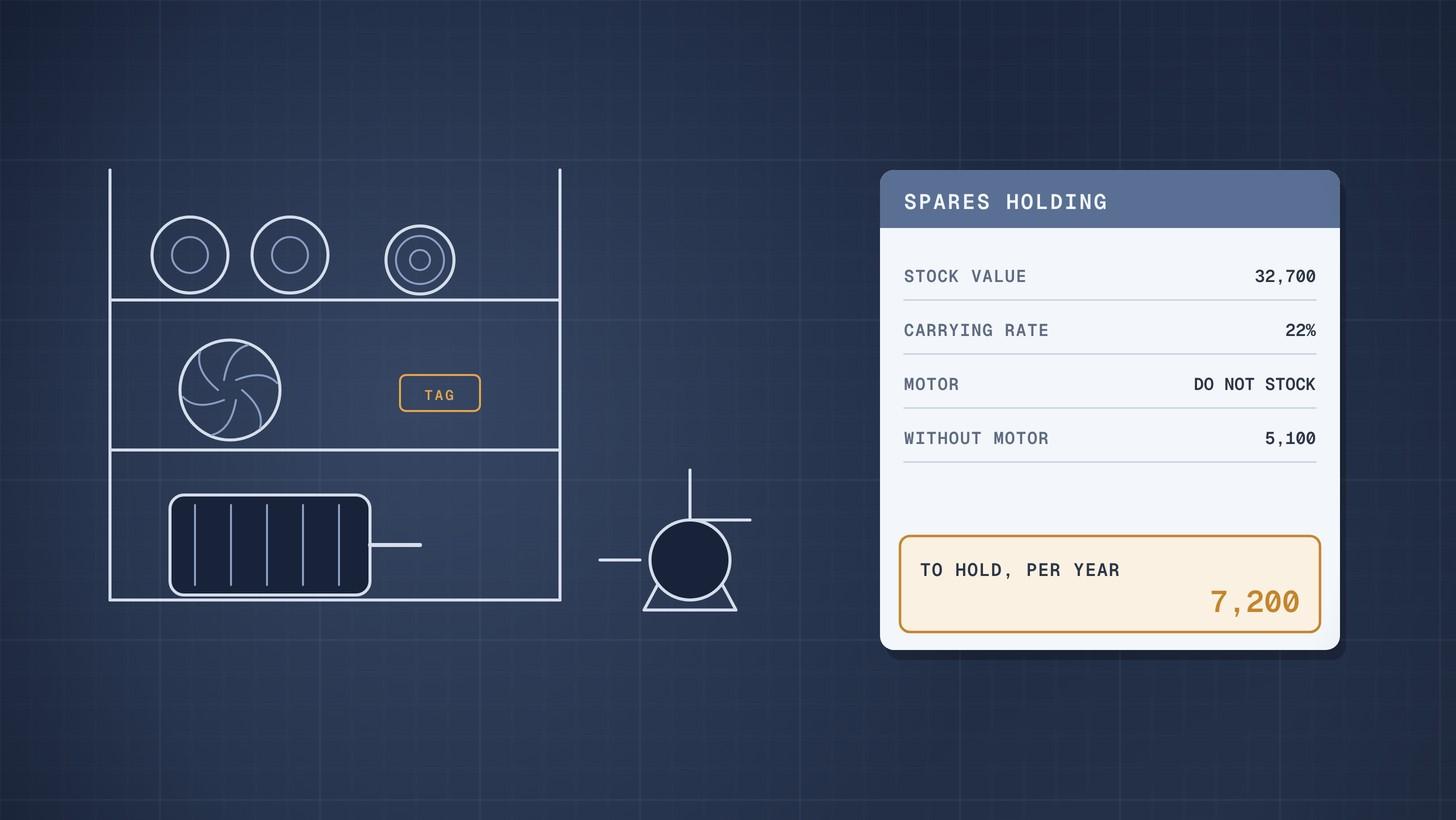
Spare Parts Carrying Cost: Worked Example
How to calculate the yearly carrying cost of spare parts, build your own carrying rate and decide which items on a recommended spares list are worth stocking.
Pump Total Cost of Ownership: Worked Example
How to calculate a pump's total cost of ownership with the Hydraulic Institute and Europump life cycle cost method, comparing two bids over 15 years in present value.