
316L vs 304 Stainless Steel for Welded Process Equipment
316L costs more because of nickel and molybdenum, and earns it in chlorides. 304 is fine for plenty of duties. Here is how to choose for welded equipment, and what the price gap really is.
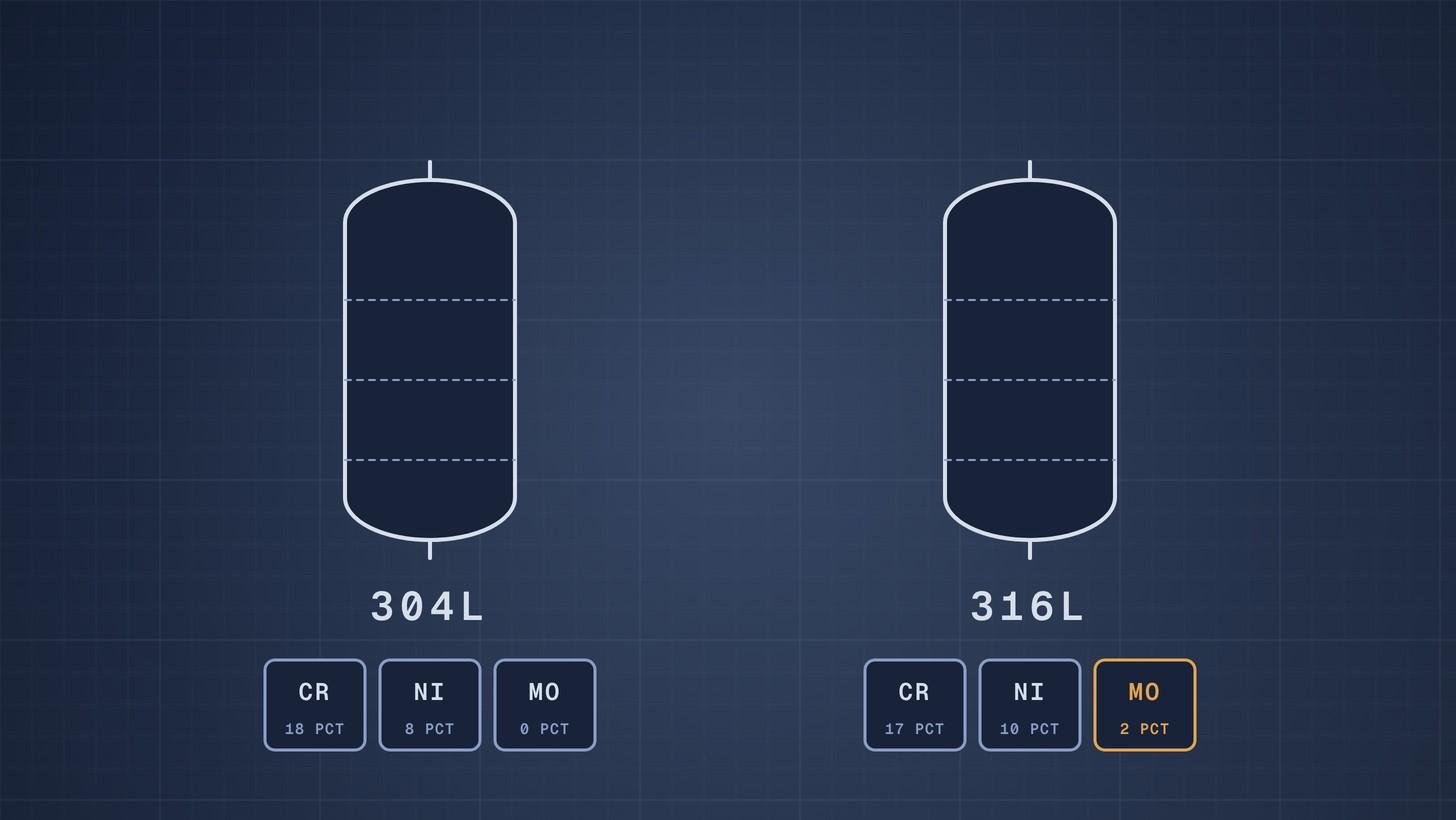
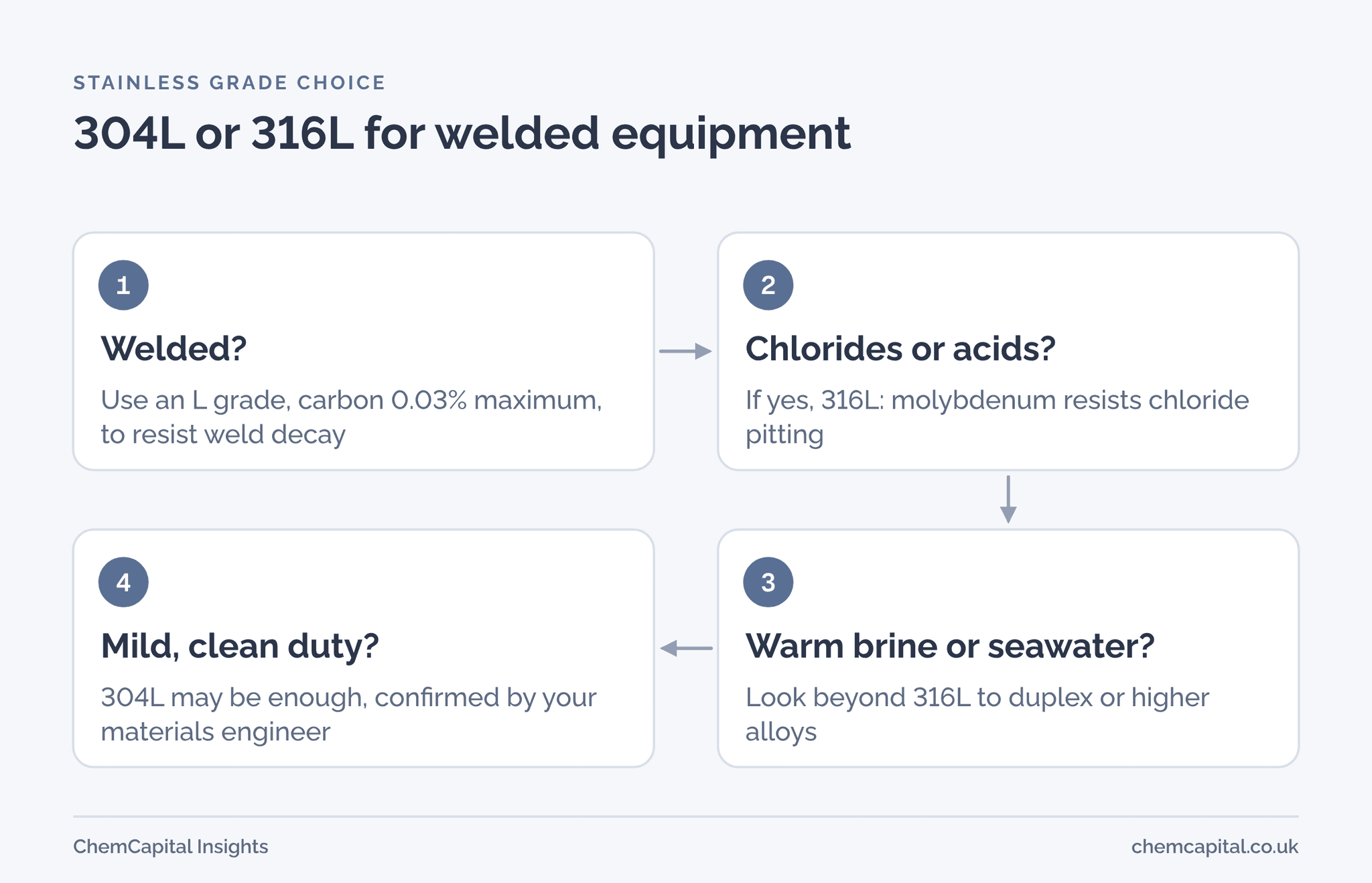
For welded process equipment, choose 316L when the duty involves chlorides, acids or a product contact specification that demands it, and accept 304L where the environment is mild and clean. The L means low carbon, which protects welds from weld decay; the 6 means molybdenum, which resists chloride pitting. You pay for the molybdenum and extra nickel through the alloy surcharge, so the right answer depends on the duty, not habit.
This guide covers the chemistry, weld decay, chlorides, the price gap, and a simple way to decide.
Why this matters now
Alloy surcharges move every month with nickel and molybdenum prices, and they are passed straight into equipment quotes. As of May 2026, Outokumpu's European surcharge for 304 flat products was €2,247 per tonne and for 316L €3,818 per tonne, a gap of €1,571 per tonne before any base price difference [1]. For June 2026 the figures quoted were $2,358 per tonne for 304, up $111, and $4,032 for 316L, down $214 [2]. The gap is large enough to matter on any vessel, and it changes, so check the current month. Our article on stainless steel and nickel prices in equipment quotes explains how surcharges flow into a quote.
Create and manage RFQs in minutes
ChemCapital handles the entire procurement cycle, from structured RFQs and supplier comparisons to formal purchase orders and delivery tracking.
The chemistry in one table
| Property | 304 | 316L |
|---|---|---|
| Chromium | 18.0 to 20.0% [3] | 16.0 to 18.0% [4] |
| Nickel | 8 to 10.5% [3] | 10.0 to 14.0% [4] |
| Molybdenum | none specified [3] | 2.0 to 3.0% [4] |
| Carbon | up to 0.08% for standard 304 [5] | 0.03% maximum [4] |
| PREN | about 19 [3] | about 24 for 316 [3] |
PREN, the pitting resistance equivalent number, is a rough ranking of resistance to pitting in chlorides, calculated as chromium plus 3.3 times molybdenum plus 16 times nitrogen for these grades [3]. The molybdenum term is why 316L ranks higher despite slightly less chromium.
Weld decay: why the L matters
When an austenitic stainless steel is welded, the heat affected zone passes through roughly 450 to 850 °C. Carbon combines with chromium to form chromium carbides at the grain boundaries, leaving chromium depleted zones that corrode in service. This is weld decay, or sensitisation [5].
Standard grades such as 304 and 316 allow up to 0.08% carbon and are susceptible. L grades cap carbon at 0.030%, which greatly reduces the risk, though prolonged time in the critical range can still sensitise them [5]. Where equipment runs hot in corrosive service for long periods, stabilised grades such as 321 and 347 are the alternative [5].
So for welded equipment the real comparison is usually 304L against 316L, not 304 against 316L. It is common for dual certified 316/316L material to meet the strength of the standard grade while keeping the low carbon content, through controlled nitrogen additions [4]. Ask for it, and say so on the purchase order.
If you need to prove sensitisation resistance, ASTM A262 is the standard test, with practice E, the Strauss test, the most common acceptance test for stainless piping [5].
Chlorides: where 304 fails
Chlorides attack the passive film locally and cause pitting and crevice corrosion. Molybdenum improves chloride pitting resistance, and makers describe 316L as having improved general and localised corrosion resistance compared with 304 and 304L [4]. Aperam lists very good resistance in acidic and chloride containing environments, and typical uses in chemical, pharmaceutical and food equipment [6].
Neither grade is a seawater material. A PREN above 40 is the usual marker for full resistance to localised corrosion in seawater [3], well above 316L. If your duty involves brine, warm chloride solutions or seawater cooling, the question is not 304 or 316L but whether you need a duplex or higher alloy. Ask the supplier for their material selection basis.
When 304L is enough
304L is a sound choice where chlorides are low and the service is mild. Typical examples are clean water and utility duties, dry powders and solids handling, structural parts and supports, and process fluids your materials engineer has confirmed are compatible. You can also consider 304L for parts that never touch product while keeping 316L for product contact, if your specification allows it.
The rule is to decide from the process, not from the price list. Write the grade into the datasheet with the reason, and get your materials or process engineer to confirm it for any duty with chlorides, acids or elevated temperature.
Practical example
Illustrative figures. A welded process vessel uses 2.0 tonnes of stainless plate. The fabricator's total price in 316L is €60,000.
| Item | Value |
|---|---|
| Surcharge gap, May 2026 [1] | €3,818 minus €2,247 = €1,571 per tonne |
| Plate weight | 2.0 tonnes |
| Surcharge difference on the plate | €3,142 |
| As a share of the vessel price | about 5% |
So choosing 304L instead of 316L might save about 5% on this vessel, before any base price difference. If the duty has chlorides, that 5% buys years of service. If it does not, it is money you did not need to spend. Either way, make it a decision, record the reason on the datasheet, and revisit it when the process conditions change, because a later switch to a chloride containing cleaning agent can turn a sound 304L choice into a corrosion problem.
Things that matter as much as the grade
A good grade badly fabricated still corrodes. Before you spend on a higher alloy, check that these are covered:
- Weld quality and heat tint. Discoloured heat tint on the inside of a weld is a weaker oxide layer. Specify how it is removed and what level of discolouration is acceptable.
- Crevices. Lap joints, poor gasket seats and partial penetration welds trap liquid. Chlorides concentrate in crevices, so good design can do as much as an extra percent of molybdenum.
- Iron contamination. Carbon steel tools, grinding discs and handling in a mixed workshop leave iron on the surface that rusts and starts pitting. Ask how the fabricator segregates stainless work.
- Surface treatment. Pickling and passivation restore the passive layer after fabrication; electropolishing adds a smoother surface. Specify which, and how it is verified.
- Operating conditions. Temperature, concentration and stagnant periods change corrosion behaviour. A grade that is fine at 20 °C in flowing liquid may pit at 60 °C in a dead leg.
Common mistakes when specifying stainless
- Writing "316" when you mean "316L". For welded equipment the difference is the carbon limit. Write the full grade, or 316/316L if you want dual certified material.
- Accepting a substitution without asking. A supplier who offers 304L in place of 316L to win on price should say so in a deviation list, not in the small print.
- Mixing grades on one item. Bolting, small fittings and instrument connections in a different grade can become the weak point. Name the grade for each part.
- Ignoring the surcharge month. Two bids a month apart can differ by hundreds of euros a tonne for the same grade.
If you are the supplier
State the grade, the certificate type and the surcharge basis clearly in your offer. If you believe 304L would serve the duty, say so as an alternative with your reasoning, rather than substituting it. Buyers trust a supplier who saves them money openly.
What to put in the RFQ
- The grade, with dual certification if you want L carbon and standard strength, for example 316/316L.
- The material certificate type; see our guide to EN 10204 3.1 and 3.2 certificates.
- Positive material identification if mixing grades is a risk; see PMI testing in the purchase order.
- Surface finish and post weld treatment; see passivation versus electropolishing.
- How the alloy surcharge will be applied and which month's surcharge the price is based on.
When bids arrive in different grades or with different surcharge months, ChemCapital's AI quotation comparison puts the grade, certificate and surcharge basis side by side so you compare like with like.
Where ChemCapital fits
Material choice changes price more than most buyers expect. Seeing it clearly across bids is the first step to spending on corrosion resistance only where the process needs it.
Ready to compare stainless equipment bids on grade and surcharge, not just headline price? Start a free 14 day ChemCapital trial, with no credit card needed.
Frequently asked questions
What is the difference between 304 and 316L stainless steel?
316L contains 2 to 3% molybdenum and more nickel, which improves resistance to chloride pitting, and its carbon is limited to 0.03%, which protects welds from weld decay. 304 has no specified molybdenum and standard 304 allows up to 0.08% carbon.
Is 316L better than 304 for welding?
For corrosion after welding, the L matters more than the 316. Low carbon grades, 304L and 316L, resist weld decay much better than standard 304 and 316. Choose between 304L and 316L by the corrosion duty.
When is 304 stainless enough?
Where chlorides are low and the service is mild, such as clean water, utilities, dry solids and structural parts, and where a materials engineer has confirmed compatibility. For welded parts use 304L.
How much more does 316L cost than 304?
It varies monthly with the alloy surcharge. In May 2026 Outokumpu's European surcharge was €3,818 per tonne for 316L against €2,247 for 304, a gap of €1,571 per tonne before base price differences.
Is 316L suitable for seawater?
Generally not for immersion in warm seawater. Full resistance to localised corrosion in seawater is usually associated with a PREN above 40, well above 316L. Duplex or higher alloys are typically considered.
Continue reading
Informational only, not procurement or legal advice. Cited names, frameworks, and statistics belong to their respective owners.
Create and manage RFQs in minutes
ChemCapital handles the entire procurement cycle, from structured RFQs and supplier comparisons to formal purchase orders and delivery tracking.
Start for freeRelated articles
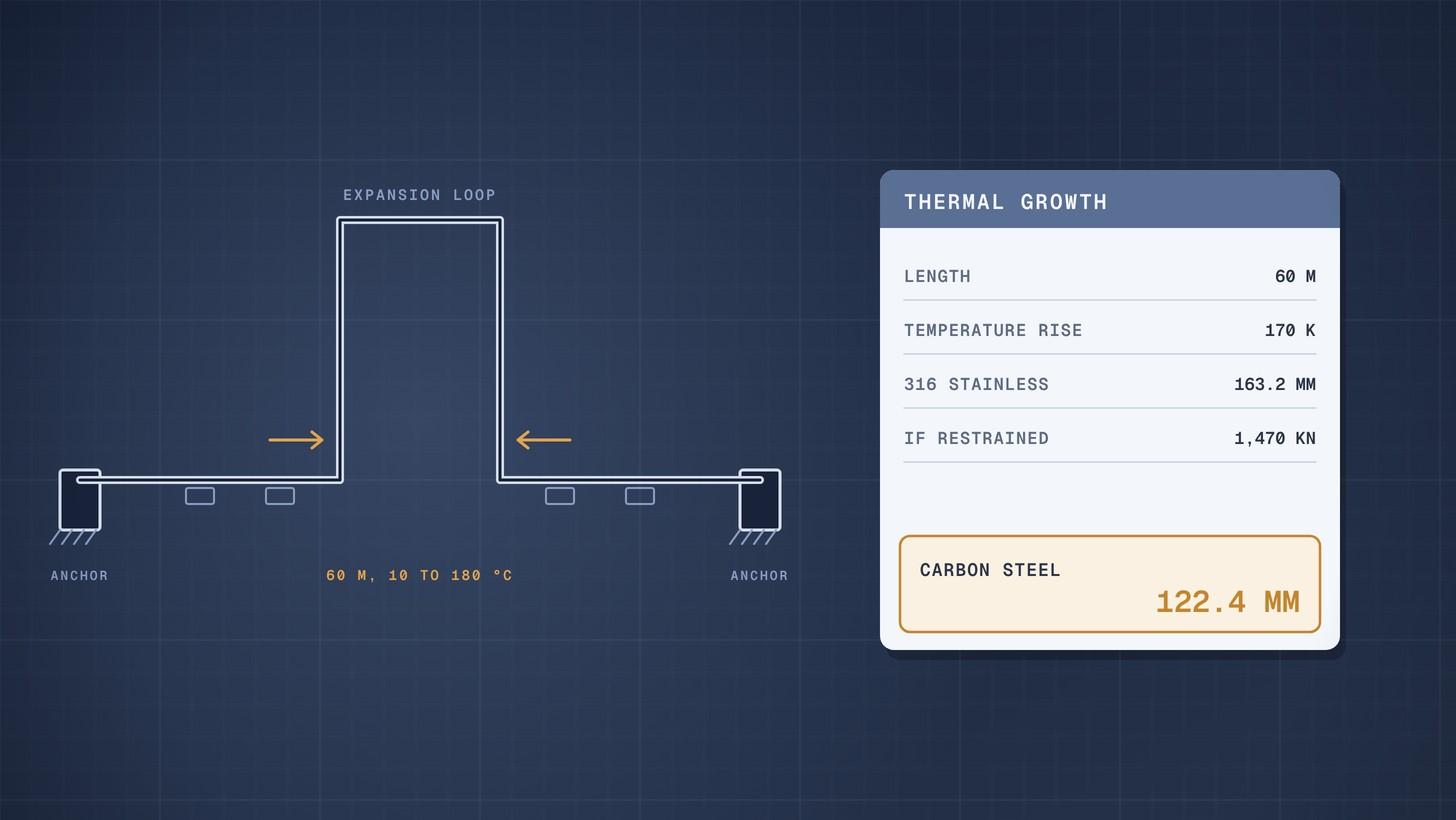
Pipe Thermal Expansion: Worked Example
How to calculate pipe thermal expansion for carbon and stainless steel, what restrained expansion does, and how loops and expansion joints absorb it.
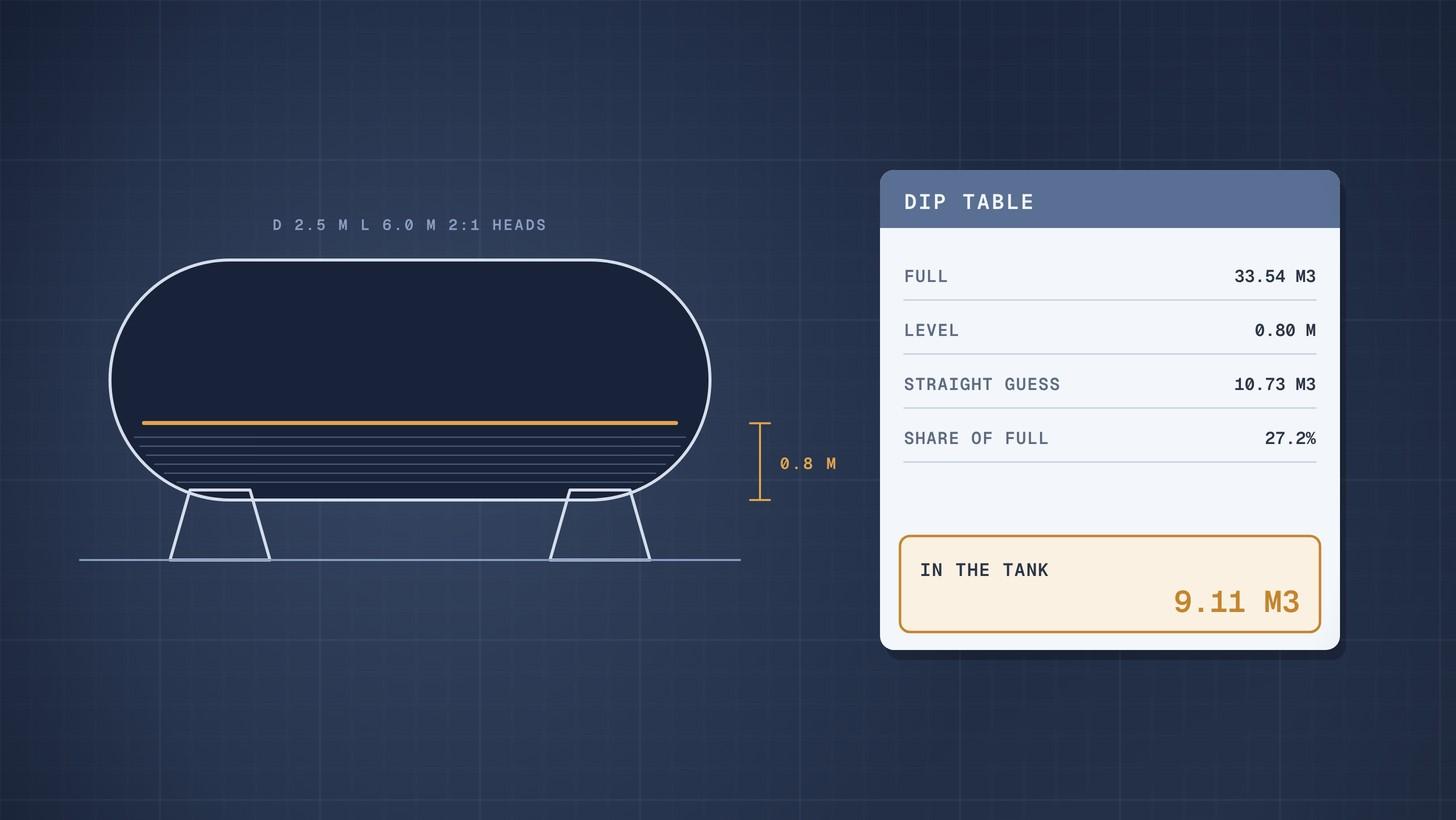
Horizontal Tank Volume When Partly Filled: Worked Example
How to calculate the volume of a partly filled horizontal tank with dished heads, with a worked example and a full dip table you can rebuild in a spreadsheet.
Cooling Water Flow Calculation: Worked Example
How to calculate cooling water flow from heat duty and temperature rise, then size the cooling tower circulation, evaporation and make up water.