
AI Quote Comparison: What It Reads, What It Misses and How to Check It
How AI tools read and score supplier quotes, the eight places they go wrong on engineered equipment, and the five checks to run before you trust the table.
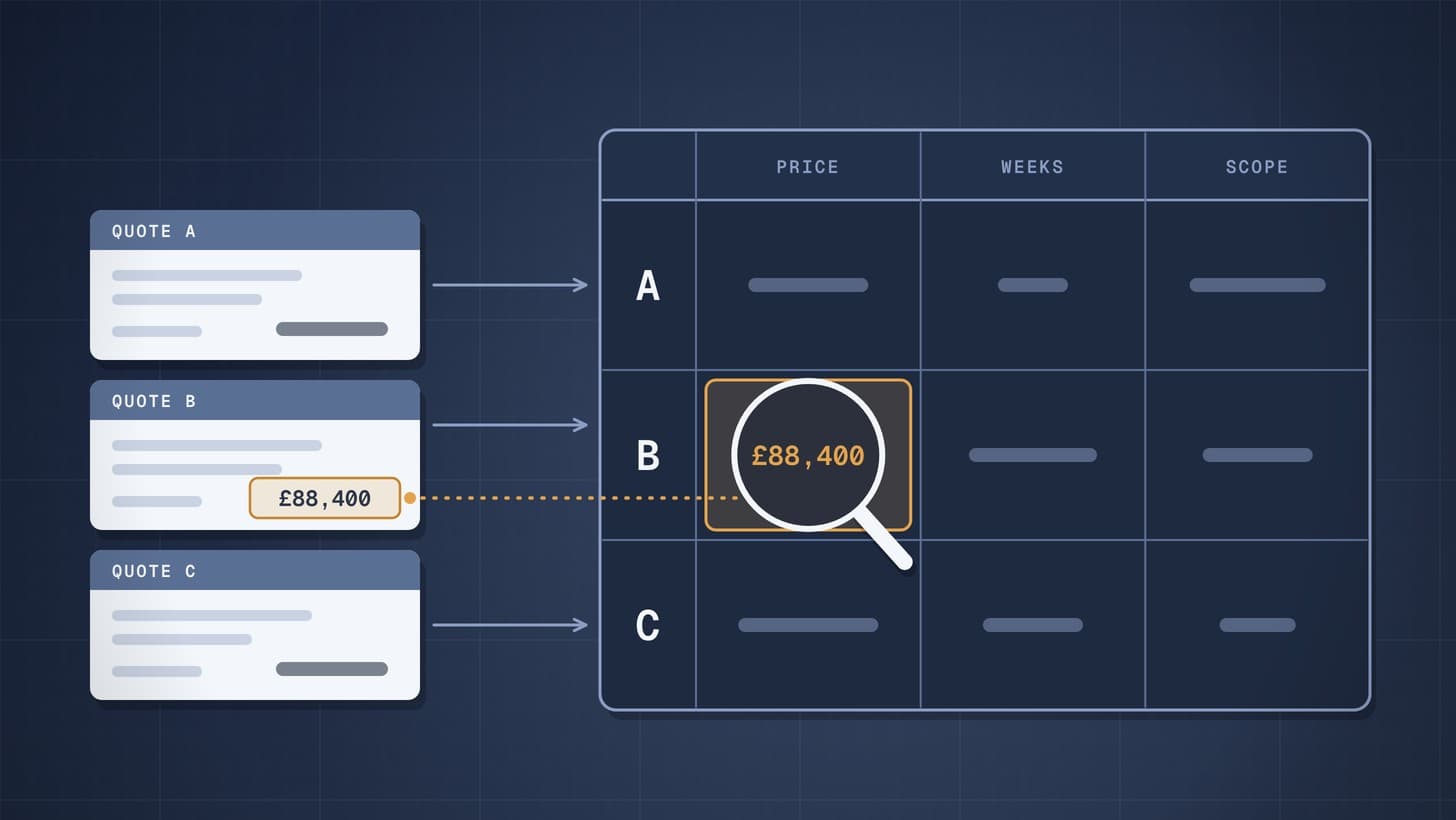
An AI quote comparison tool reads each supplier's quote, pulls out price, delivery time, payment terms, validity and listed exclusions, and lays them side by side in one table, usually in minutes. That reading and retyping is what it does well. It cannot judge what a quote leaves unsaid: whether the scope matches your datasheet, whether a deviation matters, whether the supplier can deliver. Those judgements stay with the buyer and the engineer, and so does the decision.
Engineered equipment widens the gap, because the price sits on one page, the exclusions in the general notes and the deviations in a covering letter. Whether a product is sold as quote comparison, quote matching or an autonomous agent, the work underneath and the failure points are usually the same.
Why this matters now
Read together, the guidance points to two things: check what the AI produces, and own the method.
The US National Institute of Standards and Technology (NIST) published its voluntary AI Risk Management Framework 1.0 in January 2023 for organisations in any sector that design, develop, deploy or use AI systems [1]. In the April 2024 draft of its Generative AI Profile, NIST lists confabulation among the risks: the system confidently presents wrong or invented material while trying to answer the prompt [2]. The final profile, a voluntary, cross sector companion to the framework, followed in July 2024 [3].
For UK public buyers, section 23 of the Procurement Act 2023 says award criteria must relate to what is being bought, be clear, measurable and specific enough, and be proportionate. The authority must explain how tenders will be assessed, whether failing a criterion disqualifies a tender and, with several criteria, their relative importance, for example as percentage weightings [4]. The 2024 Cabinet Office guidance on assessing competitive tenders asks authorities to scenario test their method and weightings, and does not mention automated tools or AI [5]. So the buyer, not the tool, explains the method and stands behind the result. Private buyers are not bound by the Act, but the discipline transfers. This is general information, not legal advice.
Create and manage RFQs in minutes
ChemCapital handles the entire procurement cycle, from structured RFQs and supplier comparisons to formal purchase orders and delivery tracking.
How AI quote comparison works, in three steps
1. Extraction. The tool pulls named fields from each file: prices and line items, currency, delivery time and terms, payment terms, validity, materials, certificates and listed exclusions. Scanned pages first need optical character recognition (OCR), which turns a picture of text into text and can misread digits.
2. Normalisation. It brings every quote to one basis: one currency at a stated rate, one delivery point, the same units. Incoterms 2020, in effect since 1 January 2020, are eleven three letter trade terms reflecting business to business practice in contracts for the sale of goods [6]. A price at the supplier's works and a price delivered to site are different prices, so the tool needs your rule for adding freight.
3. Scoring. It scores each quote against weighted criteria such as commercial, technical, delivery, compliance and risk. A good tool treats must have requirements as a gate, flagging a failing quote whatever its price. Ask how price is scored: the Cabinet Office guidance warns that relative price scoring, where a supplier's score depends on the lowest tender, can harm value for money, and says life cycle cost should generally be used rather than purchase price alone, except for basic purchases [5].
Every failure below starts in the first two steps, which is why a precise looking ranking can still be wrong.
Where AI quote comparison goes wrong on equipment quotes
Each supplier answers the datasheet in its own format, so look for these.
| Failure | Example | How to catch it |
|---|---|---|
| Scanned or image only PDFs | An 8 read as a 3 turns £48,500 into £43,500 | Check totals against the source page; ask for text PDFs |
| Exclusions buried in general notes | "Insulation and foundations by others" in general note 14 | Read the notes; search every file for "by others" |
| Options priced separately | Witnessed test and spares outside the headline price | Mark each option required or not; add required ones to every column |
| Units or duty points not matching the datasheet | 1,050 kW rated against a 1,200 kW duty; flow in US gallons per minute | Engineer checks duty, fluids, conditions and units against the datasheet |
| Currency and Incoterms basis | Euros at the supplier's works against sterling delivered to site | Fix one exchange rate and delivery point before opening quotes |
| Validity dates and price adjustment clauses | Valid 30 days; stainless steel surcharge at dispatch | Compare validity with your award date; flag any adjustment formula |
| Deviations in a separate letter | Covering letter offers 316 tubes, not the 316L specified | Upload every document; ask for a clause by clause deviations list |
| Confident wrong answers (confabulation) | A 12 week lead time found nowhere in the quote | Trace each figure to its page; treat any without a source as unconfirmed |
A five point check before you trust the table
Treat the AI table like a reading from an online analyser: fast, usually close, and still checked against a lab sample before anyone acts on it. These five checks cover every failure above.
- Trace every figure to its page. Find each price, lead time and validity date in the supplier's document. A figure you cannot find is unconfirmed, however confident the table looks.
- Account for every file, note and letter. Confirm the tool read everything each supplier sent, then read the general notes and covering letter yourself.
- Put every column on one basis. One currency and rate, one delivery point, required options added, validity beyond your award date. Our quotation comparison sheet sets out the levelling rows for checking by hand.
- Have the engineer check duty and scope against the datasheet. Duty point, fluids, design conditions, units, materials, design code and certificates. This is technical judgement, and it stays with a person.
- Test the weights and record the method. See whether the ranking moves when the weights do. For a public tender, the Cabinet Office guidance suggests scenario testing the method and weightings [5]; do it when you set them, before tenders arrive. A ranking that flips with a small change rests on judgement, not arithmetic. Record the weights, the rate and each adjustment with its source page.
 An AI table is a first draft; the five checks decide whether you can rely on it.
Spreadsheet, general chatbot or purpose built tool
| Criterion | Spreadsheet | General chatbot | Purpose built tool |
|---|---|---|---|
| Effort | High: every figure typed by hand | Low at first; you rebuild the prompt and table each time | Low once set up: fixed fields, weights and gates |
| Traceability | Good if you note each figure's page | Weak unless it shows the source text | Should show each field's source and log changes |
| Data handling | Stays wherever you store the file | Set by the account type and its terms | Set by the vendor's terms; ask the questions below |
| Best for | One package, two or three quotes | A quick summary of one long quote | Repeated packages you must defend |
Whichever you use, the five checks still apply. A spreadsheet hides its errors in the typing; an AI tool hides them in the extraction.
Data protection: questions to ask any AI tool
Quotes carry commercially confidential prices and personal data, often the names and contact details of the supplier's staff. Check that your RFQ or confidentiality terms allow sharing with an outside tool, then ask the vendor:
- Where do the files go? Which country hosts them, and which other companies process them.
- How long are files and extracted data kept, and can you delete them?
- Are uploads used to train models? The UK Information Commissioner's Office (ICO) says using a customer's data later to train a model for a different purpose generally needs the data owner's agreement or a separate arrangement [7].
- Who is controller and who is processor? For the ICO this turns on who actually decides the purposes and means of each processing activity, not only the contract. A deployer of a closed model may lack meaningful control and should get the information it needs from the developer [7].
The ICO expects organisations to document their roles and reasoning, for example in records of processing and data protection impact assessments (DPIAs), and stresses that the page is a consultation, not a statement that any processing is compliant [7]. This is general information, not legal advice.
ChemCapital hosts data in AWS London with role based access and multi factor authentication, and describes its controls on its security and trust pages. Ask us the same questions.
Practical example
A buyer needs one shell and tube heat exchanger: 1,200 kW duty, 316L tubes, EN 10204 3.1 material certificates, a witnessed hydrostatic test and commissioning spares, on site within 24 weeks for a planned shutdown. Rules fixed before opening: £0.86 per euro, every price delivered to site, award in six weeks. All figures are illustrative.
The first AI table ranked Supplier C first at £79,900 delivered in 12 weeks, A second at €96,000 from its works (£82,560), ready in 21 weeks, and B last at £88,400 delivered in 20 weeks. The only exclusion it found was C's spares. The five checks changed that.
- Trace every figure. C's 12 weeks is not in its quote. C offers drawings 3 weeks after order and delivery 22 weeks after approval: 26 weeks with a week to approve, two weeks late. C could not do better.
- Every file and note. A's covering letter had not been uploaded. It excludes the witnessed test, offered at €2,400, and offers 316 tubes instead of 316L. B's general note 11 prices the 3.1 certificates at £1,200 extra.
- One basis. The buyer's forwarder quoted £3,400 and a week in transit for freight and insurance from A's works. C's spares went in at C's option price of £2,300. A's price is valid for 30 days with a stainless steel surcharge at dispatch, so it lapses before award and could rise; B's is firm for 90 days.
- Engineer check. The engineer rejected 316 tubes; A requoted 316L at €2,600 extra. A and B both meet the duty at datasheet conditions.
- Weights and record. B is now cheaper, sooner and on firmer terms than A, so in this example no choice of weights puts A ahead. The buyer recorded the rate and each adjustment with its source page.
| Line | Supplier A | Supplier B | Supplier C |
|---|---|---|---|
| First AI table price, £ | 82,560 | 88,400 | 79,900 |
| First AI table lead time, weeks | 21 | 20 | 12 |
| First AI rank | 2 | 3 | 1 |
| Missing required items, £ | 2,064 | 1,200 | 2,300 |
| Freight and insurance to site, £ | 3,400 | 0 | 0 |
| 316L tubes instead of 316, £ | 2,236 | 0 | 0 |
| Checked price, £ | 90,260 | 89,600 | 82,200 |
| Checked weeks to site | 22 | 20 | 26 |
| Checked rank | 2 | 1 | Out on delivery |
A's extras are €2,400 × 0.86 = £2,064 and €2,600 × 0.86 = £2,236. The tool's first choice could not meet the shutdown, and its last choice won by £660. The tool did the reading quickly; the checks found what it had invented, missed or never been given.
Try AI quote comparison on your own quotes
ChemCapital's AI Quotation Comparison takes up to three quotes per comparison. It extracts price, lead time, materials, certifications and scope, scores commercial, technical, delivery, compliance and risk with adjustable weights, and flags mandatory fails regardless of price. Nothing is saved until a person has reviewed it, and results export to Excel. The five checks still stay with you.
Open the free sample comparisons on the AI quotation comparison page, or upload two or three of your own quotes and run the checks on the result. For the manual method behind a levelled price, see commercial bid evaluation.
Ready to compare your next equipment package in minutes and check it properly? Start a free 14 day ChemCapital trial, with no credit card needed.
Frequently asked questions
What is the best tool for comparing supplier quotes?
There is no single best tool: a spreadsheet suits one package with two or three quotes, and a purpose built tool suits repeated packages where every figure must be traced to its source and the award defended. Whichever you choose, trace each figure to the quote and have an engineer check scope against the datasheet before you rely on the ranking.
Can AI analyse supplier quotes instantly?
It can pull prices, lead times, terms and listed exclusions into one table in minutes. On engineered equipment it can still miss exclusions in general notes, deviations in covering letters and duty mismatches, and it can state figures that are not in the quote, so treat the table as a draft until it has been checked.
Is it safe to upload supplier quotes to an AI tool?
Quotes hold confidential prices and often personal data such as the names and contact details of suppliers' staff, so check your confidentiality terms first, then ask where files are stored, how long they are kept, whether uploads train models and who is controller. In a consultation, the UK ICO says controllership depends on who actually decides the purposes and means of the processing, not only on the contract. This is general information, not legal advice.
Can AI be used to evaluate tenders under the Procurement Act 2023?
Section 23 requires authorities to explain how tenders will be assessed and, where there is more than one criterion, their relative importance, and the Cabinet Office guidance on assessing tenders does not mention AI. Whatever tool helps prepare the comparison, the authority still explains the method and owns the result. This is general information, not legal advice.
Continue reading
Informational only, not procurement or legal advice. Cited names, frameworks, and statistics belong to their respective owners.
Create and manage RFQs in minutes
ChemCapital handles the entire procurement cycle, from structured RFQs and supplier comparisons to formal purchase orders and delivery tracking.
Start for freeRelated articles
How to Ask for Feedback on a Lost Equipment Tender (With Email Template)
How equipment suppliers should ask for a debrief after losing a bid: when to ask, what to ask, what buyers can and cannot share, and how to use the answers. Includes a short email template.
Bid or No Bid? A Scorecard for Engineered Equipment RFQs
A simple bid or no bid scorecard for equipment suppliers: the gates to check first, seven weighted criteria, a worked example and a template you can copy.
Equipment Quotation Template: A Proposal Buyers Can Compare
A ten section quotation template for engineered equipment suppliers: cover letter, scope and battery limits, compliance and deviations, price schedule, delivery, commercial terms, exclusions and documents.