
Ball Valve vs Butterfly Valve: How to Choose for Process Plant
Ball or butterfly valve? How they compare on shut off, pressure drop, size, weight, cost, throttling, actuation and cleaning, where each is used in process plant, and a worked cost example.
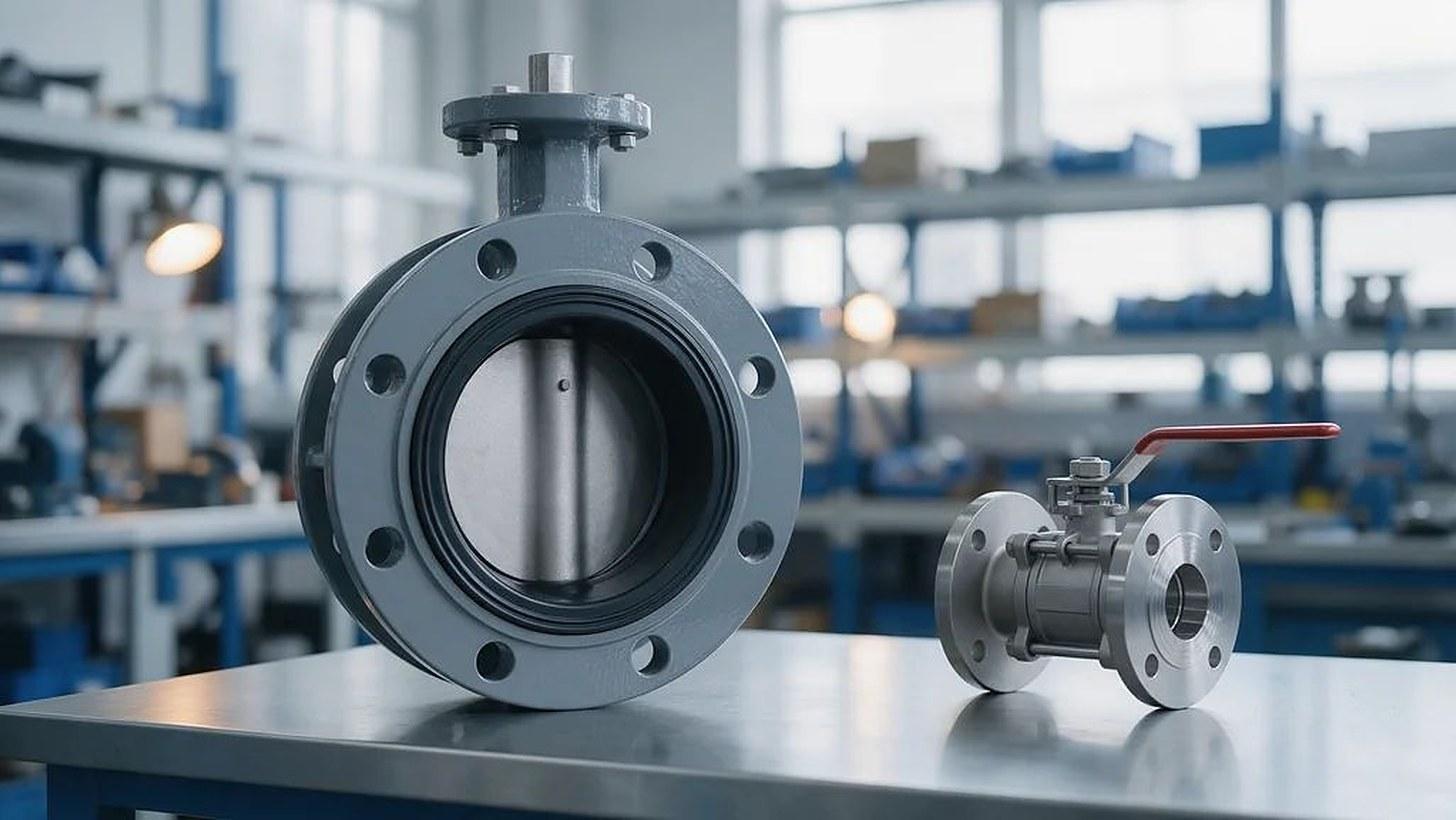
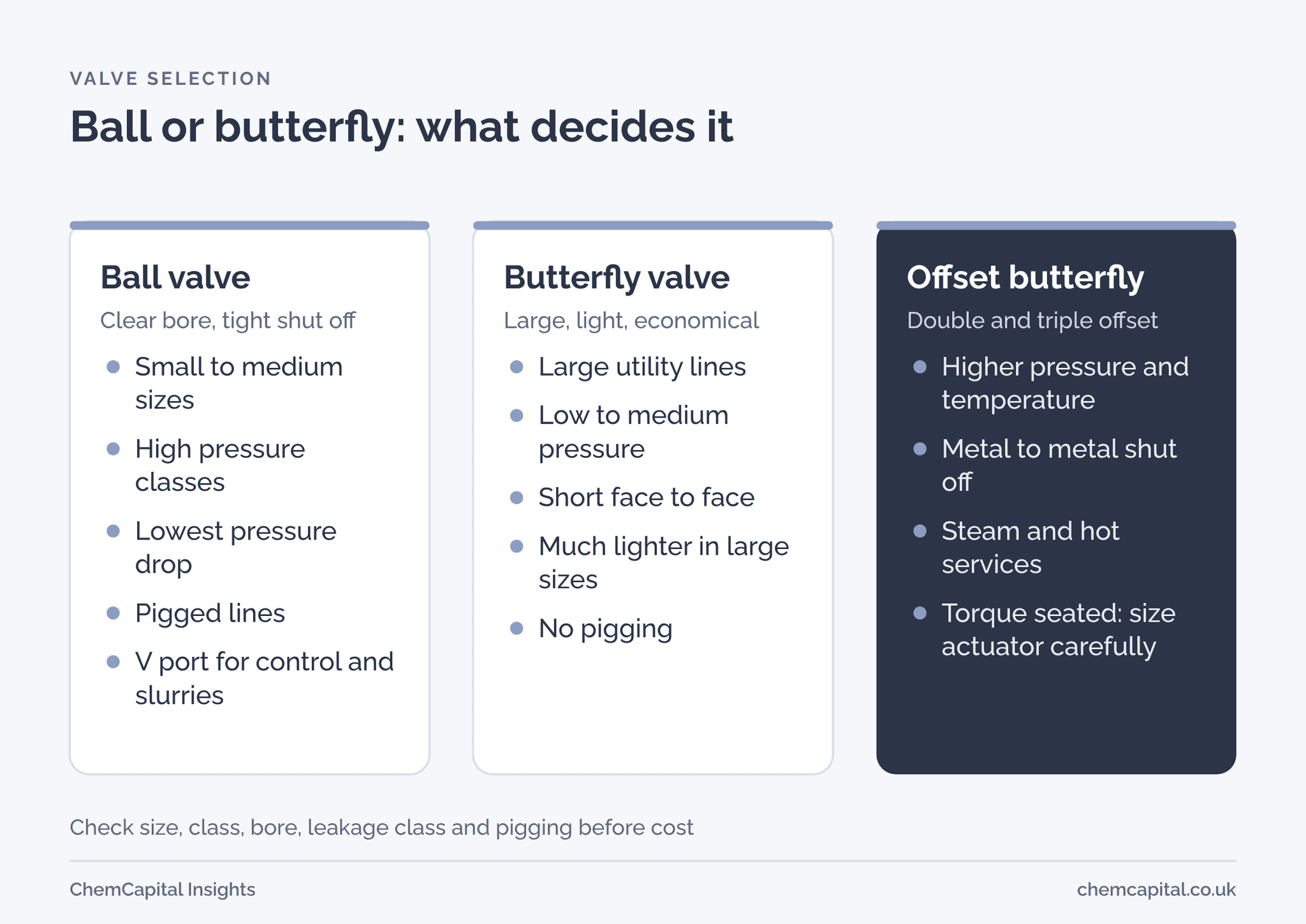
Choose a ball valve when you need tight shut off, a full bore with very low pressure drop, high pressure, or a line that must be pigged, especially in sizes up to about 12 inches. Choose a butterfly valve for large lines, low to medium pressure, tight spaces and tight budgets, where a disc in the flow path does no harm. High performance and triple offset butterfly valves stretch that choice into higher pressures and temperatures.
How each valve works
Both are quarter turn valves. A ball valve has a ball with a hole through it; rotating the ball through 90° opens and closes the valve [1]. In a full bore design the hole matches the pipe, so the open valve is almost a piece of straight pipe; reduced bore designs are cheaper but add pressure drop [1].
A butterfly valve has a disc on a shaft across the pipe. When open, the disc sits edge on to the flow and the fluid passes around it [1]. The body is short, and many designs fit between pipe flanges as a wafer [1].
Create and manage RFQs in minutes
ChemCapital handles the entire procurement cycle, from structured RFQs and supplier comparisons to formal purchase orders and delivery tracking.
Side by side
| Factor | Ball valve | Butterfly valve |
|---|---|---|
| Typical sizes | About ½ inch to 60 inch | About 2 inch to 120 inch and above |
| Pressure classes | Class 150 to 2500 | Generally Class 150 to 600; triple offset up to Class 2500 |
| Shut off | Very tight with soft seats | Resilient seated: bubble tight at low pressure; triple offset: tight metal to metal |
| Pressure drop | Very low with full bore | Slightly higher; the disc stays in the flow |
| Weight and length | Heavy, long body in large sizes | Light, very short face to face |
| Pigging | Possible with full bore | Not possible |
| Throttling | Standard ball poor; V port ball good | Possible with suitable disc design |
Sizes, classes and the pigging, weight and pressure drop comparisons are from Projectmaterials [2]; shut off by butterfly type is from Bray [3].
Shut off and leakage
Both can achieve tight shut off, but in different ways. A soft seated ball valve seals well in clean service; seat material sets the temperature limit, with PTFE seats rated to about 200 °C and PEEK to about 250 °C in Spirax Sarco's table, and metal seats far higher [1]. A concentric butterfly valve with a resilient elastomer seat gives bubble tight shut off, but Bray describes it as the economical choice for lower pressures, under 250 psi, at ambient temperatures [3].
For harder duties, offset designs move the shaft so the disc cams into the seat over the last few degrees of closing [1]. A double offset, or high performance, butterfly valve reaches Class 600 in Bray's range, and a triple offset valve seals metal to metal, which allows bubble tight shut off at high temperatures [3]. If you specify a seat leakage class, read our guide to valve seat leakage classes first.
Pressure drop, size and cost
The ball valve's advantage is the clear bore. The butterfly valve's disc always sits in the flow, giving a slightly higher pressure drop than a full bore ball valve [2].
In large sizes the butterfly valve wins on weight, length and price. Projectmaterials quotes a 24 inch Class 150 wafer butterfly valve at about 250 kg against about 1,200 kg for a trunnion ball valve, and a price of roughly 30 to 40% of the ball valve at that size [2]. Lighter valves also need smaller actuators and less pipe support.
Control and throttling
Standard ball valves are not recommended for throttling [2]. A segmented or V port ball valve is different: the V shaped opening gives a nearly equal percentage characteristic, and the edge can shear solids, which suits slurries and fibrous fluids [4]. Butterfly valves can throttle with the right disc design [2], and eccentric designs are used for throttling [1]. For a true control duty, size the valve properly; our article on control valve sizing explains how.
Actuation
Because both are quarter turn valves, both take the same families of actuator: manual levers and gearboxes, pneumatic rack and pinion or scotch yoke actuators, and electric actuators. The differences are in torque. A ball valve's soft seats grip the ball, so breakaway torque can be high after the valve has sat in one position, especially in large trunnion designs. Offset butterfly valves are designed to reduce seat friction during travel [3], but triple offset valves are torque seated, so the actuator must deliver the seating torque to achieve shut off.
In practice, ask each supplier for the valve's breakaway, running and seating torques under your pressure and temperature, and the safety factor applied in sizing the actuator. State the fail position you need (fail open, fail closed or fail in place) and any partial stroke testing requirement. An undersized actuator is a common cause of a valve that will not close fully, which is the one thing an isolation valve must do.
Hygiene and cleaning
In clean services, the ball valve's cavity between ball and body can hold process fluid, leading to contamination and corrosion; Spirax Sarco recommends cavity fillers in clean steam systems [1]. Hygienic butterfly valves are common in dairy, food, beverage and brewery lines, and handle liquids with particles because the restriction is small [5]. For sterile pharmaceutical service, neither is usually the first choice; see our guide to diaphragm valves for hygienic service.
Where each is used in process plant
- Ball valves: isolation in small bore process lines, high pressure gas, hydrocarbons, steam and condensate (Spirax Sarco notes ball valves have largely replaced butterfly valves for steam [1]), lines that need pigging, and slurries with V port designs.
- Butterfly valves: cooling water, fire water, large utility headers, wastewater, HVAC, and with offset designs, steam distribution and higher temperature services [3].
Practical example
Illustrative figures. A project needs ten 24 inch Class 150 isolation valves on a cooling water header. The quoted trunnion ball valve price is £12,000 each. Using Projectmaterials' rule of thumb of 30 to 40% [2]:
| Item | Ball valve | Butterfly valve |
|---|---|---|
| Price each | £12,000 | £3,600 to £4,800 |
| Ten valves | £120,000 | £36,000 to £48,000 |
| Weight each | about 1,200 kg | about 250 kg |
| Weight saved, ten valves | about 9,500 kg |
The saving is £72,000 to £84,000 plus lighter supports and actuators. Cooling water needs neither pigging nor the lowest pressure drop, so the butterfly valve is the sensible choice. On a 2 inch hydrocarbon line at Class 600, the answer reverses.
What to put in the RFQ
State the valve type and, for butterfly valves, the design (concentric, double offset or triple offset), bore (full or reduced) for ball valves, pressure class, body and seat materials, end connections, required leakage class, fire safe requirement if any, and the actuator and fail position. Get these from the piping class and valve data sheet.
Where ChemCapital fits
Valve RFQs often attract offers with different designs for the same tag. ChemCapital's AI quotation comparison puts type, class, materials and leakage class side by side, so a cheaper valve that is not like for like stands out.
Ready to compare valve offers clearly? Start a free 14 day ChemCapital trial, with no credit card needed.
Frequently asked questions
Which is better, a ball valve or a butterfly valve?
Neither in general. Ball valves suit tight shut off, low pressure drop, high pressure and pigged lines, mostly in smaller sizes. Butterfly valves suit large lines at low to medium pressure where weight, space and cost matter.
Do butterfly valves seal as tightly as ball valves?
Resilient seated butterfly valves seal bubble tight at low pressure and ambient temperature. Triple offset designs seal metal to metal and give tight shut off at high pressure and temperature.
Can you throttle with a ball valve?
A standard ball valve is not recommended for throttling. A segmented or V port ball valve has a nearly equal percentage characteristic and is designed for control duty.
Why are butterfly valves cheaper in large sizes?
They use far less material. A 24 inch Class 150 wafer butterfly valve can weigh about a fifth of a trunnion ball valve and cost roughly 30 to 40% as much.
Continue reading
Informational only, not procurement or legal advice. Cited names, frameworks, and statistics belong to their respective owners.
Create and manage RFQs in minutes
ChemCapital handles the entire procurement cycle, from structured RFQs and supplier comparisons to formal purchase orders and delivery tracking.
Start for freeRelated articles
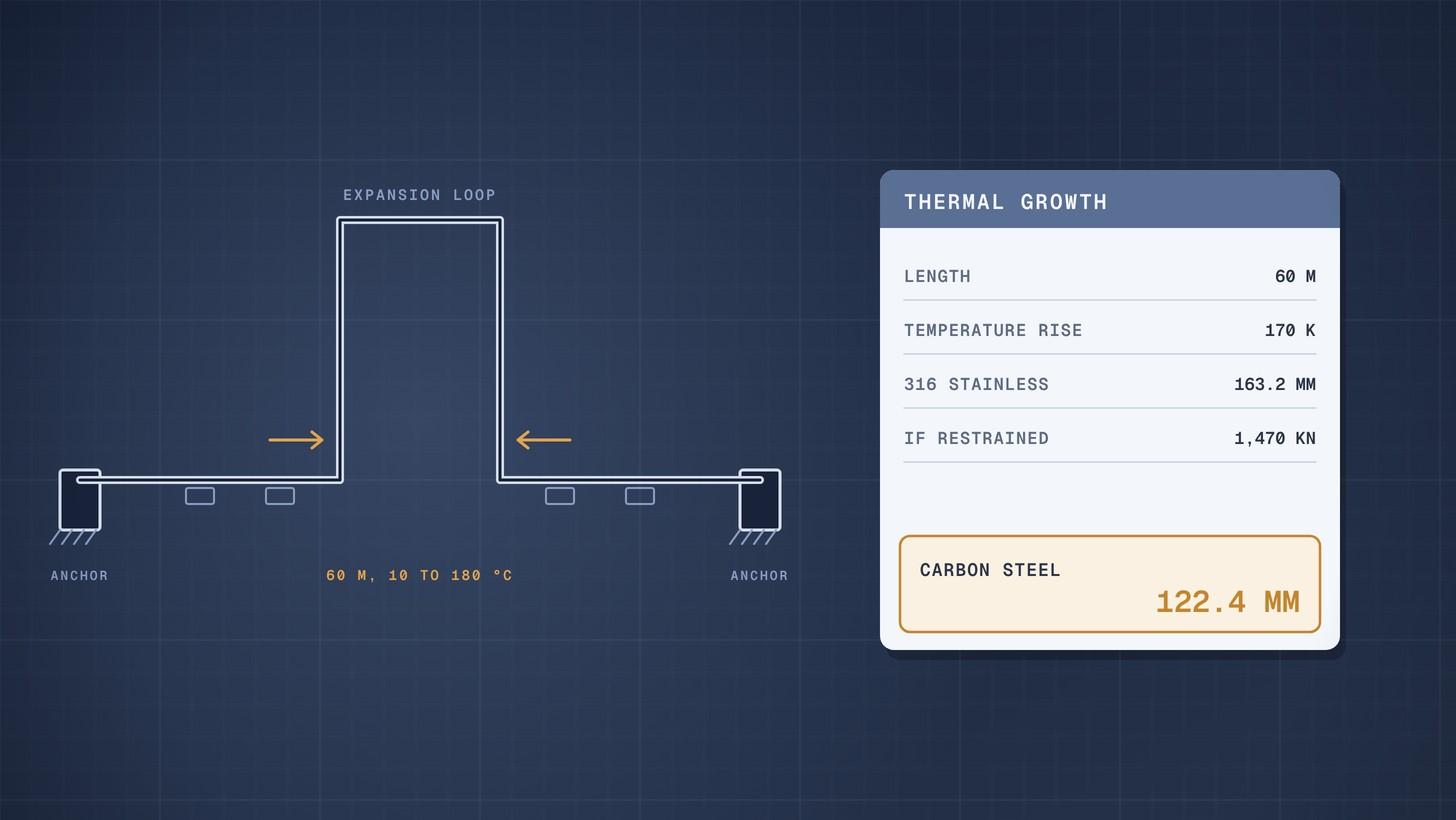
Pipe Thermal Expansion: Worked Example
How to calculate pipe thermal expansion for carbon and stainless steel, what restrained expansion does, and how loops and expansion joints absorb it.
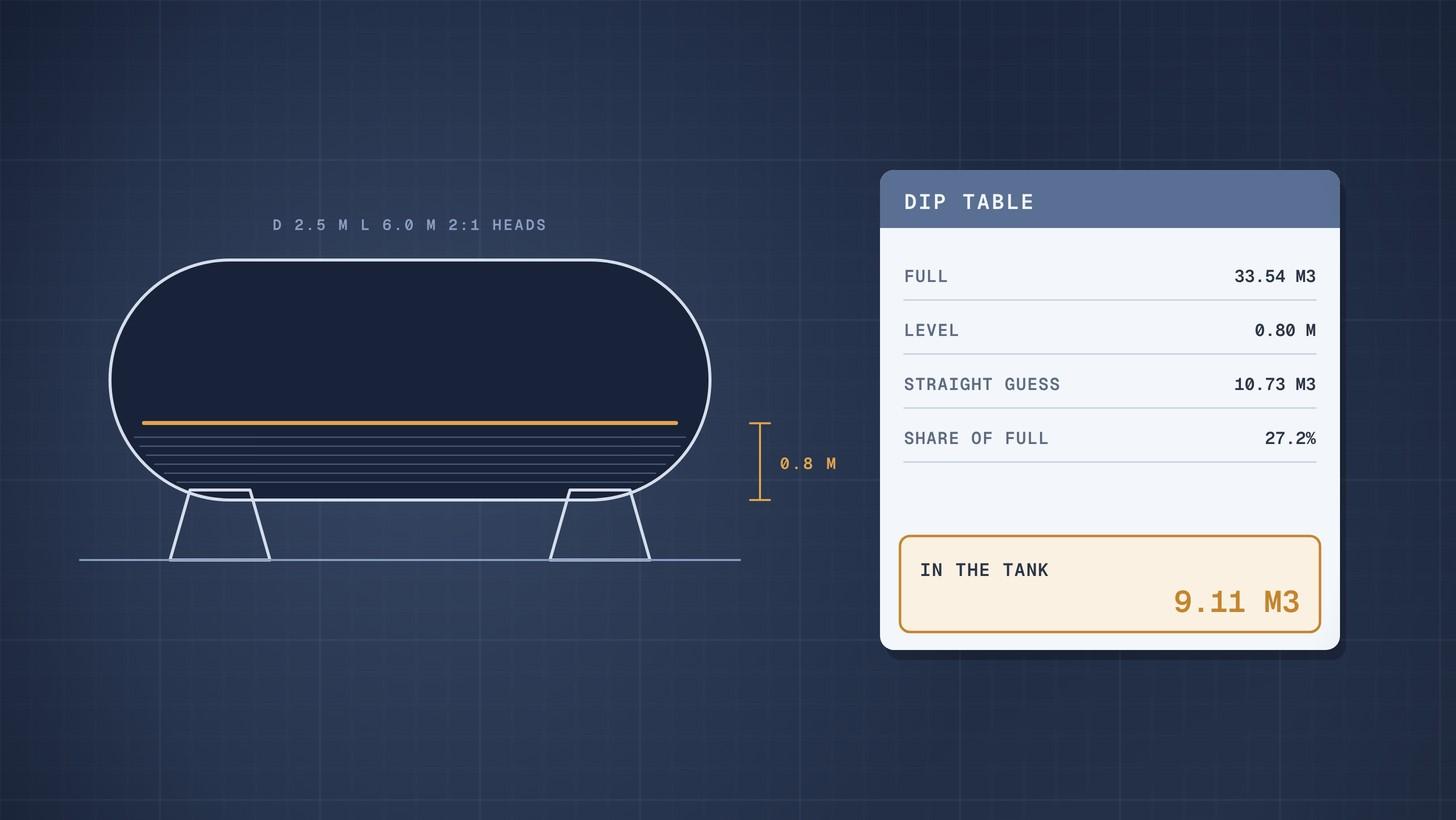
Horizontal Tank Volume When Partly Filled: Worked Example
How to calculate the volume of a partly filled horizontal tank with dished heads, with a worked example and a full dip table you can rebuild in a spreadsheet.
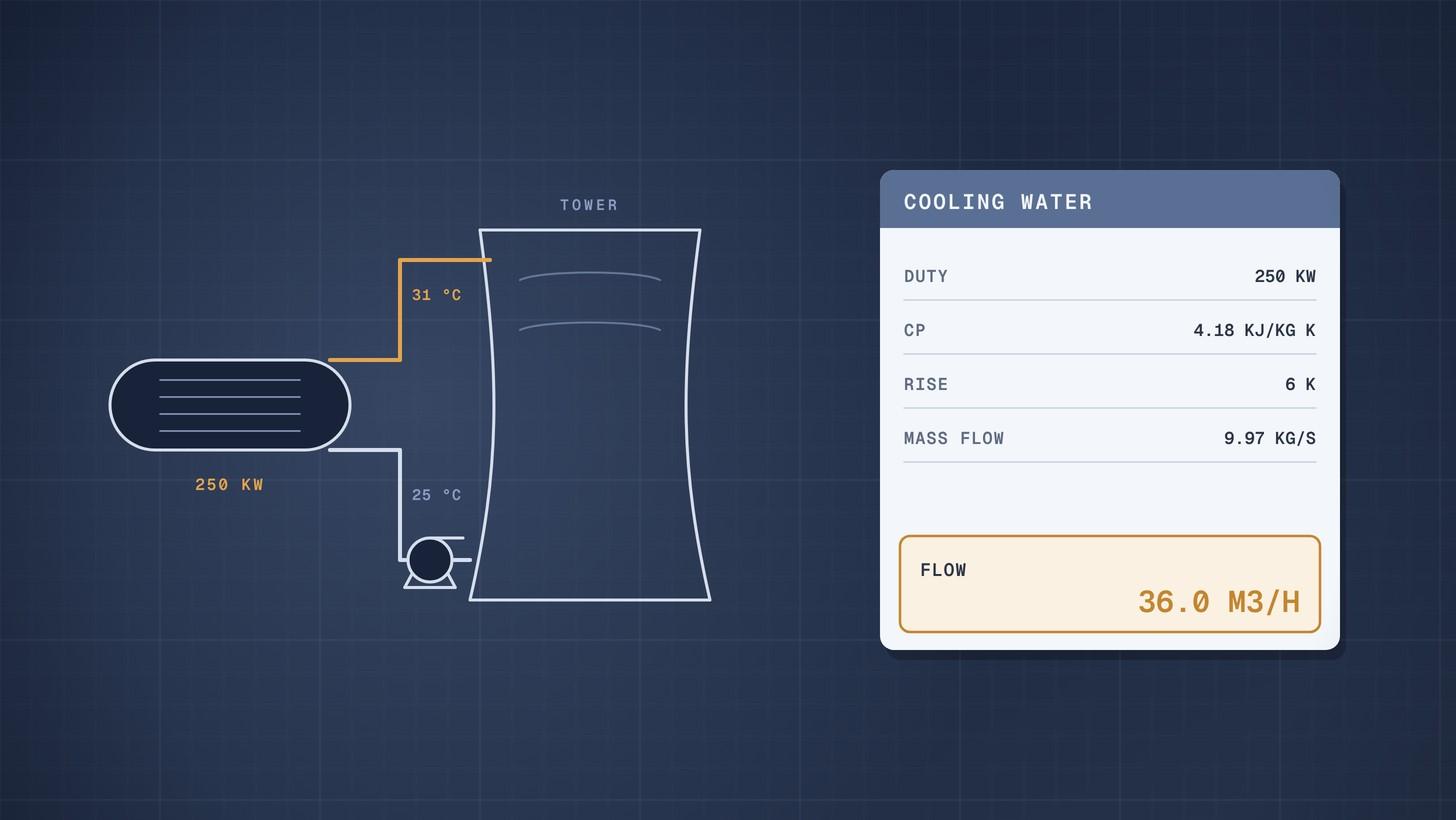
Cooling Water Flow Calculation: Worked Example
How to calculate cooling water flow from heat duty and temperature rise, then size the cooling tower circulation, evaporation and make up water.