
Piping Class Explained: Reading a Pipe Specification Before You Buy
A piping class is the project's rulebook for one service: rating, material, corrosion allowance and every allowed component by size. Here is how to read one before you buy valves and fittings.
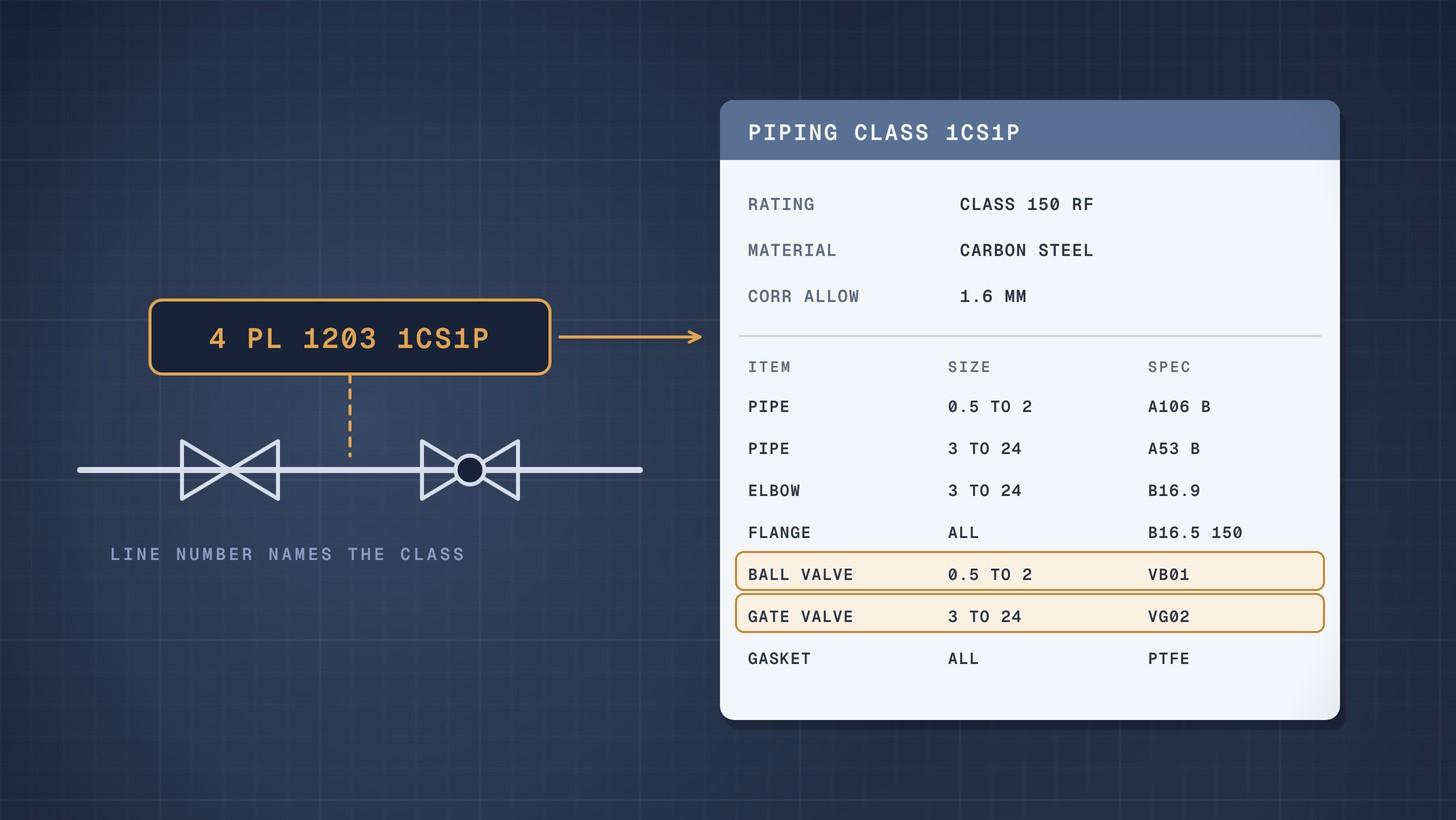
A piping class is the project's rulebook for one family of lines: it fixes the pressure rating, the material, the corrosion allowance and every pipe, fitting, flange, gasket, bolt and valve allowed in that service, size by size. The line number on the P&ID tells you which class applies, so anyone buying valves or fittings for that line should read the class sheet before writing a single RFQ line.
This guide explains what a class sheet contains, how it connects to the line list, and what a valve or fittings buyer should take from it.
Why this matters now
Piping materials are usually bought in large lots against a material take off, and valves often go out early because they are long lead. If the buyer reads the class sheet wrongly, the error is multiplied across hundreds of items. A Class 150 valve bought for a line that later moves to Class 300 cannot be fixed on site.
The class is also project specific. A piping specification is written for one plant, site or installation, and specs from different sites are not interchangeable [1]. You cannot assume the supplier's "standard" offer, or last project's class, matches yours.
Create and manage RFQs in minutes
ChemCapital handles the entire procurement cycle, from structured RFQs and supplier comparisons to formal purchase orders and delivery tracking.
Piping class or pipe specification?
The words get mixed up, so settle them first. A pipe class is a project document, issued by the owner or the EPC contractor, that lists every compatible component for a service condition. A pipe specification in the narrow sense is a product standard such as ASTM A106, which says how one pipe is made and tested. The class points to those standards rather than replacing them [2].
Many companies still call the whole class document the "pipe spec". Read the context. In this article, "class sheet" means the project document.
What a piping class sheet contains
Most class sheets follow the same pattern, whether they are written in a spreadsheet or held in a design database. Hexagon's reference data model, used in 3D plant design, shows the typical content: header data with allowed media and pressure and temperature ranges; the material and corrosion allowance; allowed sizes and schedules; a branch table; gasket type; notes; and the list of components with their size ranges [3].
| Part of the sheet | What it tells you | Example from a published Class 150 sheet [4] |
|---|---|---|
| Header and scope | Service, base material, design code, revision | Carbon steel, general non corrosive gas and liquid service |
| Pressure and temperature limits | The allowed pressure at each temperature | About 17.2 barg up to 38 °C, falling to about 14.1 barg at 177 °C |
| Corrosion allowance | Extra wall added for metal loss | 1.6 mm (1/16 inch) |
| Pipe | Material, schedule or wall by size | ASTM A106 B (no weld seam) in small sizes, A53 B in larger sizes |
| Fittings and branches | Socket weld or butt weld by size, branch table | Class 3000 socket weld small bore, ASME B16.9 butt weld above 2 inch |
| Flanges, gaskets, bolting | Type, rating, facing, gasket, studs and nuts | B16.5 Class 150 raised face, PTFE gaskets, A193 B7 studs, A194 2H nuts |
| Valves | Type, body material, rating, ends, trim, size range | Ball, butterfly, check, gate, globe and plug valves |
| Notes and testing | Special rules and the pressure test | Threaded joints only for vents, drains and instruments; hydrostatic test |
Two details are easy to miss. First, the sheet's pressure limit is usually lower than the flange rating alone, because the weakest component sets it. That published example bases its limits on Class 150 ductile iron valves and the company's temperature limit for PTFE gaskets [4]. For comparison, a carbon steel Class 150 flange to ASME B16.5 is rated 19.6 bar at up to 38 °C and 13.8 bar at 200 °C [5]. The rating falls with temperature, so always read the row for your design temperature.
Second, the branch table. It is a grid of header size against branch size, with a letter in each cell for how the branch is made: a tee, a reducing tee, a weldolet or sockolet, a reinforcing pad, or an unreinforced stub in [4]. The fittings buyer needs it, because it decides whether you buy tees or olets.
How the class links to the line list and the P&ID
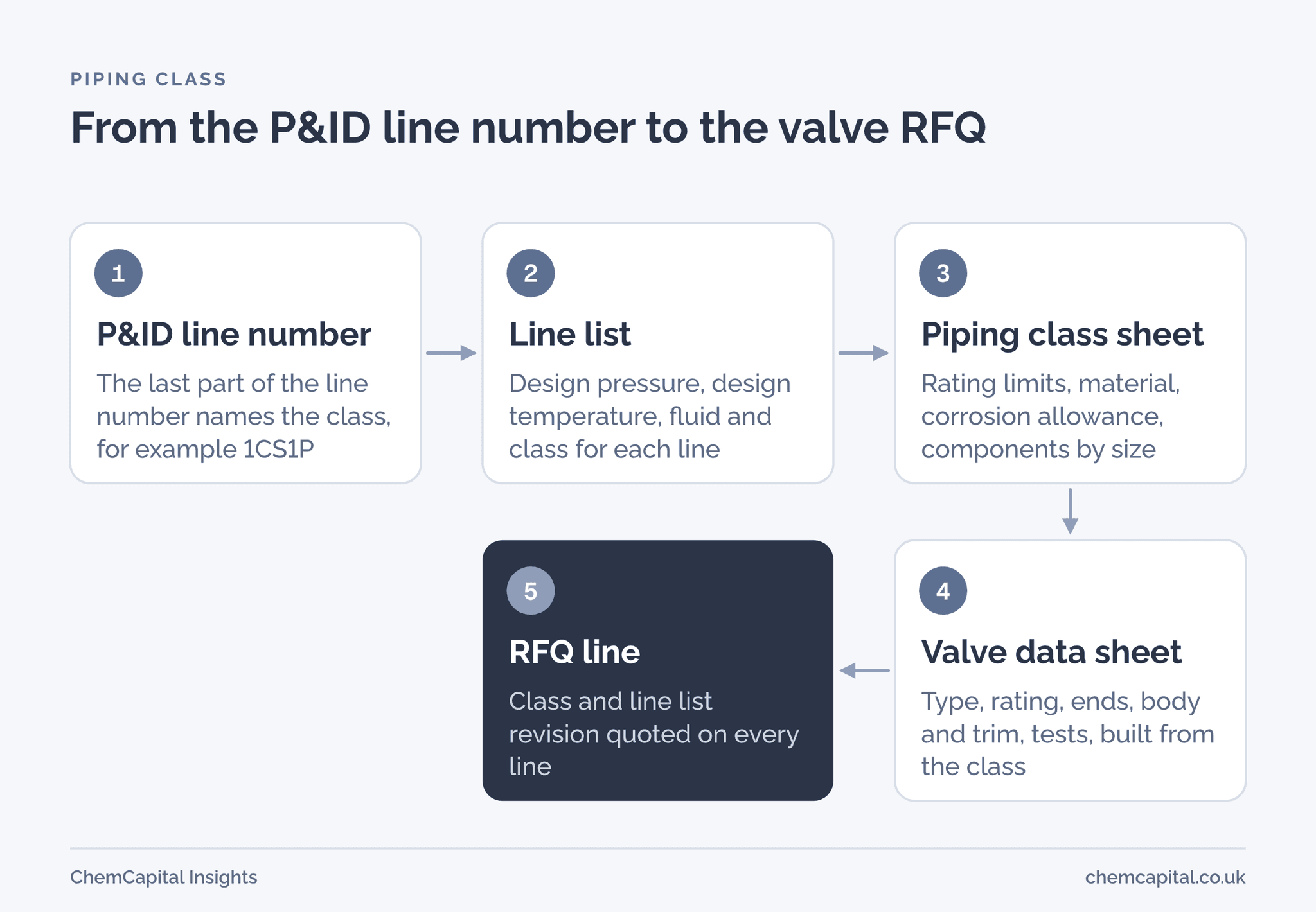
The chain runs from the drawing to the class sheet. Every line on the P&ID carries a line number, and the last part of that number is the class. In Wermac's example, line 12 FW 1014 1CS1P (drawings join these parts with dashes) decodes as 12 inch, fire water service, line 1014, class 1CS1P. In that company's system the class code itself means Class 150, carbon steel, a corrosion allowance code, and the service family [1]. Other companies use other codes, so always ask for the project's legend.
The line list then repeats the line number with its design pressure, design temperature, fluid and class. Our guide to the line list, valve list and instrument index shows the columns. Downstream, the class code is what procurement uses to build material take offs and RFQs [2].
The corrosion allowance in the class is worth understanding too. It is usually set as corrosion rate multiplied by design life. One worked example uses 0.1 mm a year over 25 years, which gives 2.5 mm. Typical carbon steel allowances range from 1.5 mm for clean services to 3 to 6 mm for produced water, and stainless steel classes often carry none [6].
The class also sits under the design code. For process plant that is often ASME B31.3, which covers design criteria, pressure design of components, fluid service categories including Category M, and testing [7]. If a class note mentions Category M or Category D service, the inspection and test rules change, and so can what you buy. The published Class 150 example sets a helium leak test for Category M and an initial service leak test for Category D [4].
What a valve buyer reads from the class
Valves are where class sheets matter most to procurement, because they are expensive, long lead and hard to change. Each valve on the P&ID is tied by its tag to a valve data sheet, and the piping engineer builds that data sheet from the P&ID, the line list and the pipe class [8]. Read the class for:
- Valve type by size. Many classes allow ball valves in small bore and gate or butterfly valves in larger sizes. Do not quote a type the class does not allow.
- Rating and ends. Class 150 or 300, socket weld or flanged, raised face or ring joint. Ends must match the class's flange and fitting rules; see flange types, PN versus ASME class.
- Body and trim materials. Forged bodies in small bore and cast bodies in larger sizes are common. Trim and seat materials matter for temperature limits.
- Special requirements. Sour service, fire safe or fugitive emission testing may sit in the class, a class note, or the valve data sheet [8] [2].
- Leakage and testing. Check whether the class or data sheet calls up a seat leakage class; our article on valve seat leakage classes explains them.
Some operators go further and keep separate material data sheets for each grade. NORSOK practice, for example, states the grades on the piping class sheet and adds supplementary requirements through material data sheets [9]. If your class refers to such sheets, they are part of the purchase specification and must go out with the RFQ.
When those requirements are spread across a class sheet, notes and data sheets, missing one is easy. ChemCapital's P&ID to RFQ works from DEXPI P&IDs to pull the line, tag and class data into structured RFQ lines, so the class is carried through rather than retyped.
Practical example
Illustrative figures. A buyer is sourcing 2 inch and 4 inch isolation valves for a carbon steel utility line. The line list gives a design pressure of 10 barg at 150 °C and class 1CS1P, a Class 150 carbon steel class.
| Check | Value | Result |
|---|---|---|
| Class 150 Group 1.1 flange rating at 150 °C [5] | 15.8 bar | Above 10 barg design, so Class 150 is suitable |
| Revised design after a process change | 14 barg at 200 °C | |
| Class 150 rating at 200 °C [5] | 13.8 bar | Below 14 barg, so Class 150 no longer works |
| Class 300 rating at 200 °C [5] | 43.8 bar | The line moves to a Class 300 class |
Flange ratings are the starting point, not the class limit. The class sheet's own limit can be lower, as the published example shows, so the engineer confirms against the class. For the buyer, the lesson is simple: if valves had been ordered against the first revision of the line list, every one would now be the wrong rating. Order long lead valves only against a frozen line list revision, and put the class and line list revision on the purchase order.
Questions to ask before you send the RFQ
- Which revision of the class sheet and the line list does this RFQ use?
- Are there class notes or material data sheets that apply to these items?
- Does the valve data sheet repeat the class, or add to it?
- Are any lines Category M, sour, or otherwise special?
- Who in engineering confirms that a supplier's alternative still complies with the class?
Then compare offers line by line against the class, not against each other. Inspection documents such as EN 10204 3.1 and 3.2 certificates should match the grades on the class sheet too.
Where ChemCapital fits
The class sheet is engineering's decision; the buyer's job is to carry it, unchanged, into every RFQ and purchase order. Structured RFQs keep the class, rating and material on each line, so suppliers price the same thing and deviations stand out.
Ready to turn your line list and piping classes into clean valve RFQs? Start a free 14 day ChemCapital trial, with no credit card needed.
Frequently asked questions
What is a piping class?
A project document that sets the rules for one family of lines: pressure and temperature limits, base material, corrosion allowance, and every allowed pipe, fitting, flange, gasket, bolt and valve by size. The line number on the P&ID names the class that applies.
What is the difference between a pipe class and a pipe specification?
A pipe class is project specific and covers all components for a service. A pipe specification in the narrow sense is a product standard, such as ASTM A106, for one type of pipe. The class refers to those standards.
What is a branch table in a piping class?
A grid of header size against branch size that shows how each branch connection is made, for example with a tee, a reducing tee, a weldolet or sockolet, or a reinforcing pad.
How do I find the piping class of a line?
Read the line number on the P&ID or the line list. The class code is usually the last part of the line number. The project's legend explains what each part of the code means.
Why is the class pressure limit lower than the flange rating?
The weakest component sets the class limit. A gasket temperature limit or a valve body rating can be lower than the flange rating, so always read the class sheet's own pressure and temperature table.
Continue reading
Informational only, not procurement or legal advice. Cited names, frameworks, and statistics belong to their respective owners.
Create and manage RFQs in minutes
ChemCapital handles the entire procurement cycle, from structured RFQs and supplier comparisons to formal purchase orders and delivery tracking.
Start for freeRelated articles
Pipe Thermal Expansion: Worked Example
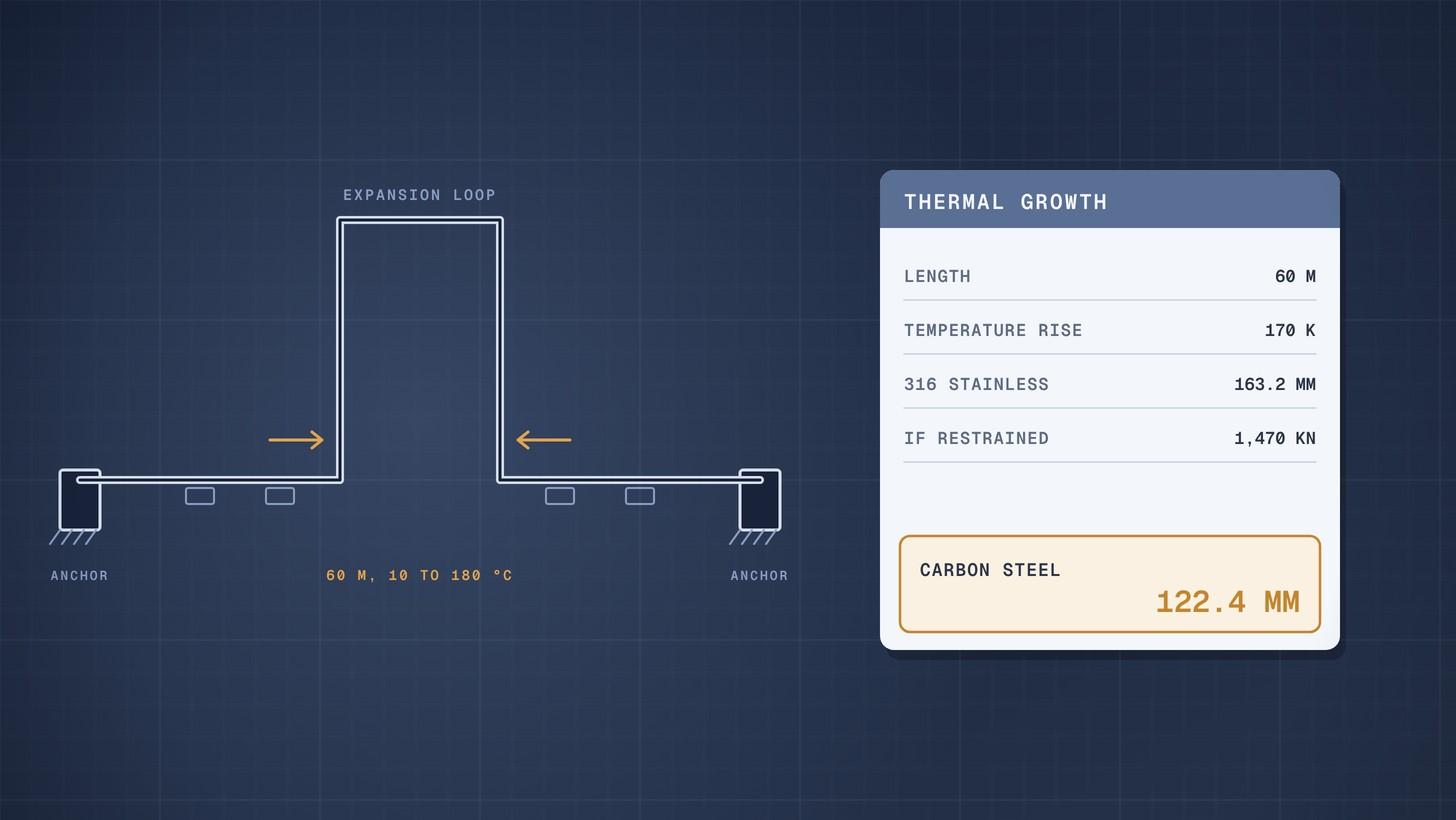
How to calculate pipe thermal expansion for carbon and stainless steel, what restrained expansion does, and how loops and expansion joints absorb it.
Horizontal Tank Volume When Partly Filled: Worked Example
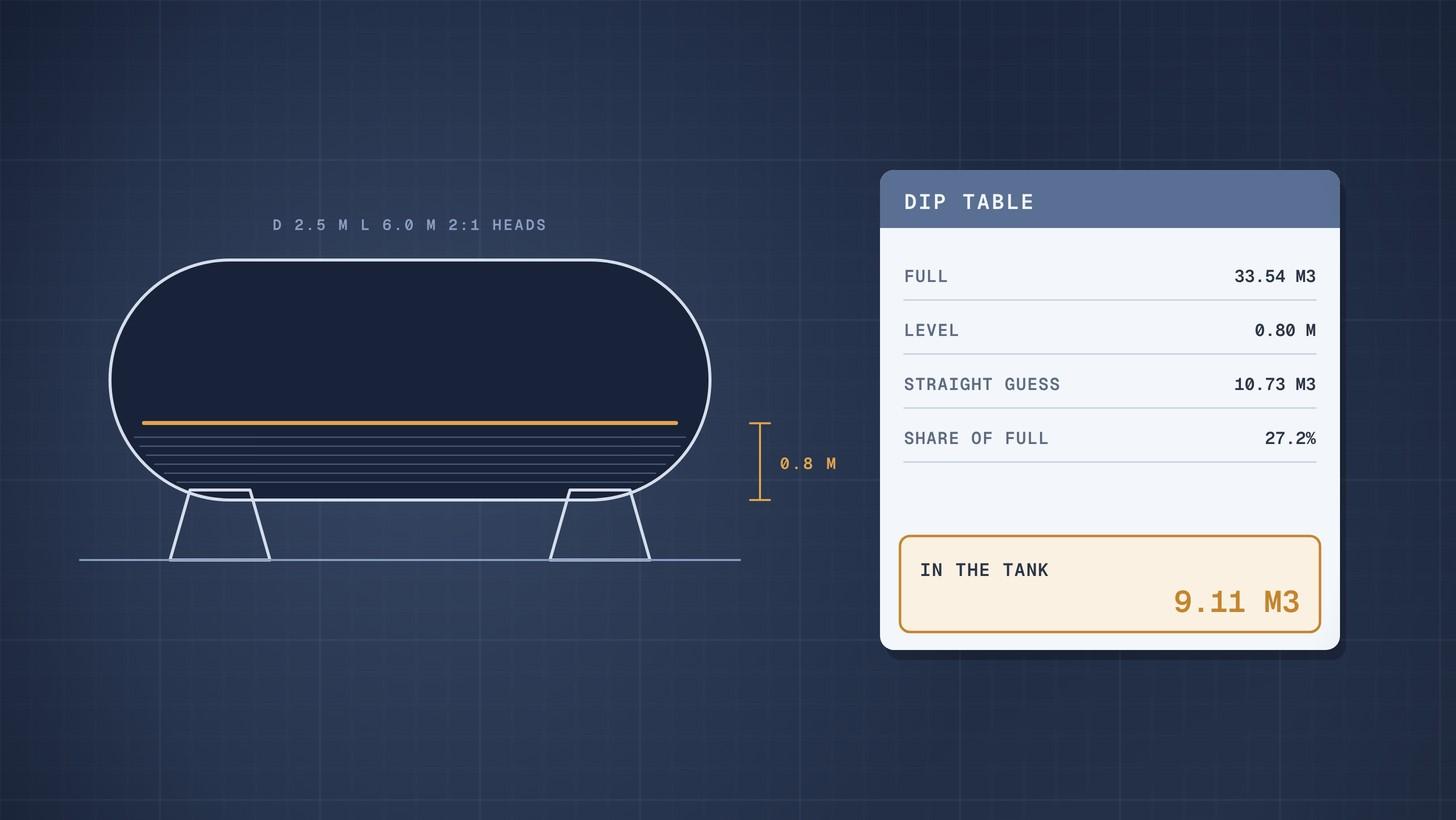
How to calculate the volume of a partly filled horizontal tank with dished heads, with a worked example and a full dip table you can rebuild in a spreadsheet.
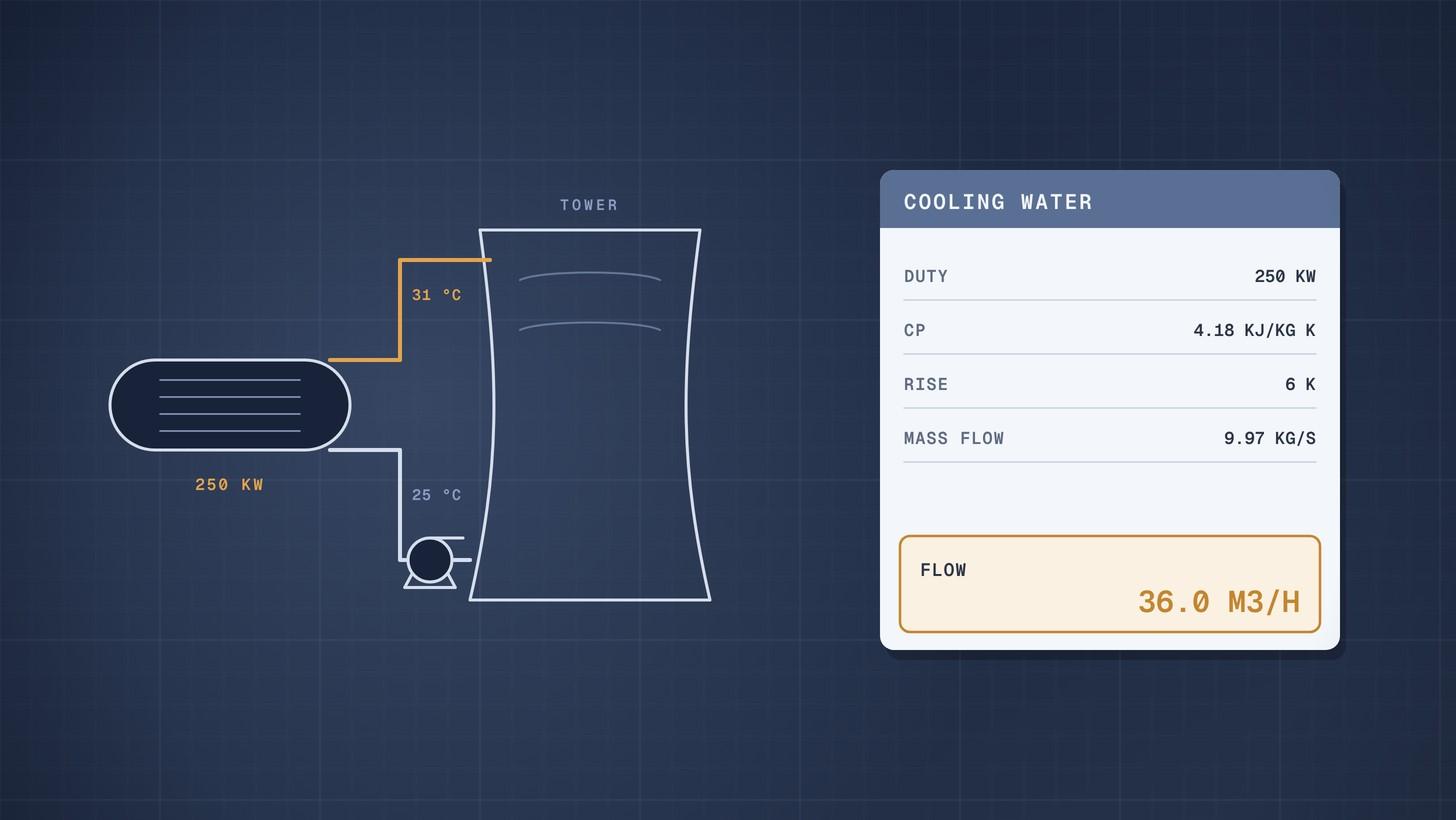
Cooling Water Flow Calculation: Worked Example
How to calculate cooling water flow from heat duty and temperature rise, then size the cooling tower circulation, evaporation and make up water.