
Payback and NPV for a Capital Equipment Purchase: Worked Example
How to calculate simple payback, discounted payback, NPV and IRR for an equipment purchase, and use them to compare two supplier quotes, with a sensitivity check.
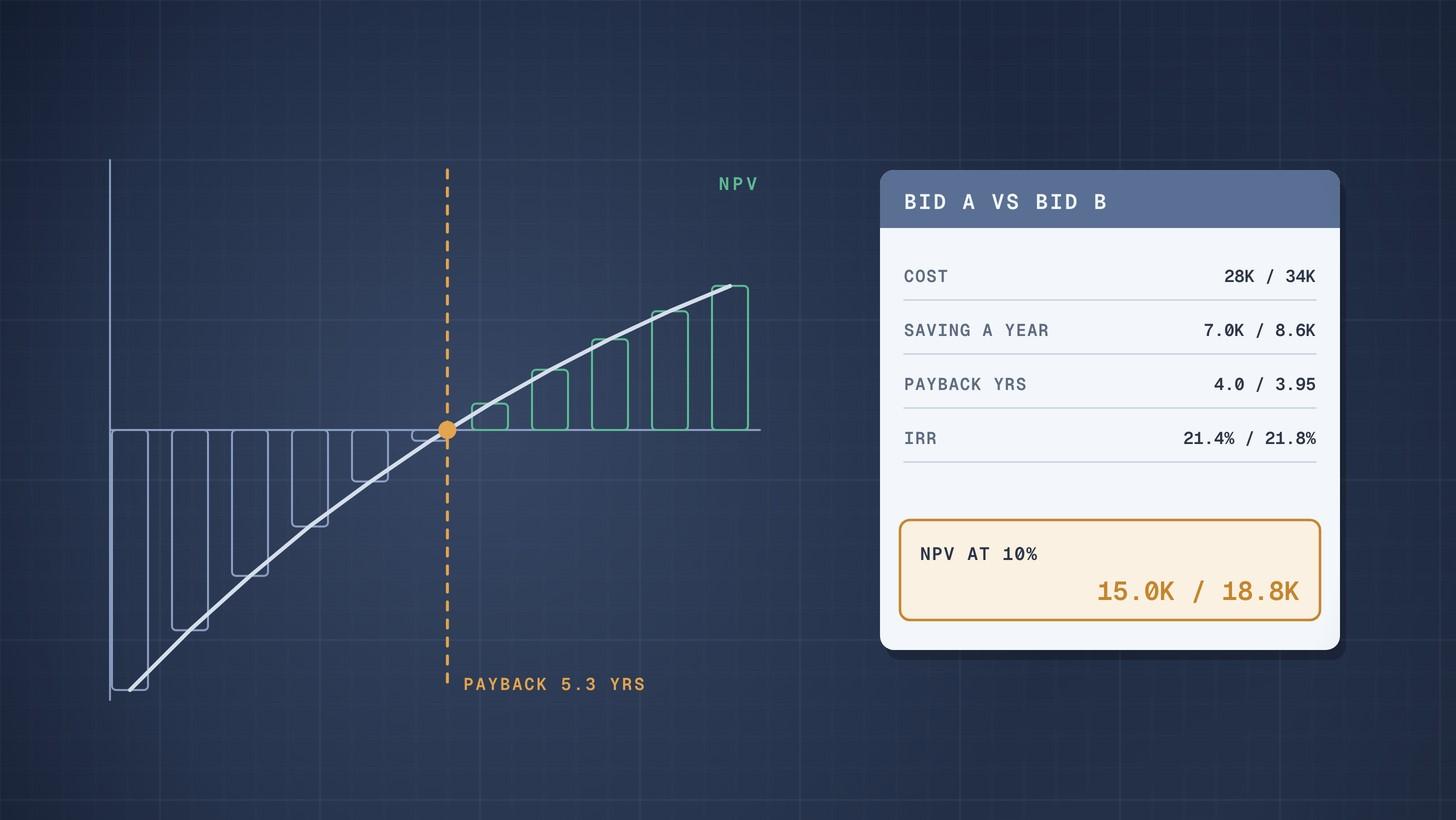
Simple payback is the installed cost divided by the yearly saving; net present value (NPV) discounts every future saving back to today and subtracts the cost. In the worked example below, a £34,000 pump replacement that saves £8,600 a year pays back in 4.0 years and has an NPV of £18,843 over ten years at a 10% discount rate, with an internal rate of return (IRR) of 21.8%.
Payback answers "how fast do we get our money back". NPV answers "how much is this worth to the business". A capital request needs both, and so does a fair comparison of two equipment quotes.
Why this matters now
Most capital equipment is bought against a business case, and finance teams will test it. A replacement pump, a heat recovery exchanger or a new dryer competes for the same budget as every other project on site. The case that gets approved is usually the one with clear, defensible numbers.
Payback alone can steer you wrong. A guide written by the Carbon Trust for the Department of Energy and Climate Change notes that simple payback says little about the overall value of an investment and ignores how long the project lasts [1]. Its own example shows a project with the longer payback earning more than twice the net return of the other [1]. The same trap appears when comparing a cheaper quote with a more efficient one.
Create and manage RFQs in minutes
ChemCapital handles the entire procurement cycle, from structured RFQs and supplier comparisons to formal purchase orders and delivery tracking.
The four measures in plain words
Simple payback is the project cost divided by the annual return, such as energy cost savings [1]. It is easy to explain and is often used as a quick hurdle. The same guide mentions one or two year payback as a typical hurdle applied to energy projects [1], though capital equipment replacements are often judged on longer horizons.
Net present value adds up every cash flow, each multiplied by a discount factor of 1 ÷ (1 + r)ᵗ, where r is the discount rate and t the year [1]. The ACCA calls NPV the most important appraisal method, and a positive NPV means the project adds to shareholder wealth [2].
Discounted payback is payback worked on the discounted cash flows. It is always longer than simple payback, and it shows how long the money is really at risk.
Internal rate of return is the discount rate at which NPV is zero. Excel's IRR function finds it by iteration and needs at least one negative and one positive cash flow at regular intervals [3].
Which cash flows to include
The ACCA's rule is that a relevant cash flow must be future and incremental [2]. In practice:
- Include the purchase price, installation, commissioning, spares bought with the order, and every yearly change in energy, maintenance, downtime and labour.
- Exclude sunk costs such as a feasibility study already paid for, allocated overheads and depreciation. Exclude financing costs too, because the cost of finance sits in the discount rate [2].
- Residual and scrap values. If the old pump set has resale or scrap value, count it as a saving in year 0. Any value left in the new equipment at the end of the period goes in the final year, which is where the ACCA's worked example places it [2].
- Working capital and spares. A strategic spares holding bought with the new equipment is cash out in year 0, even though it sits in the stores rather than on the plant.
- Treat inflation consistently. Either include it in both cash flows and discount rate, or leave it out of both [2].
- Tax changes the answer. Tax relief on the investment creates a tax saving, and the extra profit from the saving is taxed [2]. The example below ignores tax; ask your finance team how they want it shown.
Choosing the discount rate
Many organisations have a policy on which discount rate to use, and a higher rate makes it harder for projects to pass and is sometimes used as insurance against risk [1]. Ask your finance team for the company figure before you build the case. Using the wrong method or rate is a common reason a case comes back [1].
Public sector projects in the UK use the Treasury's rate. HM Treasury's Green Book guidance gives a social time preference rate of 3.5% for years 1 to 30, falling to 3.0% for years 31 to 75 [4]. That is a public sector rate; private companies normally use a higher figure tied to their cost of capital.
Worked example: replacing a cooling water pump
A site plans to replace an old cooling water pump set. Two suppliers quote. All figures are illustrative.
| Bid A | Bid B | |
|---|---|---|
| Installed cost | £28,000 | £34,000 |
| Yearly saving (energy plus maintenance) | £7,000 | £8,600 |
| Life assumed | 10 years | 10 years |
Simple payback. Bid A: 28,000 ÷ 7,000 = 4.0 years. Bid B: 34,000 ÷ 8,600 = 3.95 years. On payback the two look the same.
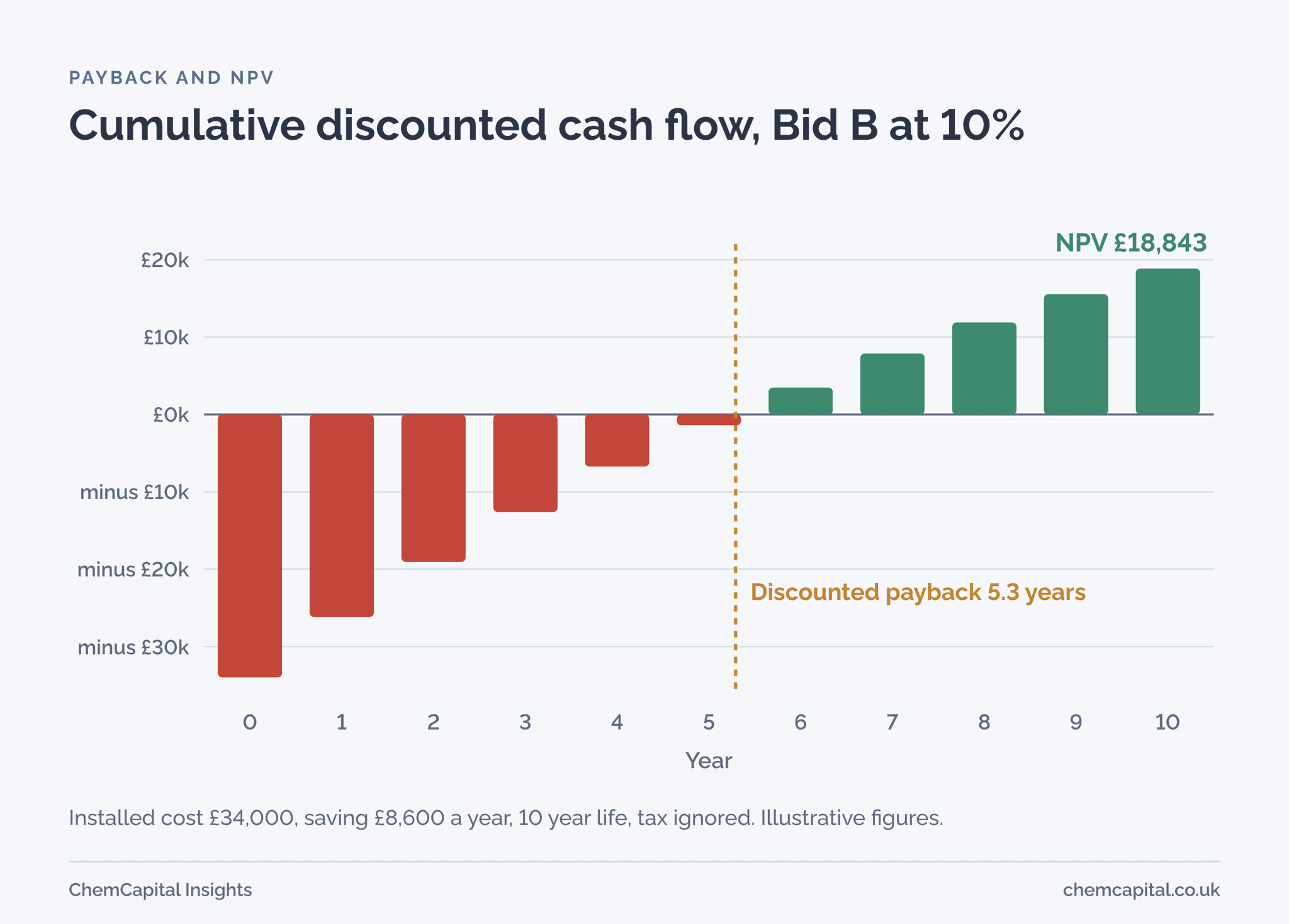
NPV of Bid B at 10%. Each year's £8,600 is multiplied by its discount factor and added to the running total, starting from minus £34,000 in year 0:
| Year | Cash flow | Discount factor | Present value | Cumulative |
|---|---|---|---|---|
| 0 | minus £34,000 | 1.0000 | minus £34,000 | minus £34,000 |
| 1 | £8,600 | 0.9091 | £7,818 | minus £26,182 |
| 2 | £8,600 | 0.8264 | £7,107 | minus £19,074 |
| 3 | £8,600 | 0.7513 | £6,461 | minus £12,613 |
| 4 | £8,600 | 0.6830 | £5,874 | minus £6,739 |
| 5 | £8,600 | 0.6209 | £5,340 | minus £1,399 |
| 6 | £8,600 | 0.5645 | £4,854 | £3,455 |
| 7 | £8,600 | 0.5132 | £4,413 | £7,868 |
| 8 | £8,600 | 0.4665 | £4,012 | £11,880 |
| 9 | £8,600 | 0.4241 | £3,647 | £15,528 |
| 10 | £8,600 | 0.3855 | £3,316 | £18,843 |
The cumulative figure turns positive during year 6, so discounted payback is about 5.3 years. NPV over ten years is £18,843.
Comparing the bids.
| Measure, 10 years | Bid A | Bid B |
|---|---|---|
| Simple payback | 4.0 years | 3.95 years |
| Discounted payback at 10% | 5.4 years | 5.3 years |
| NPV at 10% | £15,012 | £18,843 |
| IRR | 21.4% | 21.8% |
Bid B costs £6,000 more but is worth about £3,800 more to the business. Look at the difference on its own: an extra £6,000 now for an extra £1,600 a year gives an NPV of £3,831 and an IRR of 23.4%. The extra spend earns more than the project as a whole. This is the comparison a lowest price award misses, and it is why our guide to life cycle cost in equipment quotes matters at bid evaluation.
Test the case before finance does
A business case is stronger when it shows what happens if the assumptions are wrong. For Bid B at 10%:
| Change | NPV | IRR |
|---|---|---|
| Base case | £18,843 | 21.8% |
| Savings 20% lower | £8,275 | 15.4% |
| Installed cost 20% higher | £12,043 | 16.5% |
| Life only 7 years | £7,868 | 16.7% |
| Energy saving rising 3% a year | £23,278 | 23.7% |
The project stays positive in every case, which is what a finance reviewer wants to see. The energy price case follows the Carbon Trust guide's advice to allow for rising energy prices, which increase savings over a project's life [1]. The same guide notes that a motor's capital cost may be as little as 1% of its lifetime cost [1], which is why running cost usually decides these comparisons. To widen the range further, our guide to P50 and P90 cost risk analysis shows how to put probabilities on the inputs.
Doing it in Excel without the classic error
Excel's NPV function assumes every value falls at the end of a period, so the first value is discounted by one period. A cost paid now must be added outside the function: =NPV(rate, values) + initial cost [5]. Put the initial cost inside the brackets and Excel discounts it by a year, which flatters every project. IRR has no such trap; give it the full series starting with the negative year 0 value [3].
Turning it into a capital request
A good request states the cost from real quotes, the savings with their basis, the life, the discount rate your finance team uses, and the four measures above, plus the sensitivity table. Our guide to capex procurement strategy covers the wider approval path, and contingency in capital cost estimates explains how much allowance to carry on the cost line.
ChemCapital's Project Costing builds cost estimates from the quotes in your quote library, so the installed cost in the business case comes from real supplier prices rather than a rough figure.
This is general information, not financial advice; check your company's appraisal rules before you rely on it.
Ready to build capital requests on real quotes? Start a free 14 day ChemCapital trial, with no credit card needed.
Frequently asked questions
How do you calculate payback period for equipment?
Divide the installed cost by the yearly saving or extra profit the equipment brings. A £34,000 pump set that saves £8,600 a year pays back in about 3.95 years. Simple payback ignores the time value of money and what happens after payback, so pair it with NPV.
How do you calculate NPV for a capital project?
List every cash flow by year, starting with the cost as a negative value in year 0. Multiply each by 1 ÷ (1 + r) to the power of the year, where r is the discount rate, and add them up. A positive total means the project is worth more than it costs at that discount rate.
What discount rate should I use for NPV?
Use the rate your finance team sets, which is usually tied to the company's cost of capital and sometimes raised for risk. UK public sector appraisals use the Treasury's social time preference rate of 3.5% for the first 30 years.
What is the difference between NPV and IRR?
NPV gives the value a project adds in pounds at a chosen discount rate. IRR is the discount rate at which NPV is zero, so it shows the project's return as a percentage. When comparing two bids, compare NPVs, or the IRR of the difference between them.
Continue reading
Informational only, not procurement or legal advice. Cited names, frameworks, and statistics belong to their respective owners.
Create and manage RFQs in minutes
ChemCapital handles the entire procurement cycle, from structured RFQs and supplier comparisons to formal purchase orders and delivery tracking.
Start for freeRelated articles
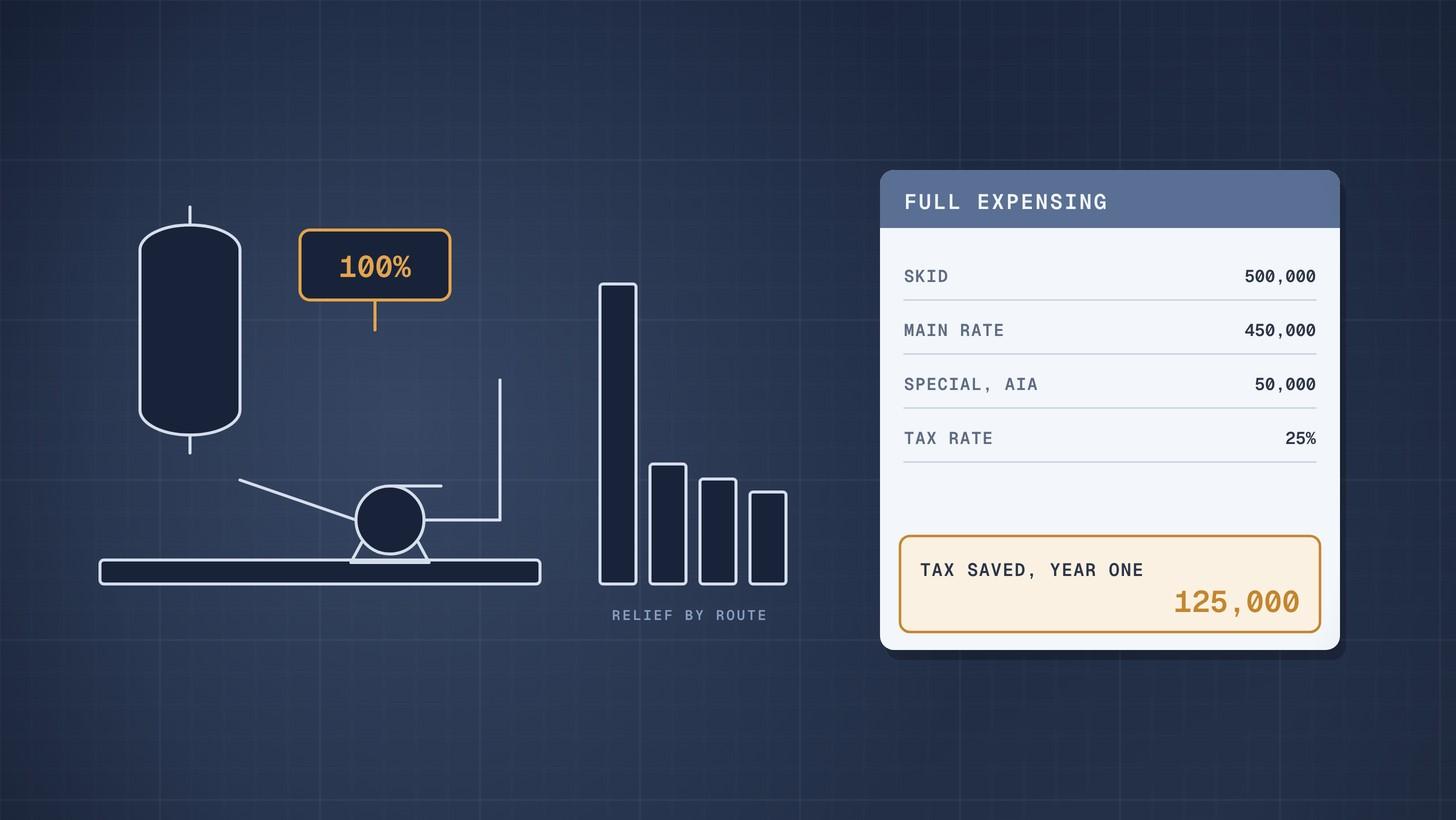
Full Expensing for Plant and Machinery: Worked Example (UK)
How full expensing, the annual investment allowance, first year allowances and writing down allowances apply to a £500,000 process skid, with the November 2026 rates.
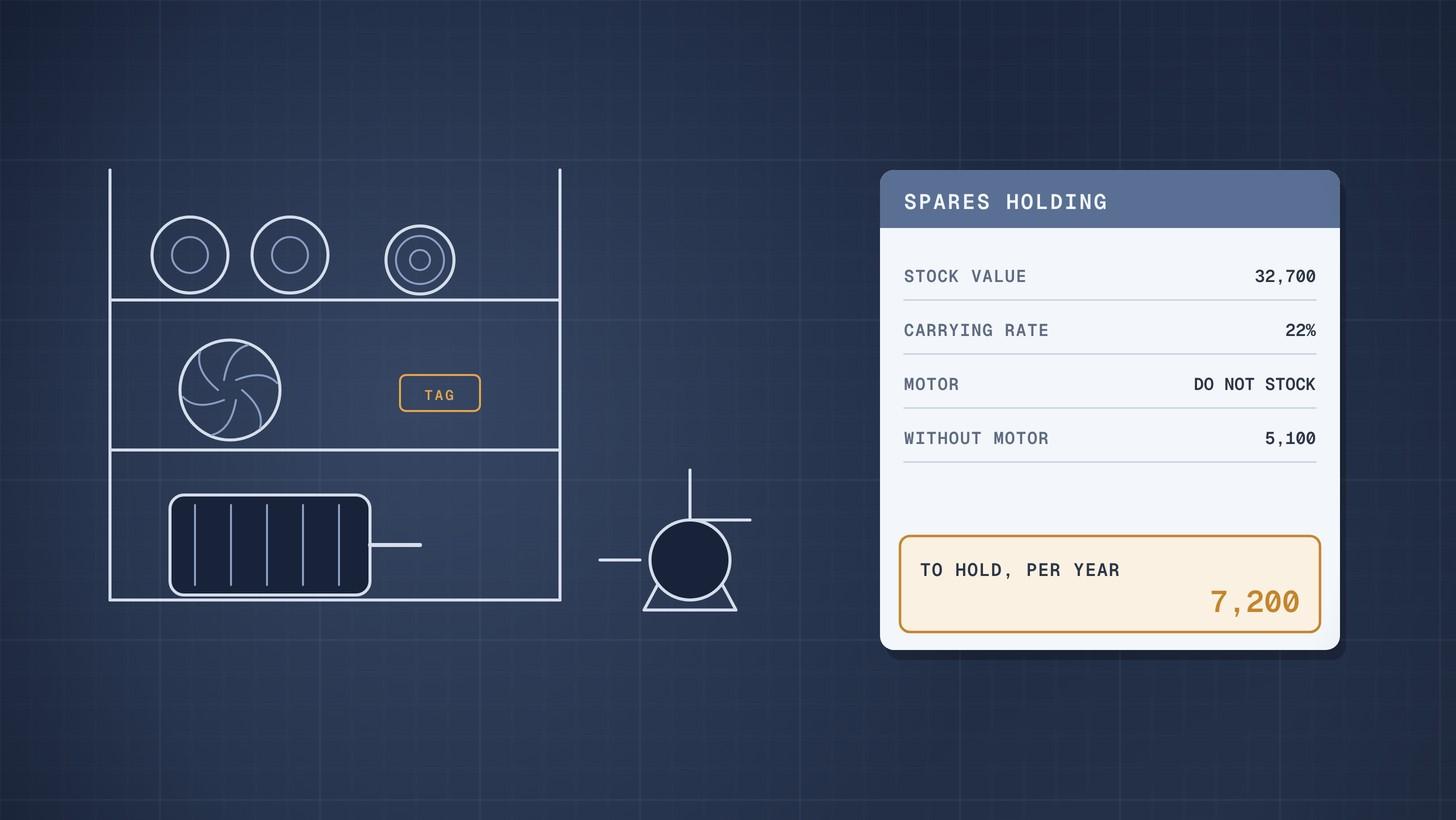
Spare Parts Carrying Cost: Worked Example
How to calculate the yearly carrying cost of spare parts, build your own carrying rate and decide which items on a recommended spares list are worth stocking.
Pump Total Cost of Ownership: Worked Example
How to calculate a pump's total cost of ownership with the Hydraulic Institute and Europump life cycle cost method, comparing two bids over 15 years in present value.