
CE Marking a Process Skid: The Technical File, Step by Step
What goes in the technical file to CE mark a process skid under the Machinery Directive, how to build it for an assembly of machinery, and what changes when the Machinery Regulation applies from January 2027.

To CE mark a process skid as machinery, the manufacturer must compile a technical file that proves the skid meets the essential health and safety requirements, then sign an EU declaration of conformity and fix the CE mark. Under the Machinery Directive 2006/42/EC the file contains a description, drawings, the risk assessment, the standards used, test reports, the instructions and the declarations of incorporated parts, and must be available to authorities for at least 10 years. The new Machinery Regulation (EU) 2023/1230 replaces the Directive from 20 January 2027, keeps the 10 year duty and adds rules on digital instructions. This guide sets out what goes in the file and how to build it for a skid.
Why this matters now
Many skid builders buy CE marked pumps, motors, vessels and instruments, connect them on a frame, add a control panel and ship. If the result works as a single machine under one control system, the skid builder is likely to be the manufacturer of an assembly of machinery, with its own CE marking and technical file. Pilz explains that an assembly exists where machines are linked both in production and in safety terms, and that whoever builds the assembly, or has it built, is the manufacturer; if contracts do not say otherwise, the operator may end up in that role [1].
The rules are also about to change. The Machinery Regulation applies from 20 January 2027, after a corrigendum moved the date from 14 January [2]. Skids designed now will often be placed on the market after that date. Our overview of the EU Machinery Regulation 2023/1230 covers the wider changes.
Access real procurement opportunities from global buyers
Join ChemCapital to get discovered by verified procurement teams across pharmaceutical, chemical, and industrial manufacturing.
What the technical file must contain
Annex VII of the Machinery Directive sets the contents. The file "must demonstrate that the machinery complies with the requirements" of the Directive, and includes [3]:
| Part | What it contains | For a process skid |
|---|---|---|
| General description | What the machine is and does | Duty, process description, boundaries of the skid |
| Overall drawing and control circuits | The arrangement and the control logic | General arrangement, P&ID, electrical and control schematics |
| Detailed drawings with calculations, test results and certificates | Evidence each part is designed safely | Frame and lifting calculations, guarding, pressure parts, material certificates |
| Risk assessment documentation | The procedure followed, hazards found and measures taken | Mechanical, electrical, pressure, thermal, chemical and noise hazards; residual risks |
| Standards and technical specifications used | Which harmonised and other standards were applied | Risk assessment, safety of control systems, electrical equipment, guarding |
| Test reports | Results of tests by the manufacturer or a chosen body | FAT records, electrical tests, pressure test certificates, functional safety tests |
| Instructions | A copy of the instructions for use | Installation, operation, cleaning, maintenance and residual risk warnings |
| Declarations of incorporated parts | Declarations of incorporation for partly completed machinery | For example a pump supplied without its drive |
| Declaration of conformity | A copy of the signed declaration | The skid's own declaration |
| Series production measures | How conformity is maintained for repeat builds | Build checks and configuration control |
The UK's Northern Ireland regulator, HSENI, lists the same items under the UK's Supply of Machinery Regulations 2008, adding the list of applicable essential requirements, protective measures and residual risks, and declarations for incorporated products [4]. The file does not have to be held permanently in paper form, but it must be produced in response to a reasoned request from the authorities [3]. HSENI warns that failing to present it may give grounds for doubting the machine's conformity [4].
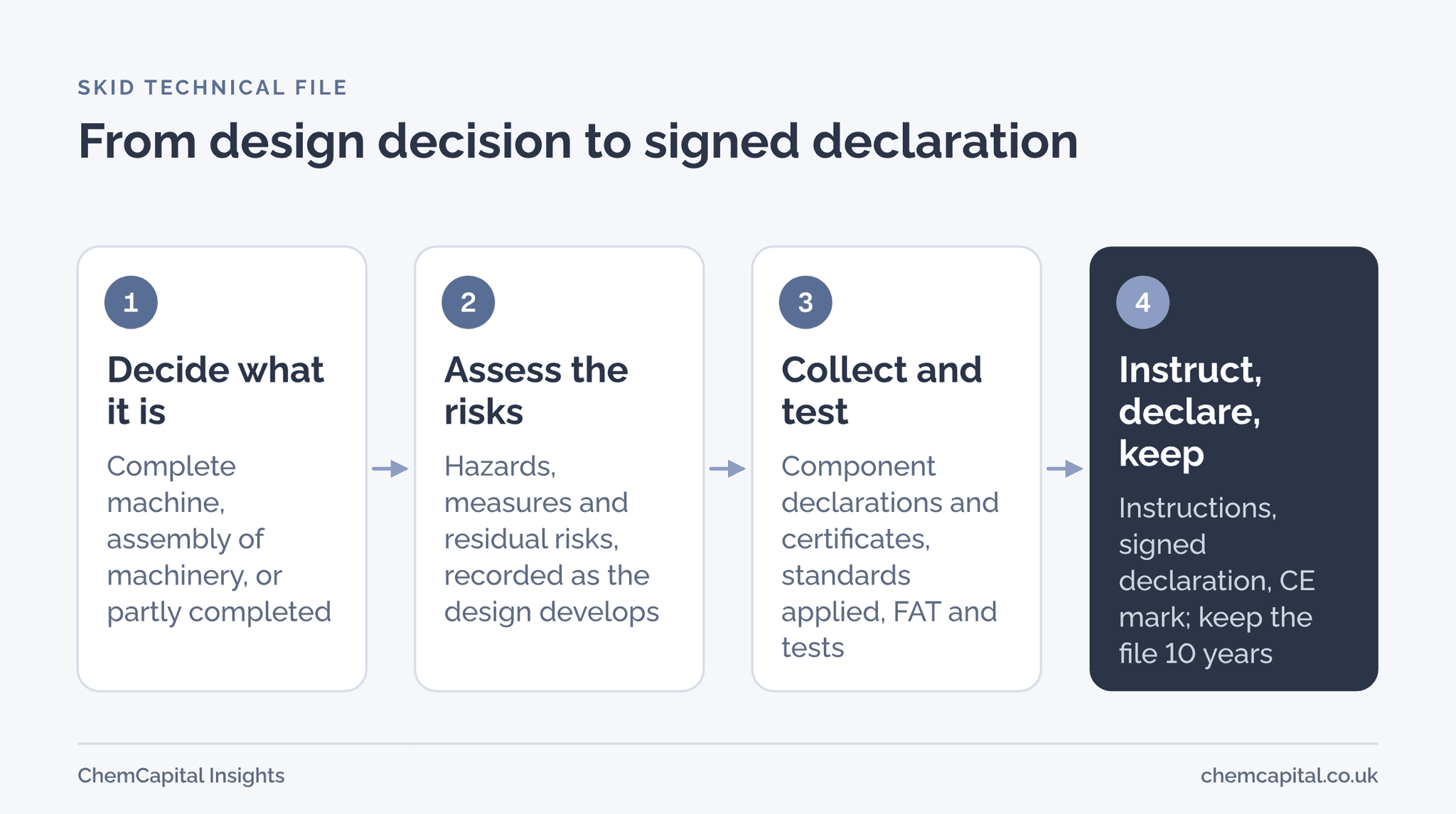
Building the file for a skid, step by step
- Decide what the skid is. A complete machine, an assembly of machinery, or partly completed machinery to be built into the buyer's plant. The answer decides whether you issue a declaration of conformity or a declaration of incorporation.
- List every directive or regulation that applies. Machinery for the moving parts and controls; often pressure equipment, ATEX for hazardous areas, and electrical and EMC rules for the panel. Each has its own conformity route. Our guides to PED categories and ATEX and DSEAR cover two of the common ones.
- Do the risk assessment early. It should drive the design, not justify it afterwards. Record hazards, risk estimates, measures and residual risks, and keep versions.
- Collect component evidence. Declarations of conformity and incorporation, assembly instructions, certificates and manuals for every bought in item. Check that each declaration matches the model and options you actually received.
- Apply standards and test. Record which standards you applied and how. Test what the risk assessment relies on: guards, interlocks, emergency stops, pressure tests. FAT records are useful evidence; see our FAT checklist for process skids.
- Write the instructions. Include installation, commissioning, normal operation, cleaning, maintenance, residual risks and the warnings the risk assessment calls for.
- Sign the declaration and mark. Our guide to the EU declaration of conformity sets out what it must contain.
- Store and control the file. Keep it for at least 10 years and keep versions linked to each serial number.
When the skid is partly completed machinery
Sometimes the skid is not a finished machine. If it will be built into a larger line by the buyer or an integrator, and cannot perform its function safely on its own, it may be partly completed machinery. In that case the skid builder does not CE mark it as machinery. Instead it issues a declaration of incorporation and assembly instructions, and the person who completes the line takes on the manufacturer's role for the whole. The completed machine's technical file then includes the skid's declaration of incorporation [3], and HSENI lists the declarations of incorporation and assembly instructions among the file's contents [4].
Agree this in the contract. Pilz recommends settling contractually who is the manufacturer of an assembly, because otherwise the operator may be treated as the manufacturer [1]. A purchase order that says "CE marked skid" without saying whether that means a declaration of conformity or of incorporation invites a dispute at handover.
What changes under the Machinery Regulation
For skids placed on the market from 20 January 2027, technical documentation and declarations of conformity must be kept for at least 10 years after the machine is placed on the market [2]. Instructions may be supplied digitally, but Intertek points out that they must stay accessible, downloadable and printable for the machine's expected lifetime and at least 10 years, and that a paper copy must be provided free of charge within one month if the user asks at the time of purchase [5]. Intertek also stresses version control: manufacturers should be able to show which document version applied to a specific machine [5]. Pilz's guidance under the Directive already expects documentation to be traceable and written in an official EU language [6].
The practical point: set up your document control now, so that each skid's file, instructions and declaration can be found by serial number for at least a decade.
Practical example
Illustrative. A supplier builds a cleaning in place skid: two pumps bought with CE declarations, a heat exchanger and a small pressure vessel, instruments, valves, a frame and a control panel with a single emergency stop circuit covering the whole skid. Because the pumps, valves and heater run under one control system and one safety circuit, the supplier treats the skid as an assembly of machinery and issues one declaration for the whole skid.
| Technical file section | Documents |
|---|---|
| Description and drawings | Process description, general arrangement, P&ID, electrical schematics |
| Risk assessment | Hazard list and risk reduction record, with residual risks |
| Component evidence | Pump declarations and manuals; vessel PED certificate; instrument certificates; motor declarations |
| Standards and tests | List of standards applied; FAT record; pressure test; electrical tests; emergency stop test |
| Instructions | Operation and maintenance manual, with cleaning procedures and warnings |
| Declarations | The skid's declaration of conformity, signed; copies of incorporated parts' declarations |
The pump declarations alone are not enough: they cover each pump, not how the skid's controls start, stop and protect them together. The skid's risk assessment and tests fill that gap.
Common mistakes
- Assuming CE marked parts make a CE marked skid. The assembly has hazards of its own.
- Writing the risk assessment after FAT to match what was built.
- Declarations that do not match the parts delivered, such as a different motor size.
- No version control, so nobody knows which manual went with which skid.
- Forgetting the UK. Skids sold into Great Britain may need UKCA or may use CE under current UK rules; check before you mark.
This is general information, not legal advice; check the current text before you rely on it.
Where ChemCapital fits
Buyers shortlist skid builders who can show they handle compliance properly. A ChemCapital profile on Supplier Discovery lets you show the equipment you build and the documents you deliver. See what suppliers get from ChemCapital.
Ready to be found by buyers who value a complete technical file? List your company on ChemCapital. It is free to start.
Frequently asked questions
What is a technical file for CE marking?
The manufacturer's collection of evidence that a machine meets the essential health and safety requirements: description, drawings, risk assessment, standards used, test reports, instructions and declarations. Authorities can ask to see it.
How long must a machinery technical file be kept?
At least 10 years. Under the Machinery Regulation, which applies from 20 January 2027, technical documentation and declarations of conformity must be kept for at least 10 years after the machine is placed on the market.
Does a skid made from CE marked parts need its own CE marking?
Often yes. If the parts work together under one control and safety system as an assembly of machinery, the assembly needs its own risk assessment, declaration of conformity and CE marking.
What is the difference between a declaration of conformity and a declaration of incorporation?
A declaration of conformity accompanies complete machinery that is CE marked. A declaration of incorporation accompanies partly completed machinery that will be built into something else, together with assembly instructions.
Continue reading
Informational only, not procurement or legal advice. Cited names, frameworks, and statistics belong to their respective owners.
Access real procurement opportunities from global buyers
Join ChemCapital to get discovered by verified procurement teams across pharmaceutical, chemical, and industrial manufacturing.
List your companyRelated articles
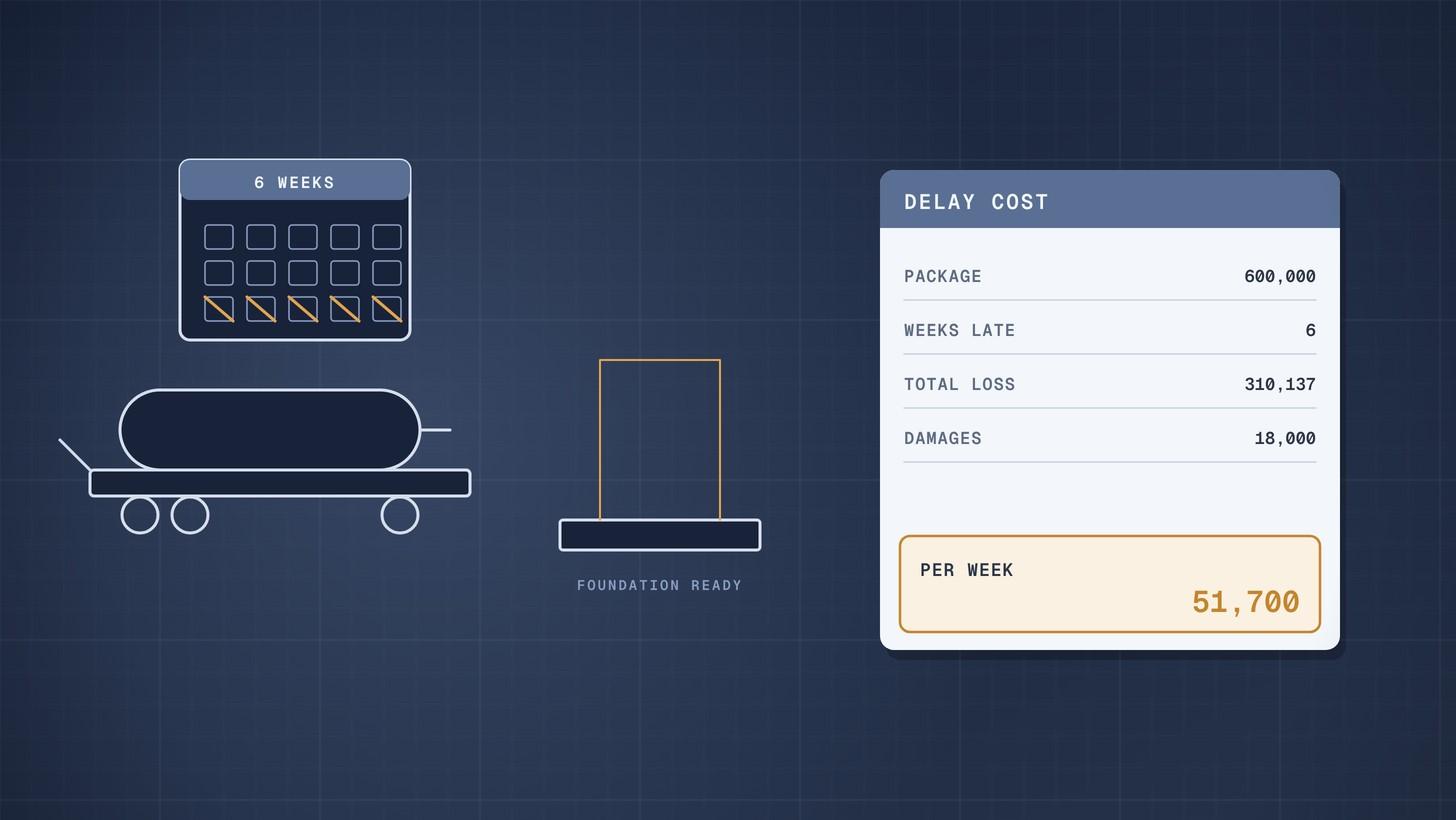
Cost of Late Equipment Delivery: Worked Example
How to calculate the weekly cost of late equipment delivery, compare it with liquidated damages and use it to set a damages rate a supplier can accept.
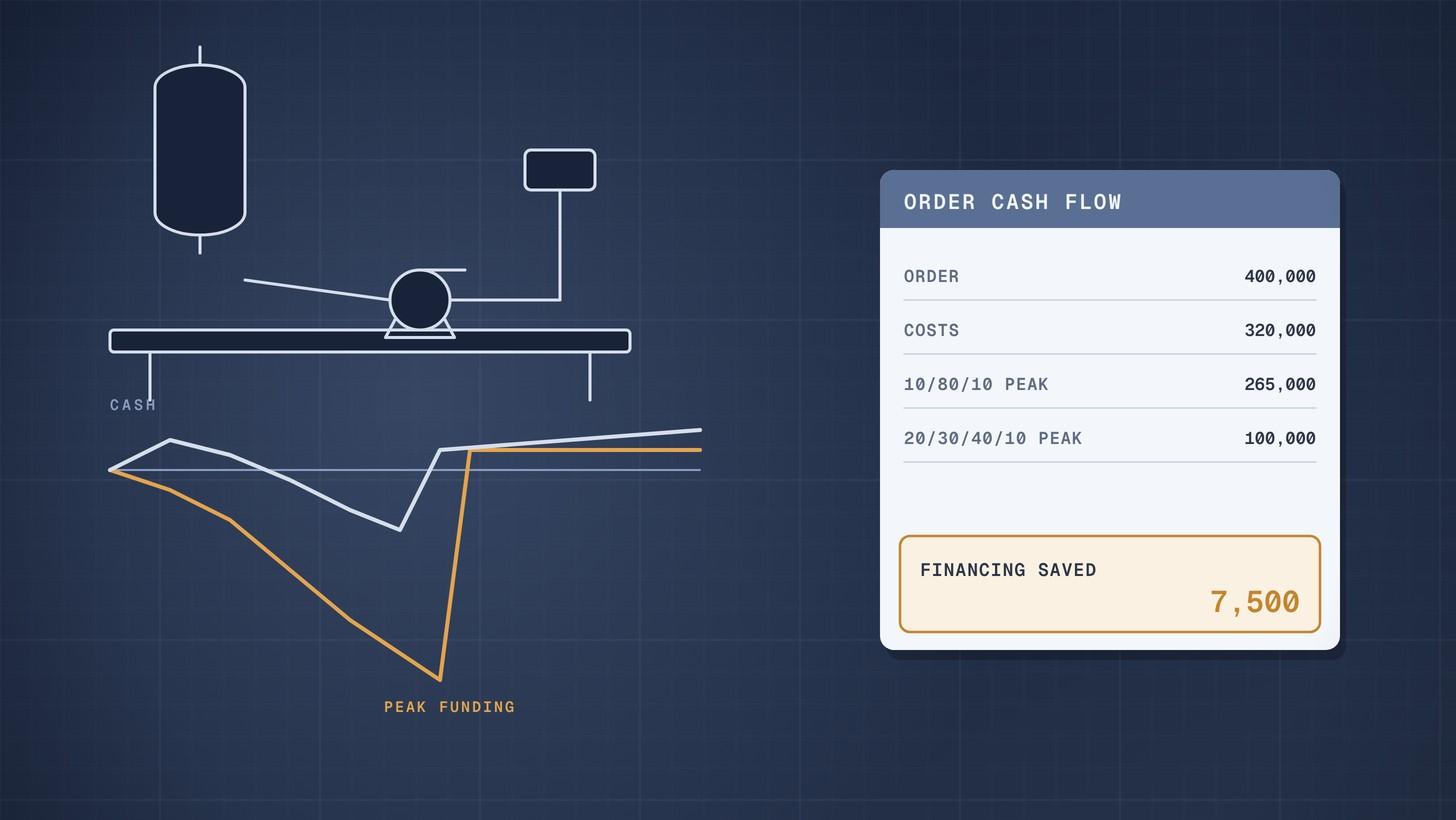
Payment Milestones and Supplier Cash Flow: Worked Example
How payment milestones, bonds and retention shape an equipment supplier's cash curve, with a worked example comparing two schedules on a £400,000 order.
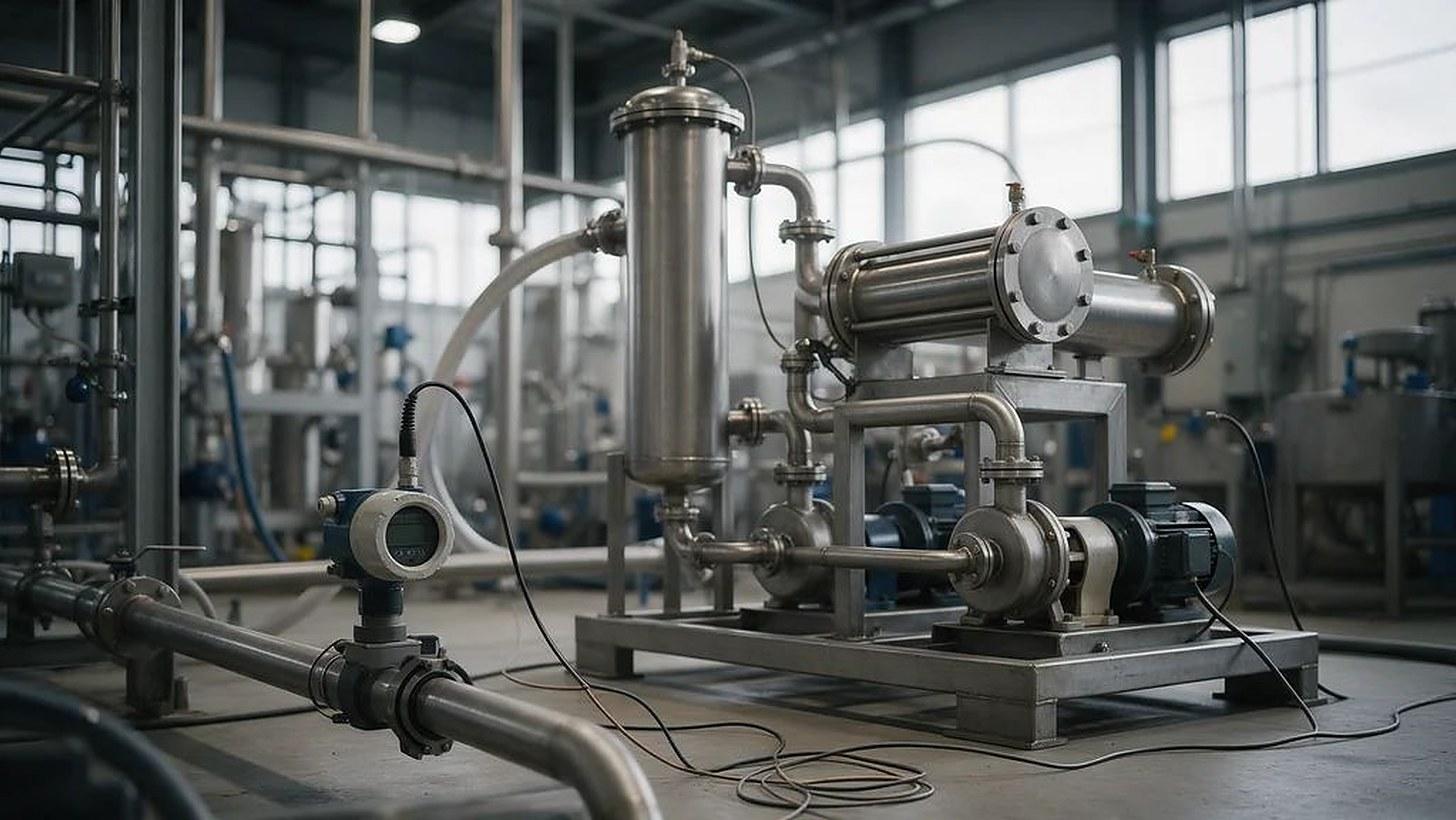
Performance Guarantees and Performance Tests for Process Packages
What a process package supplier should guarantee, how the performance test is run, and what happens when the plant falls short, with a worked example of performance liquidated damages.