
Centrifugal vs Positive Displacement Pumps: How to Choose
Centrifugal pumps suit thin liquids at steady duty; positive displacement pumps suit viscous, shear sensitive or metered duties. Here is how to choose before the RFQ.
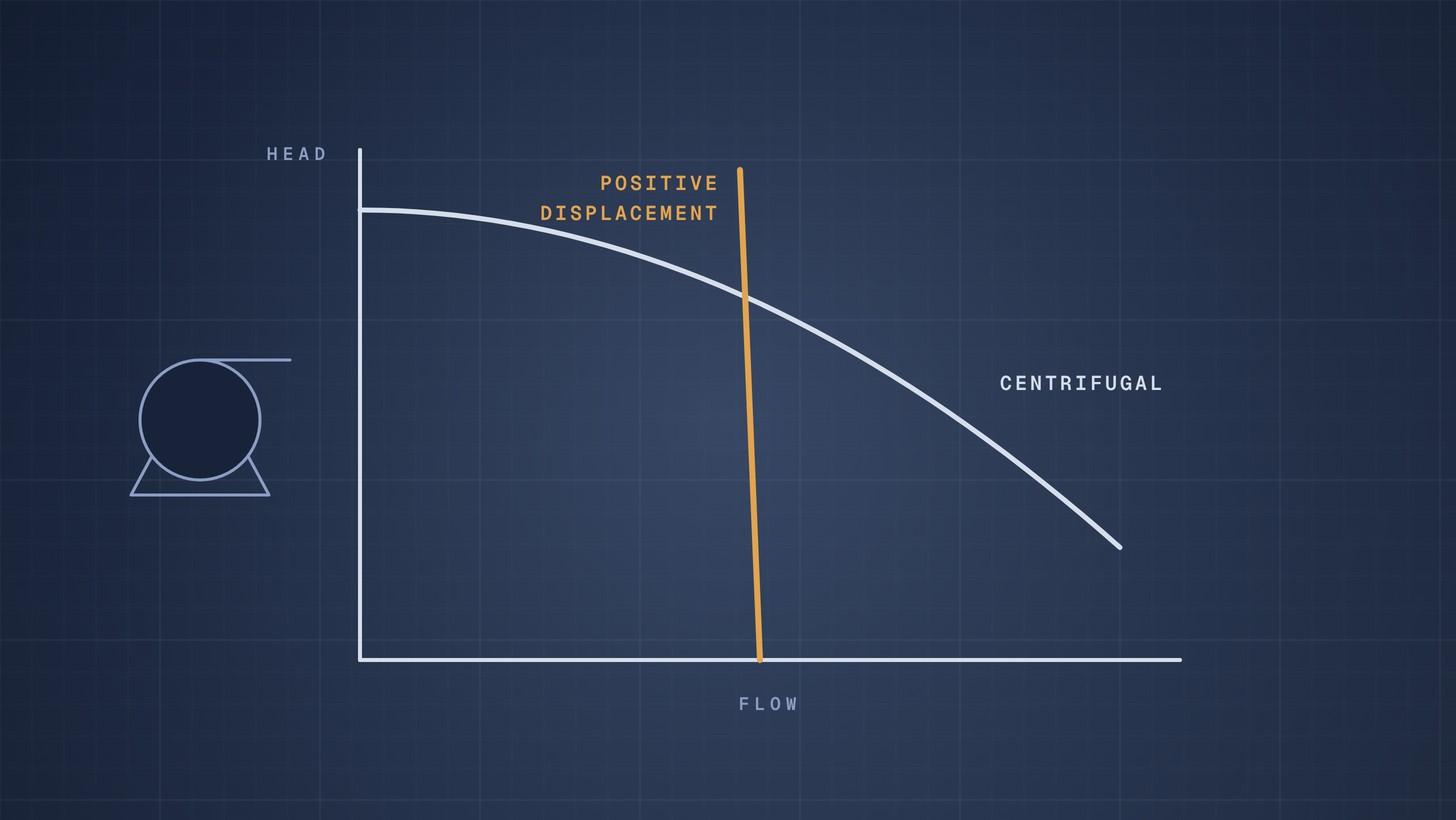
Choose a centrifugal pump for thin, clean liquids at a fairly steady duty, where flow can vary with system pressure; choose a positive displacement pump for viscous liquids, shear sensitive products, accurate metering, or high pressure at low flow. The deciding questions are viscosity, how flow should behave when pressure changes, how gently the product must be handled, the suction conditions, and what happens if the pump runs dry.
Why this matters now
The pump type decides the datasheet, the suppliers you invite, and the protection you must add. Get it wrong and every bid will be for the wrong machine, or a centrifugal pump will be bought for a duty where it wastes power every hour it runs. Settle the type before the RFQ, not during bid evaluation.
Create and manage RFQs in minutes
ChemCapital handles the entire procurement cycle, from structured RFQs and supplier comparisons to formal purchase orders and delivery tracking.
How each type works
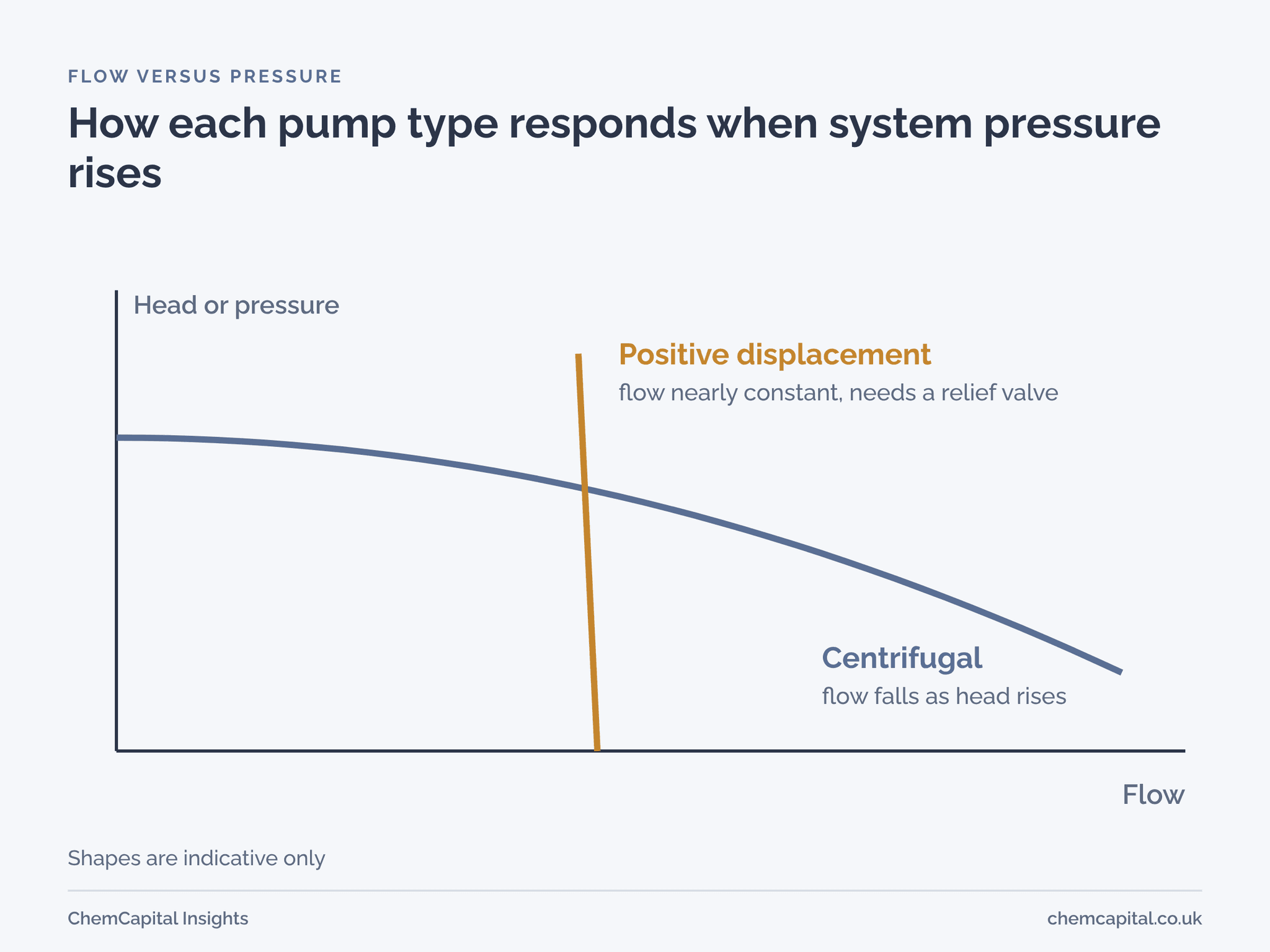
The Hydraulic Institute groups pumps into two classes. Rotodynamic pumps, which include centrifugal pumps, add energy to the liquid through a rotating impeller. Positive displacement pumps trap and move a fixed volume with each shaft rotation, either by reciprocating pistons, plungers or diaphragms, or by rotary elements such as screws, gears, lobes and vanes [1].
That difference drives everything else. A centrifugal pump's flow falls as system resistance rises, following its head and flow curve. A positive displacement pump's flow stays nearly constant as pressure changes, with only slight slip losses at high pressure [2]. Our guide on how to read a pump curve shows the centrifugal side.
The five questions that decide it
| Question | Points to centrifugal | Points to positive displacement |
|---|---|---|
| Viscosity | Thin liquids, close to water | Viscous liquids, where centrifugal performance falls away |
| Flow versus pressure | Flow may vary with system pressure | Flow must stay constant, or be metered |
| Shear | Robust liquids | Shear sensitive products, emulsions, polymers, food |
| Suction | Adequate NPSH available | Depends on type; check each design |
| Dry running and blocked discharge | Must not run dry; minimum flow protection | Relief protection needed; some types must not run dry either |
Viscosity. A more viscous liquid reduces a centrifugal pump's flow, head and efficiency, and increases the power needed and the NPSH required [3]. The Hydraulic Institute's correction method, ANSI/HI 9.6.7, estimates those losses from the water curve; its correction factors are based on data up to 3,000 cSt and can be extended to 4,000 cSt with more uncertainty [4] [3]. One guide suggests derating begins once viscosity passes roughly 100 cSt, while for positive displacement pumps higher viscosity reduces internal slip, so they handle thick liquids well [2].
Shear. Centrifugal impellers impose high shear, which can damage polymers and emulsions. Rotary positive displacement designs such as screw, lobe and progressive cavity pumps run slower and move liquid in gentle cavities [2]. Progressive cavity pumps, for example, can move oil and water mixtures without emulsifying them, and pass soft solids [5].
Suction. Centrifugal pumps need enough NPSH available at the impeller eye to avoid cavitation. Reciprocating pumps must also overcome acceleration head in the suction line [2]. See NPSH explained before you fix the type.
Dry running. Centrifugal pumps rely on the liquid to cool seals and wear rings, so running dry damages them quickly [2]. Some positive displacement pumps are just as sensitive: dry running is the most common cause of progressive cavity pump failure, because heat destroys the stator, so sensors on the suction or the stator are used to stop the pump [5].
Blocked discharge. This is the safety difference. A positive displacement pump keeps pushing its volume until something gives, so a relief valve on the discharge, upstream of the first isolation valve, is essential. A centrifugal pump instead needs protection against running at low or zero flow, such as a minimum flow bypass [2].
Matching the type to the duty
- Water, thin solvents, cooling water, general transfer. Centrifugal, often to a standard such as API 610 or ASME B73.1 depending on service [2].
- Chemical injection and dosing. Diaphragm or plunger metering pumps, for accurate, adjustable flow; see dosing pump versus metering pump.
- Heavy oils, resins, syrups. Rotary screw or gear pumps [2].
- Sludges, slurries, pastes and food products. Progressive cavity or lobe pumps [5].
- High pressure at low flow. Reciprocating plunger pumps, usually with pulsation dampeners [2].
- Portable, solids tolerant, no electricity at the point of use. Air operated diaphragm pumps; see our AODD pump guide.
Control, maintenance and cost of ownership
The type also changes how you control flow and what you maintain.
- Flow control. A centrifugal pump is often throttled with a control valve or run on a variable speed drive. A positive displacement pump is normally controlled by speed or stroke, never by throttling the discharge, because closing a valve simply raises the pressure.
- Wear parts. Centrifugal pumps wear impellers, wear rings and mechanical seals. Positive displacement pumps add their own: stators and rotors in progressive cavity pumps, diaphragms and valves in metering pumps, lobes and timing gears in lobe pumps. Ask for the recommended spares and their prices with the bid.
- Footprint and accessories. Positive displacement pumps often need a relief valve, pulsation dampeners or dry running sensors. Price them with the pump so bids are complete.
- Energy. On thin liquids at their best efficiency point, centrifugal pumps are hard to beat. On viscous liquids the balance can swing the other way, as the example below shows.
Compare bids on life cycle cost, not just purchase price.
Common selection mistakes
- Using the water curve for a viscous liquid. Always ask for viscous performance, or apply the correction yourself.
- Forgetting the temperature range. A liquid that is thin when hot may be thick at start up in winter.
- No relief protection on a positive displacement pump. A blocked discharge can burst a pipe or a casing.
- Ignoring shear. A polymer or emulsion can be ruined by a centrifugal impeller even if the hydraulics look fine.
Practical example
Illustrative figures. A plant needs to transfer 20 m³ per hour against 40 m of head. On water, a suitable centrifugal pump runs at 65% efficiency. The actual liquid is viscous enough that, using correction factors from the HI method, the pump's efficiency falls to 55% of its water value. For simplicity, this ignores the head and flow corrections, which would make the centrifugal pump bigger still.
| Case | Calculation | Shaft power |
|---|---|---|
| Hydraulic power | 1,000 kg/m³ × 9.81 × (20 ÷ 3,600) m³/s × 40 m | 2.18 kW |
| Centrifugal on water | 2.18 ÷ 0.65 | 3.35 kW |
| Centrifugal on the viscous liquid | 2.18 ÷ (0.65 × 0.55) | 6.10 kW |
| Rotary positive displacement pump at 70% | 2.18 ÷ 0.70 | 3.11 kW |
The difference is about 3 kW. Over 6,000 running hours a year at £0.20 per kWh, that is about 17,900 kWh and £3,580 a year, every year. Your own correction factors, run hours and tariff replace these; the point is to run the numbers before the type is fixed.
What to put in the RFQ
- The liquid's viscosity at pumping temperature, ideally across the temperature range, and whether it is shear sensitive.
- Solids content and size.
- Required flow behaviour: constant, variable, or metered, with turndown.
- NPSH available at the pump suction.
- Protection expected: relief valve on positive displacement pumps, minimum flow or dry running protection as needed.
- Whether bidders may offer the other pump type as an alternative, with the power and life cycle cost shown.
Then use the centrifugal pump datasheet or the maker's positive displacement datasheet so every bid answers the same questions.
If you are the supplier
If the buyer has asked for the wrong type for the duty, say so with numbers: viscous performance, power, and life cycle cost for both options. A well argued alternative wins more trust than a compliant bid for a pump that will disappoint.
Where ChemCapital fits
Different pump types usually mean different makers. ChemCapital's AI Supplier Discovery finds suppliers by pump type, duty and region, so a positive displacement duty reaches positive displacement specialists instead of a list of centrifugal pump houses.
Ready to send the right pump RFQ to the right makers? Start a free 14 day ChemCapital trial, with no credit card needed.
Frequently asked questions
What is the main difference between centrifugal and positive displacement pumps?
A centrifugal pump adds energy through a rotating impeller, so its flow falls as system pressure rises. A positive displacement pump moves a fixed volume per rotation, so its flow stays nearly constant as pressure changes.
When should I use a positive displacement pump?
For viscous liquids, shear sensitive products, accurate metering or dosing, sludges and pastes, or high pressure at low flow.
At what viscosity does a centrifugal pump become unsuitable?
There is no single cut off. Performance falls as viscosity rises, and the Hydraulic Institute correction method covers data up to 3,000 cSt. Run the corrections and compare power and cost against a positive displacement pump for your duty.
Does a positive displacement pump need a relief valve?
Yes. If the discharge is blocked, a positive displacement pump keeps building pressure, so a relief valve upstream of the first isolation valve, or equivalent protection, is needed.
Can positive displacement pumps run dry?
It depends on the type. Some tolerate it briefly; others, such as progressive cavity pumps, are quickly damaged because heat destroys the stator, so dry running protection is used.
Continue reading
Informational only, not procurement or legal advice. Cited names, frameworks, and statistics belong to their respective owners.
Create and manage RFQs in minutes
ChemCapital handles the entire procurement cycle, from structured RFQs and supplier comparisons to formal purchase orders and delivery tracking.
Start for freeRelated articles
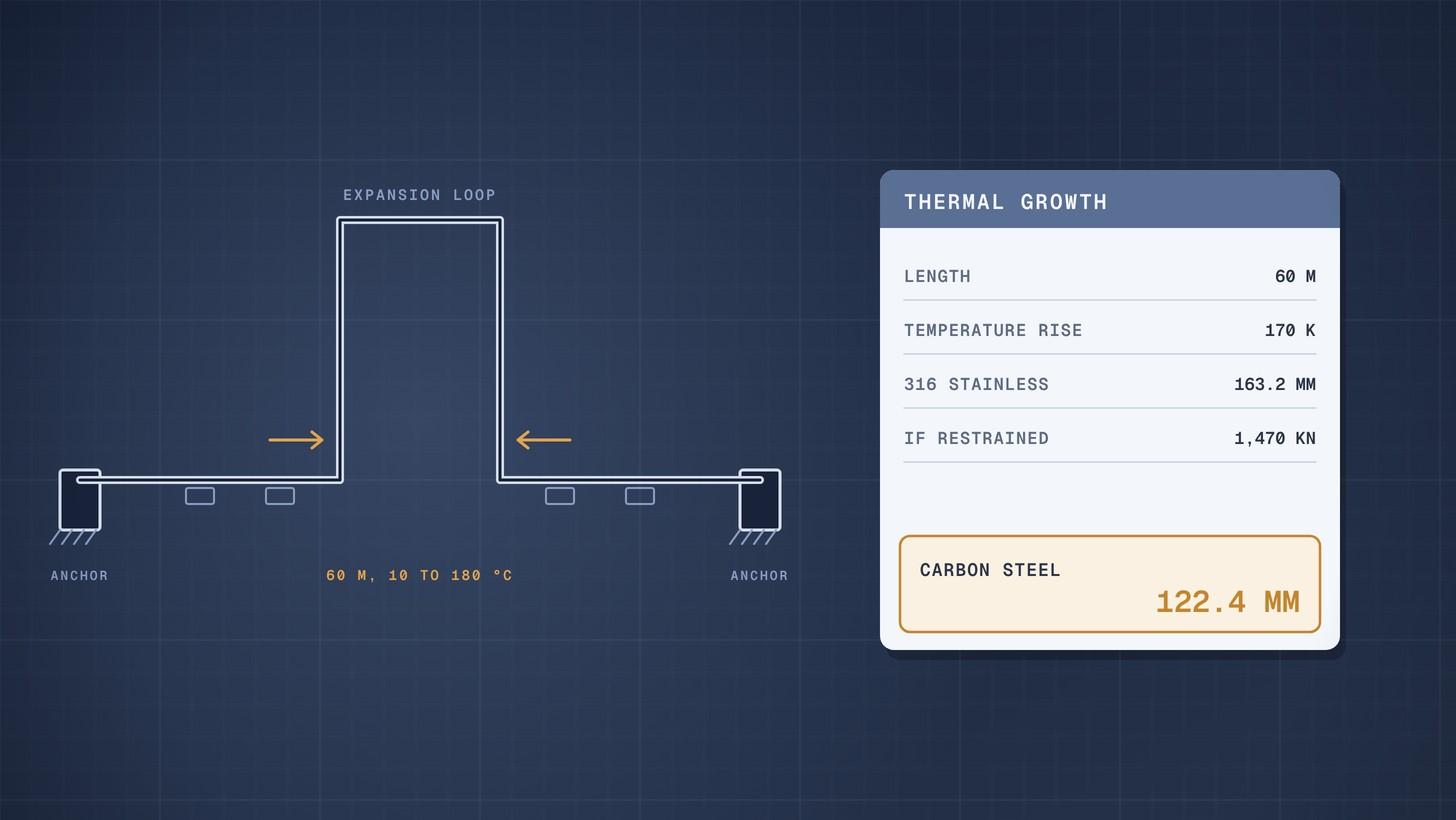
Pipe Thermal Expansion: Worked Example
How to calculate pipe thermal expansion for carbon and stainless steel, what restrained expansion does, and how loops and expansion joints absorb it.

Horizontal Tank Volume When Partly Filled: Worked Example
How to calculate the volume of a partly filled horizontal tank with dished heads, with a worked example and a full dip table you can rebuild in a spreadsheet.
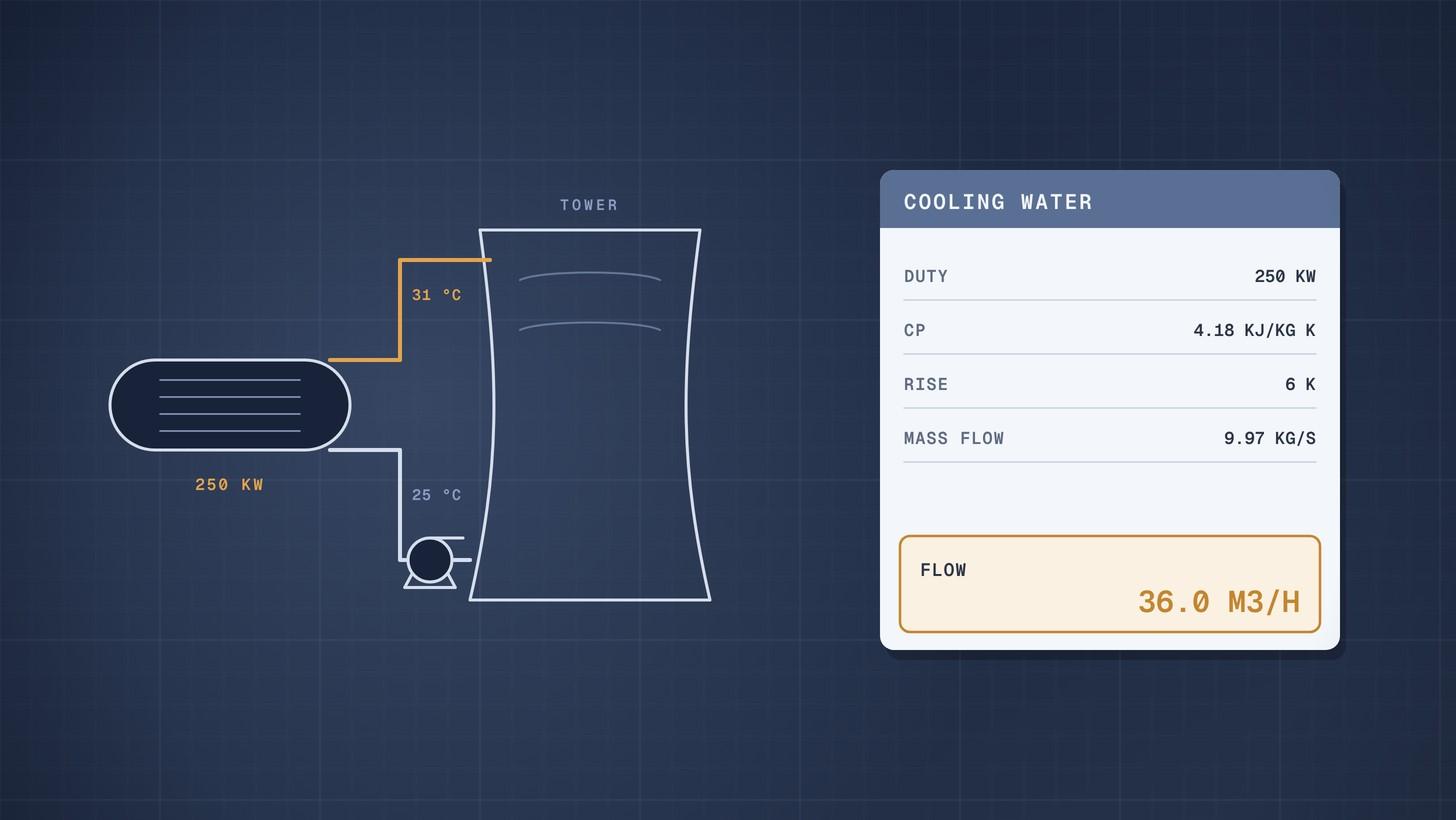
Cooling Water Flow Calculation: Worked Example
How to calculate cooling water flow from heat duty and temperature rise, then size the cooling tower circulation, evaporation and make up water.