
Installed Cost Factors for Equipment: Hand Method Worked Example
How to turn equipment quotes into an installed cost estimate with Hand's factors by equipment type, worked through for a small distillation unit and compared with a Lang estimate.
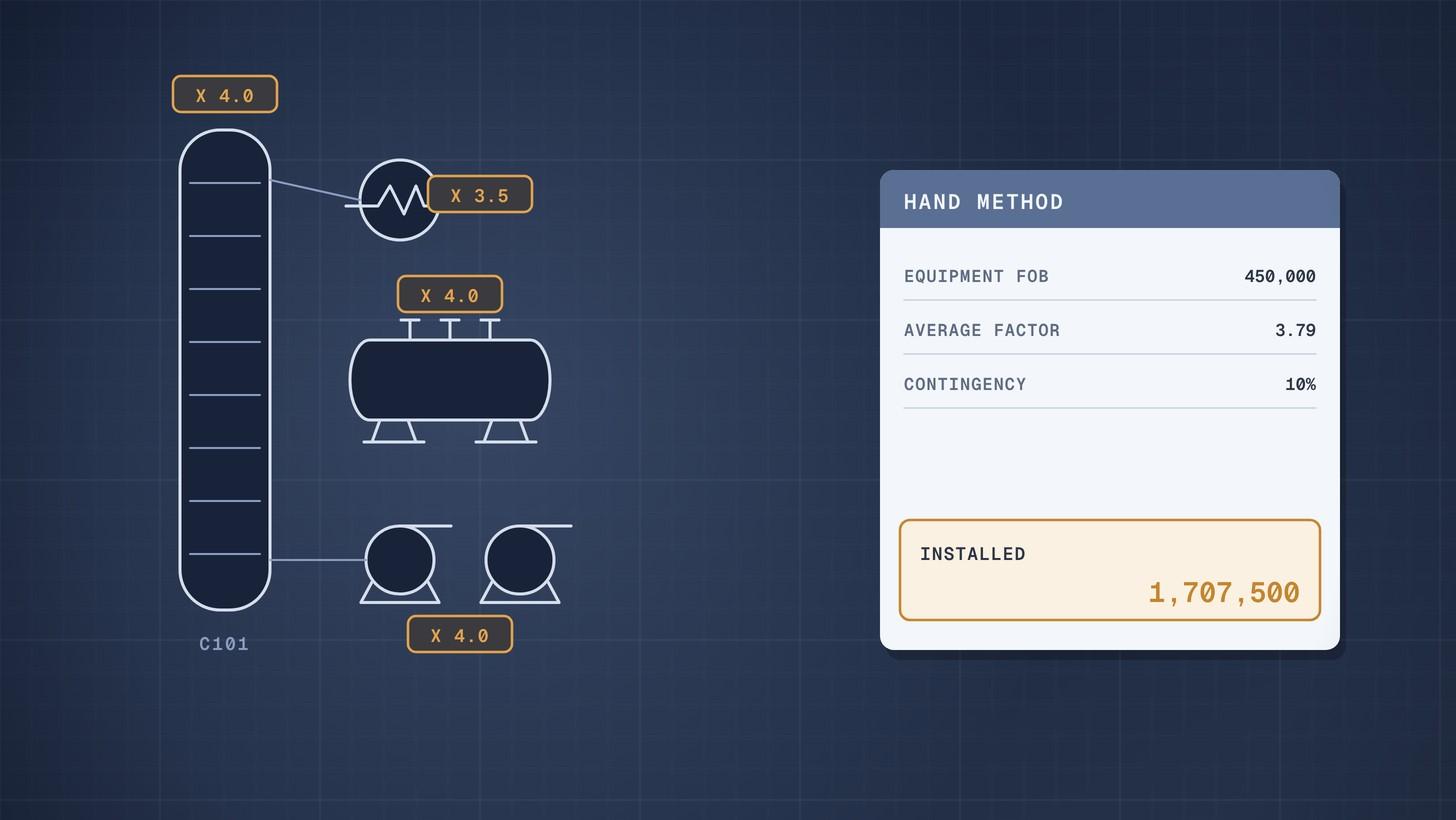
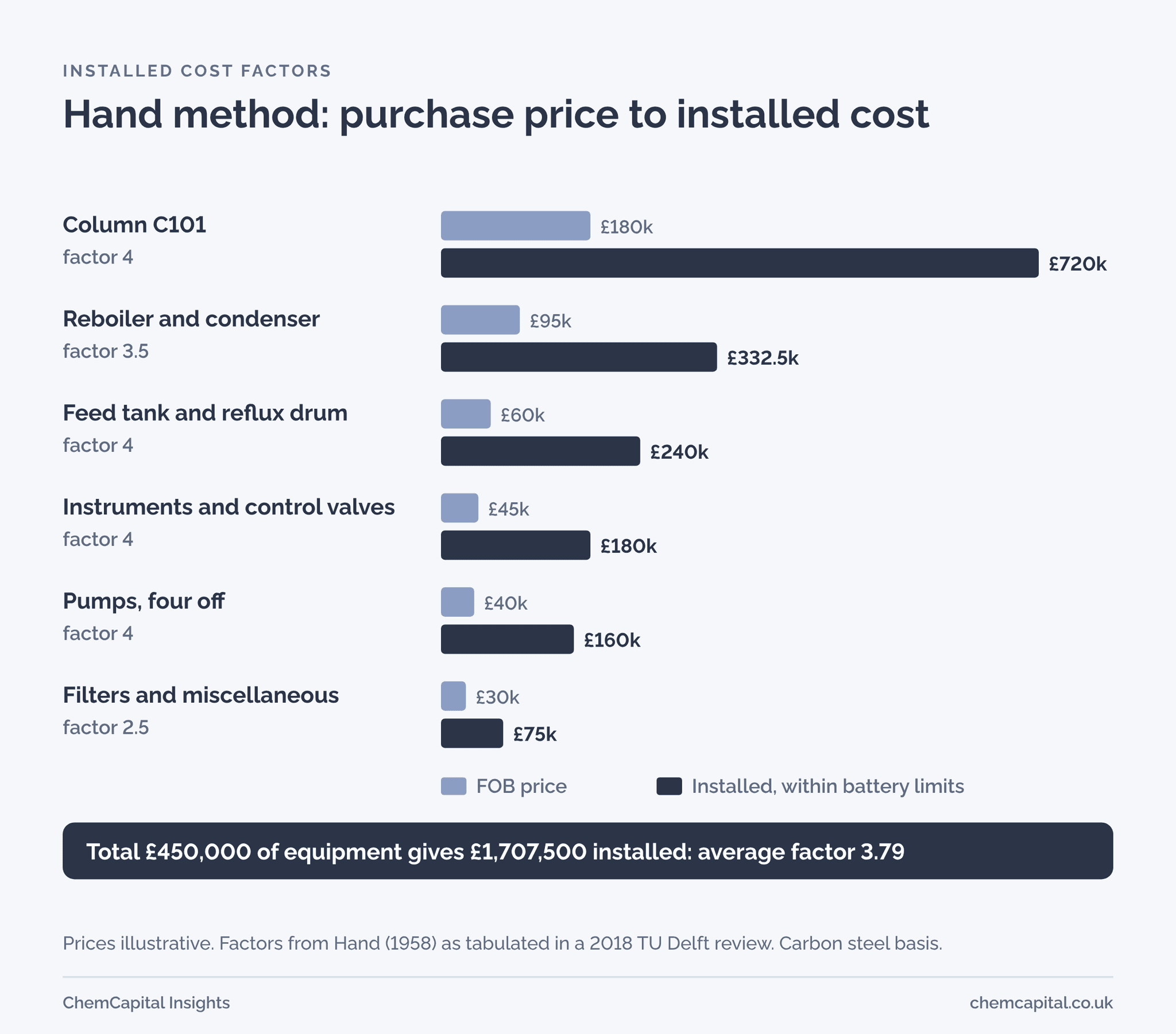
Installed cost factors turn the purchase price of each item of equipment into its installed cost: you multiply each item by a factor for its type, then add them up. In the Hand method, columns and vessels take a factor of 4, heat exchangers 3.5 and compressors 2.5. In the worked example below, £450,000 of equipment becomes about £1.71 million installed within battery limits, an average factor of 3.79.
The method sits between a single Lang factor and a detailed estimate. It needs a priced equipment list, which you can build from supplier quotes, and it gives a better answer than one factor for the whole plant.
Why this matters now
Early capital estimates decide whether a project goes ahead. Most start from the price of the main equipment, because that is what suppliers can quote quickly. The installation around it (foundations, steel, piping, electrical, instruments, insulation, paint and the labour to fit it) usually costs more than the equipment itself. Getting that multiplier right matters more than shaving a few per cent off a quote.
Costs are also moving. Chemical Engineering's plant cost index, published monthly, has recently reported an all time high after eleven consecutive monthly rises [1]. Old factored estimates need bringing up to date before they are reused; our guide to CEPCI cost escalation shows how.
Create and manage RFQs in minutes
ChemCapital handles the entire procurement cycle, from structured RFQs and supplier comparisons to formal purchase orders and delivery tracking.
From one factor to one per item
The simplest factored estimate is the Lang method. It multiplies total delivered equipment cost by a single factor for the type of plant. Lang's original values were 3.10 for solids processing, 3.63 for mixed solids and fluids and 4.74 for fluids processing [2]. Our Lang factor guide covers it in full.
One factor hides a lot. A plant full of pumps and vessels costs more to install, per pound of equipment, than one dominated by a large compressor or a furnace. In 1958, Hand proposed a factor for each equipment type instead. In a 2018 TU Delft review of factorial techniques, Hand's method sums the free on board (FOB) cost of each item multiplied by its factor, and the result is the investment within battery limits, covering the process units only [2]. Each factor is built up from field materials, field labour and indirect costs [2].
| Equipment type | Hand factor |
|---|---|
| Columns | 4.0 |
| Pressure vessels | 4.0 |
| Pumps | 4.0 |
| Instruments | 4.0 |
| Heat exchangers | 3.5 |
| Compressors | 2.5 |
| Miscellaneous equipment | 2.5 |
| Furnaces (priced erected) | 2.0 |
These are the values the TU Delft review tabulates [2]. Furnaces have the lowest factor because their price is quoted erected. The review also notes that Hand's factors were always within 20% of Guthrie's later factors, and generally higher [2].
What the factors cover, and what they do not
- Basis. Hand's equipment costs are FOB, whereas Lang's are delivered to site [2]. Use the right basis, or add freight before applying the factor.
- Scope. The result is battery limits only [2]. Offsites, utilities outside the unit, land and working capital are extra.
- Materials. The factors assume carbon steel, low pressure plant; the review points out that Hand's method had no alloy correction [2]. For stainless equipment, the installation labour does not scale with the higher equipment price, so applying the full factor to a stainless price overstates installed cost.
- Contingency. Hand suggested about 10% of total cost [2]. Set your own allowance by risk; see contingency in capital cost estimates.
What sits inside a factor of 4
It helps to see where the multiplier comes from. A 2002 report for the US Department of Energy's National Energy Technology Laboratory gives bulk material and labour factors for liquid and slurry systems at up to 150 psig [3]. Materials are a percentage of the bare equipment cost; labour is a percentage of each installed material.
| Installation item | Material, % of equipment | Labour, % of that material | Labour, % of equipment |
|---|---|---|---|
| Piping | 30 | 50 | 15.0 |
| Electrical | 8 | 75 | 6.0 |
| Instruments | 6 | 40 | 2.4 |
| Foundations | 5 | 133 | 6.7 |
| Structural steel | 4 | 50 | 2.0 |
| Miscellaneous | 4 | 80 | 3.2 |
| Buildings | 3 | 100 | 3.0 |
| Insulation | 1 | 150 | 1.5 |
| Painting | 0.5 | 300 | 1.5 |
| Total | 61.5 | 41.3 |
The same report gives labour to set a distillation column at 30% of its delivered cost, and 20% for a heat exchanger or tank [3]. For a column, the direct field cost is therefore about 1 + 0.615 + 0.413 + 0.30 = 2.33 times the equipment price. Hand's factors also carry indirect costs [2], which helps explain why they sit nearer 4. Piping is the biggest single item, so a compact skid with short pipe runs can install for noticeably less than the same equipment spread across a plant.
Worked example: a small solvent recovery unit
A site plans a solvent recovery unit. Budget quotes give FOB prices for the main items. All prices are illustrative; the factors are Hand's.
| Item | Type | FOB price | Hand factor | Installed cost |
|---|---|---|---|---|
| Column C101 | Column | £180,000 | 4.0 | £720,000 |
| Reboiler E101 and condenser E102 | Heat exchangers | £95,000 | 3.5 | £332,500 |
| Feed tank and reflux drum | Pressure vessels | £60,000 | 4.0 | £240,000 |
| Pumps P101A/B and P102A/B | Pumps | £40,000 | 4.0 | £160,000 |
| Instruments and control valves | Instruments | £45,000 | 4.0 | £180,000 |
| Filters and miscellaneous | Miscellaneous | £30,000 | 2.5 | £75,000 |
| Total | £450,000 | 3.79 average | £1,707,500 |
Adding Hand's suggested 10% contingency gives about £1.88 million within battery limits.
Compare with Lang. Add 5% freight to reach a delivered cost of £472,500 and apply the fluids factor of 4.74: about £2.24 million. The two are built on different bases: Hand on FOB prices with a result inside battery limits [2], Lang on delivered prices with one factor derived from whole plants. The gap of about £530,000 is a reminder to state the scope and basis of every estimate, and to compare estimates only when they share both.
Where the money goes. The column is 40% of the equipment price and 42% of the installed cost. The exchangers are 21% of the price but under 20% of the installed cost, because their factor is lower. If a second exchanger quote came in £20,000 cheaper, installed cost would fall by £70,000, not £20,000. That is the arithmetic that makes the equipment quotes matter at this stage.
How accurate is it?
Not very, and that is fine if you say so. ASTM's cost estimate classification puts estimates made at 1% to 15% project definition, for a concept study or feasibility, in Class 4, prepared primarily by stochastic methods such as factors [4]. A US Department of Energy laboratory report on equipment cost estimation gives order of magnitude estimates an accuracy of plus 50% to minus 30%, and budget estimates plus 30% to minus 15% [3].
The TU Delft review tested several factorial methods against real cases. It found the success rate depended more on the type of case study than on the method chosen [2]. A factored estimate is a good way to compare options on a common basis, and to decide whether a project is worth more definition. IChemE's long standing guide to capital cost estimating likewise treats its short cut costing as an approximate guide and a starting point [5].
Making the factors work for you
- Start from real quotes. The factor multiplies whatever price you feed it. A budgetary quote with clear scope beats a catalogue price; see budgetary quote vs firm quote.
- Use the right basis. FOB for Hand, delivered for Lang.
- Correct for materials and pressure. Apply the factor to a carbon steel equivalent price, then add the extra cost of the alloy item itself.
- Escalate old data. Use a cost index to bring historical prices and factors to today.
- Record your assumptions. Basis, factors, exclusions and contingency, so the next estimate can build on this one.
ChemCapital's Project Costing builds cost estimates from the quotes in your quote library, so the equipment prices at the heart of a factored estimate come from real supplier offers, with the source of every number kept.
Ready to build early estimates on real equipment quotes? Start a free 14 day ChemCapital trial, with no credit card needed.
Frequently asked questions
What is the Hand method of cost estimation?
It estimates installed cost within battery limits by multiplying the free on board price of each item of equipment by a factor for its type, then adding them up. Hand's factors are 4.0 for columns, vessels, pumps and instruments, 3.5 for heat exchangers, 2.5 for compressors and miscellaneous equipment, and 2.0 for furnaces priced erected.
What is the difference between Lang and Hand factors?
Lang uses one factor for the whole plant, applied to total delivered equipment cost. Hand uses a factor per equipment type, applied to free on board prices, and gives battery limits installed cost. Hand is more detailed and reflects the mix of equipment in the plant.
What does an installation factor include?
The field materials, field labour and indirect costs needed to install the equipment: foundations, structural steel, piping, electrical, instruments, insulation and painting. Hand's factors give battery limits cost, so offsites, land and working capital are extra, and they assume carbon steel, low pressure plant.
How accurate is a factored cost estimate?
Factored estimates are early estimates, typically Class 4 or Class 5 in the ASTM and AACE classification. A US Department of Energy laboratory report gives order of magnitude estimates an accuracy of plus 50% to minus 30%, so state the range alongside the number.
Continue reading
Informational only, not procurement or legal advice. Cited names, frameworks, and statistics belong to their respective owners.
Create and manage RFQs in minutes
ChemCapital handles the entire procurement cycle, from structured RFQs and supplier comparisons to formal purchase orders and delivery tracking.
Start for freeRelated articles
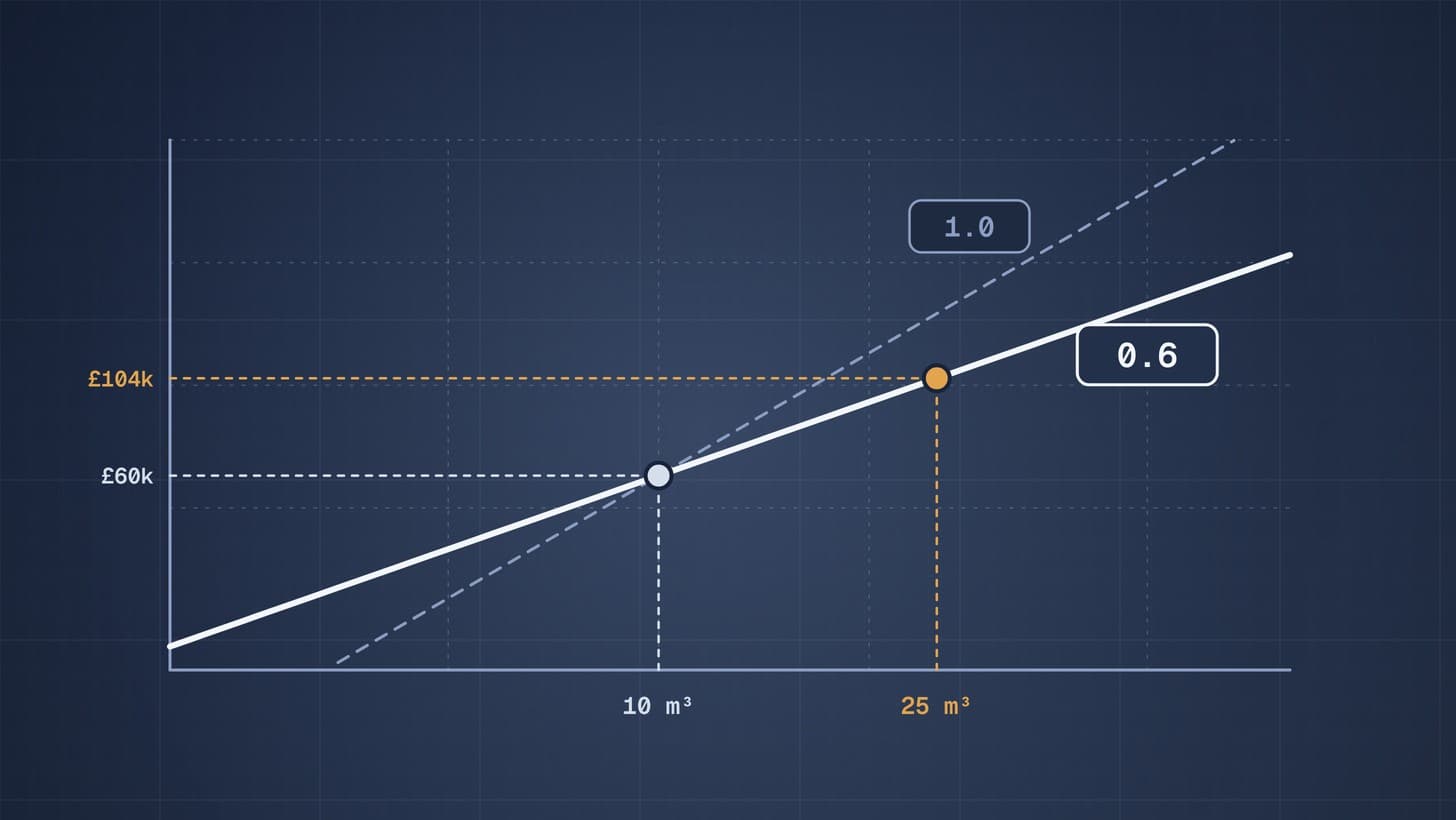
The Six Tenths Rule: Scaling Equipment Costs, with Worked Examples
How to scale a known equipment price to a new capacity with the six tenths rule, better exponents by equipment type, and how to bring an old quote up to date.
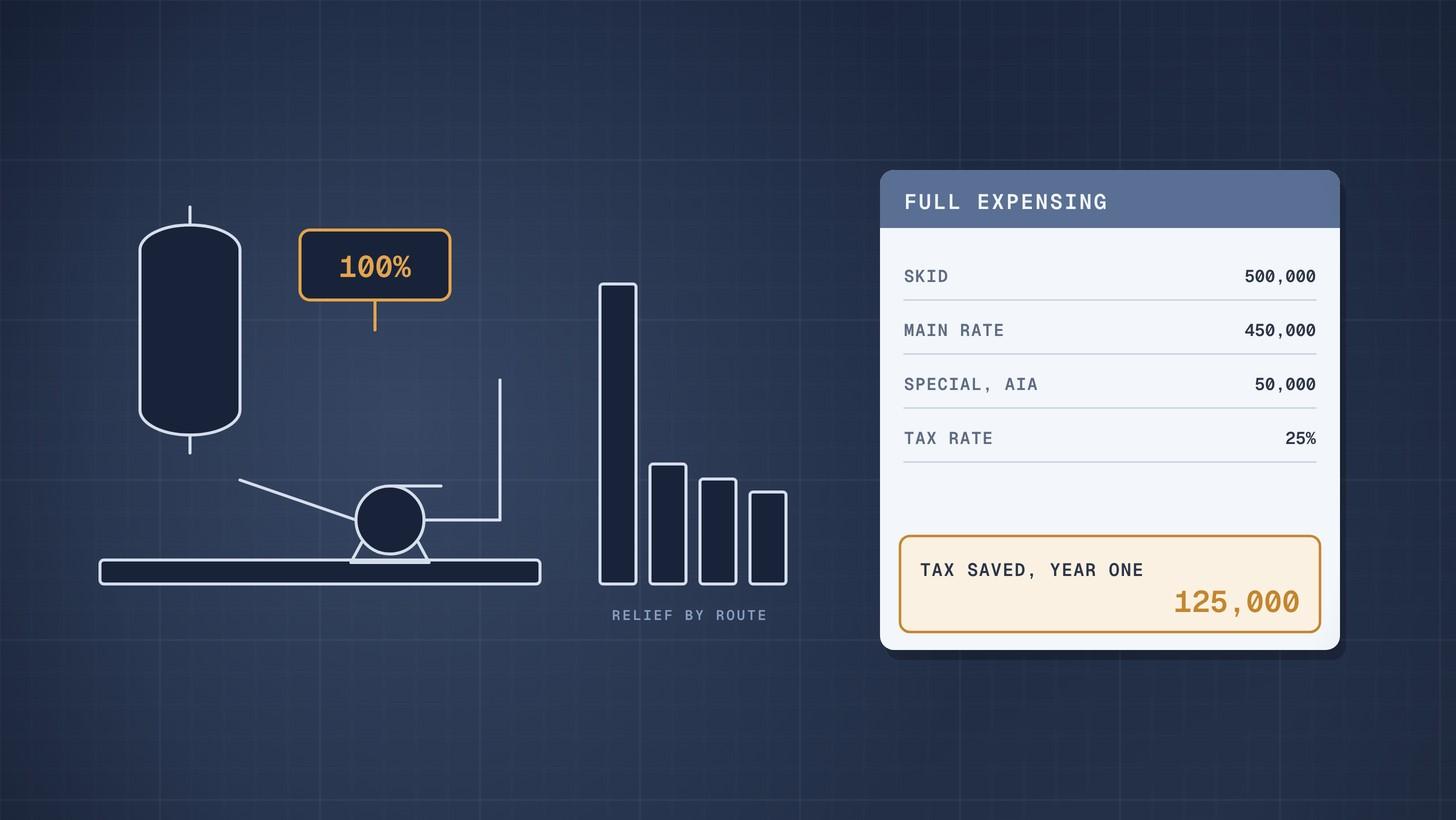
Full Expensing for Plant and Machinery: Worked Example (UK)
How full expensing, the annual investment allowance, first year allowances and writing down allowances apply to a £500,000 process skid, with the November 2026 rates.
Spare Parts Carrying Cost: Worked Example
How to calculate the yearly carrying cost of spare parts, build your own carrying rate and decide which items on a recommended spares list are worth stocking.