
Material Requisition vs Purchase Requisition: The EPC Document Chain
On EPC projects the material requisition is the engineering document that defines what to buy; the purchase requisition is the internal approval to spend. Here is the full chain from MR to purchase order.
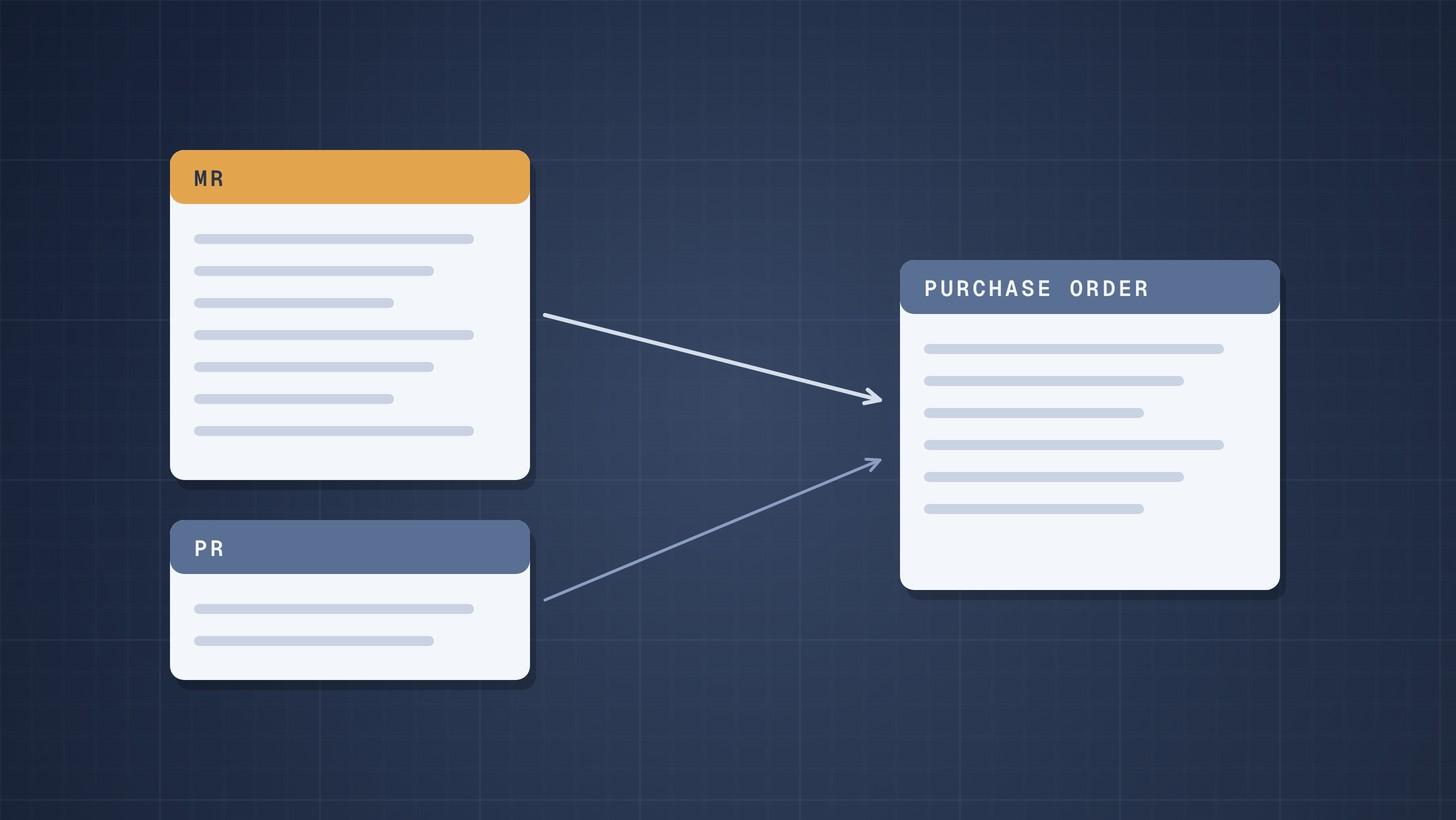
A material requisition (MR) is the engineering document that defines what to buy: the scope, quantities, specifications, datasheets and inspection and documentation requirements for a package. A purchase requisition (PR) is an internal request and budget approval asking procurement to buy it. On EPC projects the MR drives the RFQ and the technical evaluation, and the PR, or its equivalent, authorises the spend before the purchase order is issued.
Why this matters now
The two terms are used loosely, and the confusion costs time. A procurement team from an operating plant thinks of a requisition as a one line request in the ERP system. An engineering contractor means a technical package with dozens of attachments, and who issues it depends on whether the contractor works under an EPC or EPCM model; our guide to EPC vs EPCM explains the difference. Suppliers receive RFQs built from MRs of very different quality. Knowing what each document is, and who owns it, makes the chain faster and the RFQs better.
Create and manage RFQs in minutes
ChemCapital handles the entire procurement cycle, from structured RFQs and supplier comparisons to formal purchase orders and delivery tracking.
The documents in the chain
| Document | Written by | What it is for | Goes to suppliers? |
|---|---|---|---|
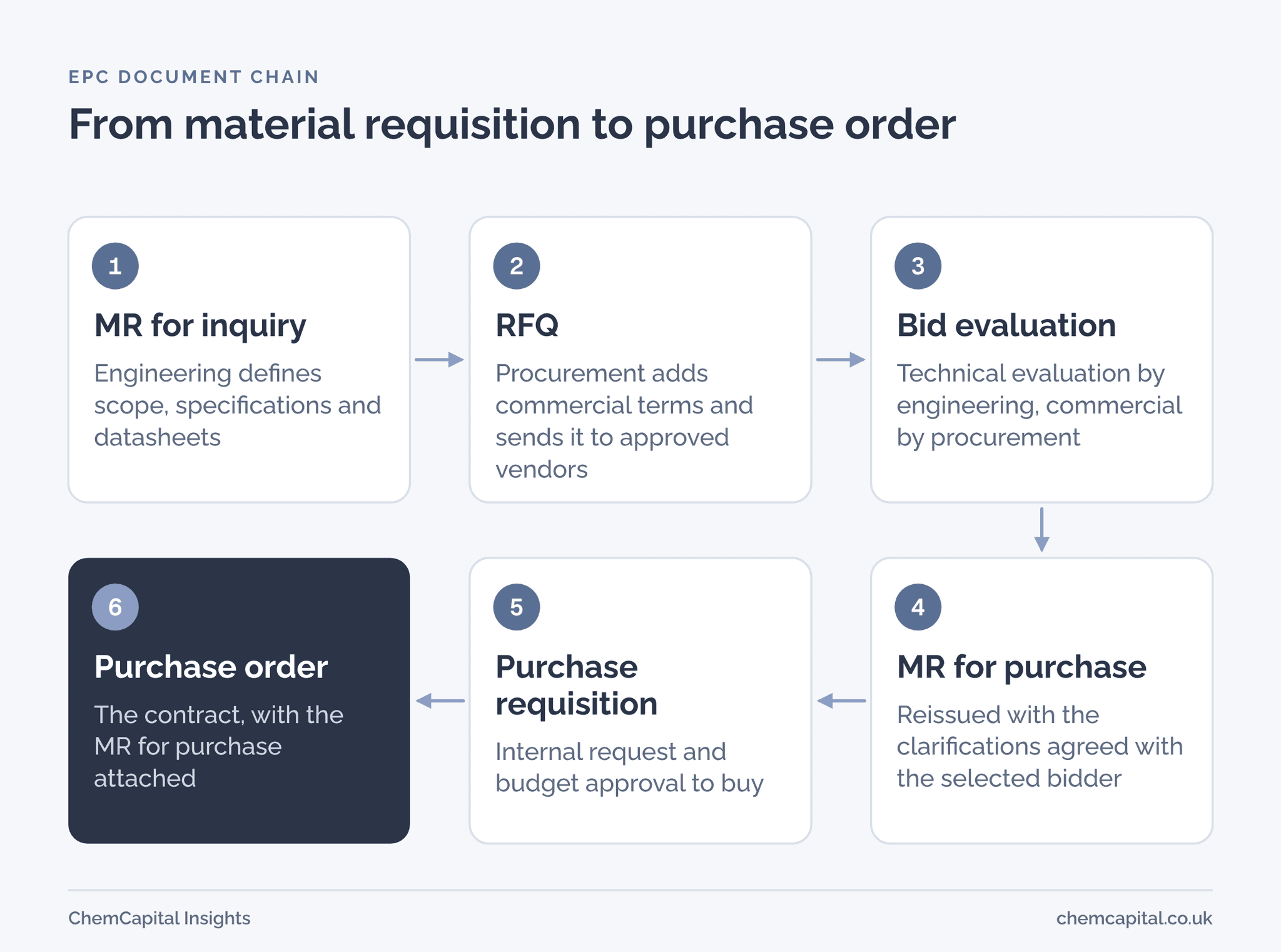
| Material requisition for inquiry | Engineering | Defines the scope and technical requirements for quotation | Yes, as the technical part of the RFQ |
| Request for quotation | Procurement | Commercial terms, deadline and bid instructions, with the MR attached | Yes |
| Technical bid evaluation | Engineering | Checks each bid against the MR and records clarifications | No |
| Commercial bid evaluation | Procurement | Compares price, terms and delivery of technically acceptable bids | No |
| Material requisition for purchase | Engineering | The MR updated with agreed clarifications and the selected supplier's offer | Yes, as the technical part of the order |
| Purchase requisition | Requesting department | Internal request and budget approval to buy | No |
| Purchase order | Procurement | The contract with the supplier | Yes |
The engineering contractor's MR is the formal document that starts procurement of materials and equipment, bundling specifications, quantities, datasheets and standards from which the RFQ is issued [1]. A purchase requisition, in ERP terms, is a request or instruction to purchasing to procure a quantity of material or service, and it is internal: it is not used outside the company [2].
In many ERP systems the PR comes first and is converted into an RFQ, quotations are entered and compared, and the purchase order is generated from the result [3]. On an engineered package the MR sits in front of that and carries the technical content the ERP record cannot.
Inquiry and purchase revisions
On many projects the same MR is issued twice. The inquiry issue goes out with the RFQ. After the technical bid evaluation, engineering reissues it for purchase, incorporating the clarifications and deviations agreed with the selected bidder. Materials software reflects this: in one widely used system, requisitions for purchase start at revision 0, while inquiry only requisitions start at revision A [4].
Design changes create further revisions. If they arrive after the RFQ has gone out, suppliers may have to requote, which is why long lead items are often issued on a preliminary MR early and revised later [1]. Our guide to long lead items covers that timing.
What a good MR contains
The contents vary by company, but a complete equipment MR usually includes [1] [5]:
- Cover sheet with the project, MR number, revision and required delivery date
- Scope of supply and battery limits
- Item list with tag numbers and quantities
- Datasheets, specifications and referenced codes and standards
- Drawings, such as P&IDs and layouts, where relevant
- Inspection requirements, including hold and witness points
- Documentation requirements, often as a vendor document requirement list
- Packing, preservation and delivery requirements
- Approved vendor list for the item
If a supplier has to ask what the scope is, the MR was not complete. Our battery limits and scope of supply and vendor document requirement list guides cover two sections that are often thin.
Where the chain breaks
- The PR is raised without the MR. Budget is approved for a line that engineering has not finished defining, and the RFQ goes out thin.
- The MR changes but the RFQ does not. A revision reaches procurement after bids are in, and nobody asks the bidders to confirm it [1].
- Clarifications live in emails. Agreements from clarification meetings never reach the MR for purchase, so the order and the offer disagree.
- No single owner. Engineering owns the MR, procurement owns the RFQ and order; someone has to own the link between them, usually the procurement engineer.
Practical example
Illustrative. A valve package for a new unit:
| Week | Step | Document |
|---|---|---|
| 0 | Piping engineering issues the MR for inquiry | MR rev A |
| 1 | Procurement sends the RFQ to four approved vendors | RFQ with MR rev A |
| 5 | Bids received | Quotations |
| 7 | Technical and commercial evaluations complete | TBE and CBE |
| 8 | Engineering issues the MR for purchase with agreed clarifications | MR rev 0 |
| 8 | Project manager approves the budget | Purchase requisition |
| 9 | Purchase order issued, MR rev 0 attached | PO |
The step that slips most often is week 8: if the MR for purchase does not capture what was agreed in clarification meetings, the order and the supplier's offer say different things.
Where ChemCapital fits
ChemCapital turns the technical content of an MR into structured RFQ lines. Its P&ID to RFQ feature works from DEXPI P&IDs to carry tags and quantities into the RFQ, and the RFQ to purchase order workflow keeps the agreed scope attached to the order.
Ready to get from requisition to purchase order without retyping? Start a free 14 day ChemCapital trial, with no credit card needed.
Frequently asked questions
What is the difference between a material requisition and a purchase requisition?
A material requisition is an engineering document defining what to buy, with specifications and datasheets, and goes to suppliers with the RFQ. A purchase requisition is an internal request and budget approval to buy, and does not go outside the company.
What is a material requisition for quotation?
The issue of the MR sent with the RFQ so suppliers can quote. After bid evaluation it is reissued for purchase with the agreed clarifications.
Who prepares a material requisition?
The engineering discipline responsible for the item, such as piping, mechanical or instrumentation, reviewed by the lead engineer and issued to procurement through document control.
Does the purchase order replace the material requisition?
No. The MR for purchase is usually attached to the purchase order as its technical part, so the order and the agreed scope stay linked.
Informational only, not procurement or legal advice. Cited names, frameworks, and statistics belong to their respective owners.
Create and manage RFQs in minutes
ChemCapital handles the entire procurement cycle, from structured RFQs and supplier comparisons to formal purchase orders and delivery tracking.
Start for freeRelated articles
Pipe Thermal Expansion: Worked Example
How to calculate pipe thermal expansion for carbon and stainless steel, what restrained expansion does, and how loops and expansion joints absorb it.
Horizontal Tank Volume When Partly Filled: Worked Example
How to calculate the volume of a partly filled horizontal tank with dished heads, with a worked example and a full dip table you can rebuild in a spreadsheet.
Cooling Water Flow Calculation: Worked Example
How to calculate cooling water flow from heat duty and temperature rise, then size the cooling tower circulation, evaporation and make up water.