
Pharma Procurement Transformation: Closing the Capital Equipment Gap
On our reading of BCG and McKinsey research, pharma procurement transformations often leave out capital equipment. Why the gap exists, how to close it under GMP, and a maturity checklist.
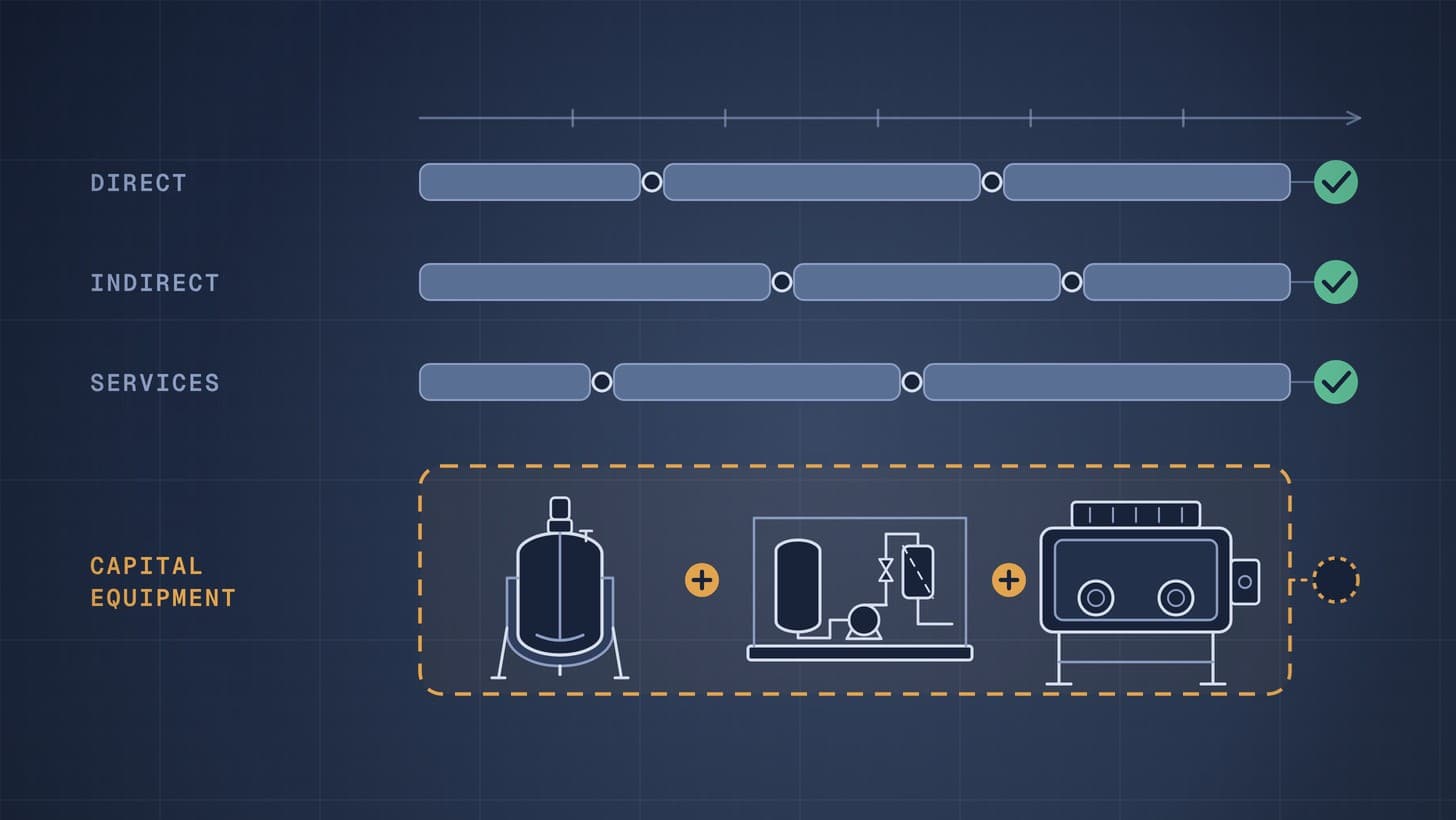
A pharma procurement transformation is a planned, multi year change to how a pharmaceutical or biotech company buys: who owns each type of spend, how categories and suppliers are managed, and which data and systems sit underneath. Typical programmes concentrate on spend visibility, category and supplier management, and digital source to pay (the complete buying process, from finding a supplier to paying the invoice). On our reading of the BCG and McKinsey work below, the piece they usually miss is capital equipment: the reactors, process skids, isolators and water systems bought for projects, which engineering teams often source one project at a time, outside the programme.
Two well known studies point to the gap. BCG's 2021 agenda for the future pharma procurement function lists capex (capital expenditure: money spent on long life assets such as plant and equipment) only as one of three indirect categories, and does not treat engineering equipment as a category of its own [1]. McKinsey surveyed ten big pharma companies and found that five had a dedicated capex group, while the other five relied on part time staff, often from engineering [2]. Neither study counts how many programmes leave capital equipment out, so treat the gap as our inference from their findings, not a measured figure.
Why this matters now
The sums involved are large. In July 2025 AstraZeneca announced plans to invest $50 billion in the United States by 2030 [3]. That includes a new multi billion dollar drug substance plant in Virginia, which the company calls its largest single manufacturing investment, plus cell therapy, continuous and specialty manufacturing in four other states. Projects like these become long lists of engineered packages, each with its own specification, supplier, factory test and qualification file.
McKinsey put capex at the top 50 pharma companies at about $40 billion in 2017, roughly 6% of revenues, with recurring smaller projects making up about half of biopharma capex [2]. Repeated projects are where a shared supplier base and reusable quote history help most, because the same kinds of equipment keep coming round.
Deloitte's 2025 survey of more than 250 chief procurement officers (CPOs) in 40 countries put risk management and talent at the top of their priorities [4]. Among the barriers they reported were siloed ways of working (57%), competing priorities (46%) and capability (40%). When engineering buys the equipment and procurement manages everything else, that silo is built into the organisation chart.
Create and manage RFQs in minutes
ChemCapital handles the entire procurement cycle, from structured RFQs and supplier comparisons to formal purchase orders and delivery tracking.
What a pharma procurement transformation usually includes
BCG sets out five themes, with the first three building the foundation, and pairs them with enablers: digital analytics backed by a modern ERP (enterprise resource planning) system with real time spend visibility, and people, meaning aligned incentives and better collaboration between the business, finance and procurement [1]. Deloitte's top quartile, which it calls Digital Masters, puts up to 24% of budgets into technology [4].
| Theme | What it usually covers | Question to ask about capital equipment |
|---|---|---|
| Spend visibility and control | One view of spend, in real time | Is project capex in the same spend data, by supplier and site? |
| Category management | A strategy for each category of spend | Is engineered equipment a category, or a line under indirect spend? |
| Supplier management | Segmentation, performance and risk | Are fabricators and skid builders in the supplier risk process? |
| Indirect spend optimisation | Indirect categories, capex among them | Does anyone consolidate requirements across projects? |
| Product life cycle cost view | Cost across the life of a product | Does equipment cost include operation and decommissioning? |
| Digital and people enablers | Analytics, ERP, incentives, collaboration | Do the tools hold quote requests, quote history and evaluation records? |
Notice where capex lands. BCG places it inside indirect spend, managed on total cost of ownership across design, operation and decommissioning [1]. That is sound budget discipline. It says little about how a fabricated vessel is specified, sourced, tested at the factory and qualified on site under GMP (good manufacturing practice, the quality rules for making medicines).
Why capital equipment gets left out
Capital equipment here means the engineered packages bought for a project: reactors and vessels, process skids (a frame carrying equipment, pipework, instruments and controls, built and tested in a factory), isolators (sealed enclosures that keep operators and product apart) and water systems. Each is usually specified for one project and paid for from that project's budget.
McKinsey's study shows how this plays out [2]:
- Engineering ran individual projects but rarely looked across the portfolio.
- More than 90% of smaller projects were officially approved, and post project evaluation was rare.
- The median site manager handled 17 projects in a year; one handled 127.
- Across 13 sites, normalised cost per unit differed by a factor of ten.
McKinsey estimated that a typical big pharma company could save about $200 million a year by cutting 20% of the cost from half of its projects [2]. That is McKinsey's figure, not ours.
BCG makes a similar point about capital projects in engineered products and infrastructure. External spending can be 80% or more of a capital project's total budget, yet at one global resources company 40% of projects had no dedicated procurement manager [5]. BCG recommends involving procurement from the concept phase and warns against engineers committing to suppliers too early.
To see whether your own programme has the gap, check five things:
- Does project capex appear in the same spend data as everything else, by supplier and by site?
- Does the approved vendor list cover fabricators, skid builders and isolator makers, or only materials and service suppliers?
- Could two projects on one site buy the same kind of equipment from different suppliers without anyone noticing?
- Can the person estimating next year's project find and reuse this year's quotes?
- Could you show an auditor, from one record, why a supplier was chosen and how its factory test was accepted?
If several answers are no, the programme leaves some of the largest and most regulated purchases outside it. If a consultancy is helping with your programme, put the same questions to it at the scoping stage.
Bringing capital equipment in: vendor selection, RFQs and GMP
This does not mean procurement taking over engineering decisions. It means giving those decisions one supplier base, one way of asking for quotes (a structured request for quotation, or RFQ) and one record that engineering, quality and procurement can all rely on.
 Each step leaves a record the next one uses, so every project starts from what the last one learned.
One approved vendor list across sites and projects. An approved vendor list (AVL) is the set of suppliers your quality and procurement teams have assessed and accepted for a defined scope. Kept per project, it is rebuilt every time; kept centrally, every audit and delivered order adds to what the next project knows. ICH Q9(R1), the international guideline on quality risk management, describes supplier decisions informed by risk assessment, knowledge management and monitoring of performance, backed by evaluation such as audits and quality agreements [6]. See our guides to supplier prequalification in pharma and getting onto a pharma approved vendor list.
Structured RFQs that carry the URS. EU GMP Annex 15 says equipment requirements should be set out in a user requirement specification (URS) or functional specification, and treats the URS as a point of reference throughout the validation life cycle [7]. When every supplier gets the same RFQ, with the URS, quantities, dates and deadline, the quotes answer the requirements you will later test against. See writing a URS for process equipment.
Evaluation on the record. Pharma vendor selection for a skid or an isolator is seldom decided on price alone. Record how each quote scored on technical, commercial, delivery, compliance and risk criteria, any mandatory requirement a supplier failed, and who approved the choice.
Quote history reused for estimates. Once adjusted for date, currency and scope, every firm quote is cost data for the next estimate. McKinsey's tenfold spread in normalised unit cost across 13 sites [2] shows what comparing like with like can reveal. Our guides to capex procurement strategy and category strategy for engineered equipment go further.
Qualification planned at award. Annex 15 allows equipment, especially novel or complex equipment, to be evaluated at the vendor before delivery in a factory acceptance test (FAT), and documentation review and some tests done at the FAT need not be repeated on site if transport and installation do not affect function [7]. Installation qualification (IQ) includes collecting supplier manuals and maintenance requirements, and site staff should confirm third party validation protocols are suitable before approval. So FAT scope, vendor documents and supplier protocols belong in the RFQ and purchase order. See our guide to installation, operational and performance qualification.
Supplier risk management scaled to the package. ICH Q9(R1) treats the formality of quality risk management as a spectrum set by uncertainty, importance and complexity, and uses risk management to set the scope and extent of qualification for equipment [6]. A transfer pump and an aseptic filling isolator should not get the same depth of supplier assessment. More in vendor risk management in pharma supply chains.
Records that meet data integrity expectations. The MHRA (the UK medicines regulator) defines data integrity as the extent to which data are complete, consistent, accurate, trustworthy and reliable throughout the data life cycle [8]. Its guidance explains ALCOA+ (attributable, legible, contemporaneous, original and accurate, plus complete, consistent, enduring and available) and expects vendor assurance to include a data governance review. Selection and qualification records for GMP equipment are easier to defend when they meet the same standard. See ALCOA+ and GMP audit trail requirements.
Where Chapter 7 fits. EU GMP Chapter 7 covers outsourced GMP activities such as contract manufacture and analysis, where the contract giver assesses competence, has a written contract and monitors performance [9]. Equipment vendors are usually handled through Annex 15 qualification and supplier management instead, unless they carry out a GMP activity for you; check with your quality unit. This is general information, not legal advice.
Capital equipment maturity checklist
Score each row on its own. Your overall level is the lowest row, and that is the one to fix first.
| Dimension | Level 1: project by project | Level 2: site coordinated | Level 3: portfolio managed | Level 4: integrated |
|---|---|---|---|---|
| Ownership | Each project team buys its own | Site engineering coordinates repeat buys | Named capex category lead across sites | Capex category in programme governance and targets |
| Supplier base | Lists kept per project | Site list for repeat items | One approved vendor list across sites and projects | List linked to performance and risk ratings |
| RFQs and evaluation | Emailed requests, mixed formats | Standard template, scores in spreadsheets | Structured RFQs, evaluation recorded | Weighted scores, mandatory fails flagged, decisions reused |
| Cost data | Quotes stay in inboxes | Some quotes filed by project | Quote history normalised and searchable | Estimates built from labelled historical quotes |
| GMP link | URS finished after quotes arrive | URS sent with the RFQ | Qualification scope set by risk | URS, FAT and IQ documents traced to the award |
| Records | Decisions live in email threads | Shared drive folders | Audit log of who decided what, and when | ALCOA+ records, data governance in vendor assurance |
Practical example
Illustrative example: a mid size biotech site, not a real company, plans £48m of capital equipment over three years across five projects.
| Project | Main packages | Capital equipment |
|---|---|---|
| Upstream expansion | Bioreactors, media and buffer preparation skids | £16m |
| Downstream purification | Chromatography and filtration skids | £11m |
| Aseptic filling | Filling line and isolator | £9m |
| Water systems | Purified water and water for injection (WFI) | £8m |
| Utilities and clean in place | Clean in place (CIP) skids, transfer pumps, tanks | £4m |
| Total | £48m |
Before, each project team runs its own procurement. After, the site runs capital equipment as one portfolio, using the practices above. The equipment and budget are the same in both.
| Measure | Before: project by project | After: one portfolio |
|---|---|---|
| Equipment needs across the five projects | 60 | 60 |
| RFQ events run | 60 | 51 |
| Repeat needs (same item type in two or more projects) | 14, each sourced separately | 14, grouped into 5 shared RFQs |
| Distinct suppliers used | 44 | 31 |
| Supplier audits for GMP critical packages | 12, including 3 repeats | 9 |
| Utilities and CIP estimate (£4.0m) resting on earlier quotes | 0% | 65% (£2.6m) |
| Median weeks from RFQ issue to award | 14 | 10 |
| Audit sample answered from one record | 2 of 5 | 5 of 5 |
How the figures work:
- RFQ events. The 14 repeat needs, such as CIP skids, transfer pumps and buffer tanks, are grouped into 5 shared RFQs, so 46 single RFQs plus 5 shared ones gives 51.
- Suppliers. One shared list takes the count from 44 to 31, while keeping at least two approved suppliers for each repeat item type.
- Audits. 3 of the 12 audits for GMP critical packages (those that can affect product quality) repeated another project's audit of the same supplier. Sharing results leaves 9.
- Estimate. £2.6m of earlier quotes adjusted for date and scope, £0.9m of budgetary quotes and £0.5m of indicative figures make up the £4.0m. £2.6m is 65% of £4.0m.
- Time to award. Approved suppliers and complete RFQs mean fewer technical queries.
- Audit sample. For five packages, an auditor asks why the supplier was chosen and how its FAT was accepted.
None of this is a forecast. What changes is how often the same work is repeated, and what the next project inherits.
Where ChemCapital fits
ChemCapital is a procurement platform for process equipment. It can sit alongside Coupa or SAP Ariba, covering sourcing, RFQs and quote comparison before the purchase order system.
- Supplier Discovery finds suppliers on the public web from a description, a pasted RFQ or an uploaded specification, scores fit against the duty point (the conditions the equipment must meet) and matches results against your approved vendors. Certifications are shown as claimed, so qualification stays with your quality team.
- Structured RFQs send every supplier the same request at once, including suppliers not yet on the platform.
- AI Quotation Comparison scores up to three quotes on commercial, technical, delivery, compliance and risk with weights you set, flags mandatory fails whatever the price, and has a person review the result before anything is saved.
- Project Costing builds capex estimates from historical quotes, with each line marked firm, budgetary, adjusted historical or indicative.
- Approved vendor management, supplier performance tracking and spend dashboards show which suppliers deliver and where the money goes.
- An audit log and ALCOA+ data integrity fit GMP buying; see security. Single sign on and Coupa or SAP Ariba integration are available on the Enterprise plan only.
If you are scoping a transformation programme and want to talk through the capital equipment piece, talk to our founder, a chemical engineer.
Ready to bring your capital equipment into one supplier base and one record? Start a free 14 day ChemCapital trial, with no credit card needed.
Frequently asked questions
What is a pharma procurement transformation?
It is a planned, multi year change to how a pharmaceutical or biotech company buys, usually covering spend visibility, category management, supplier management, digital tools and skills. Life sciences procurement transformation applies the same idea across pharma and biotech, and a complete programme also brings in the capital equipment bought for projects.
What should a bio pharma procurement strategy cover for capital equipment?
One approved vendor list across sites and projects, structured RFQs that carry the user requirement specification, recorded technical and commercial evaluation, and quote history reused in estimates. Supplier assessment and qualification effort should be scaled to risk, as ICH Q9(R1) describes.
How does GMP affect pharma vendor selection for equipment?
EU GMP Annex 15 expects equipment requirements to be set out in a user requirement specification and allows some testing to be done at the vendor before delivery. So the specification, factory acceptance test scope and vendor documents belong in the RFQ and purchase order, and the selection decision should be recorded.
How should pharma procurement manage supplier risk for equipment suppliers?
Tier suppliers by the risk of what they supply, since ICH Q9(R1) treats the formality of risk management as a spectrum set by uncertainty, importance and complexity. Track performance across projects, and include a data governance review in vendor assurance, as MHRA guidance expects.
Continue reading
Informational only, not procurement or legal advice. Cited names, frameworks, and statistics belong to their respective owners.
Create and manage RFQs in minutes
ChemCapital handles the entire procurement cycle, from structured RFQs and supplier comparisons to formal purchase orders and delivery tracking.
Start for freeRelated articles
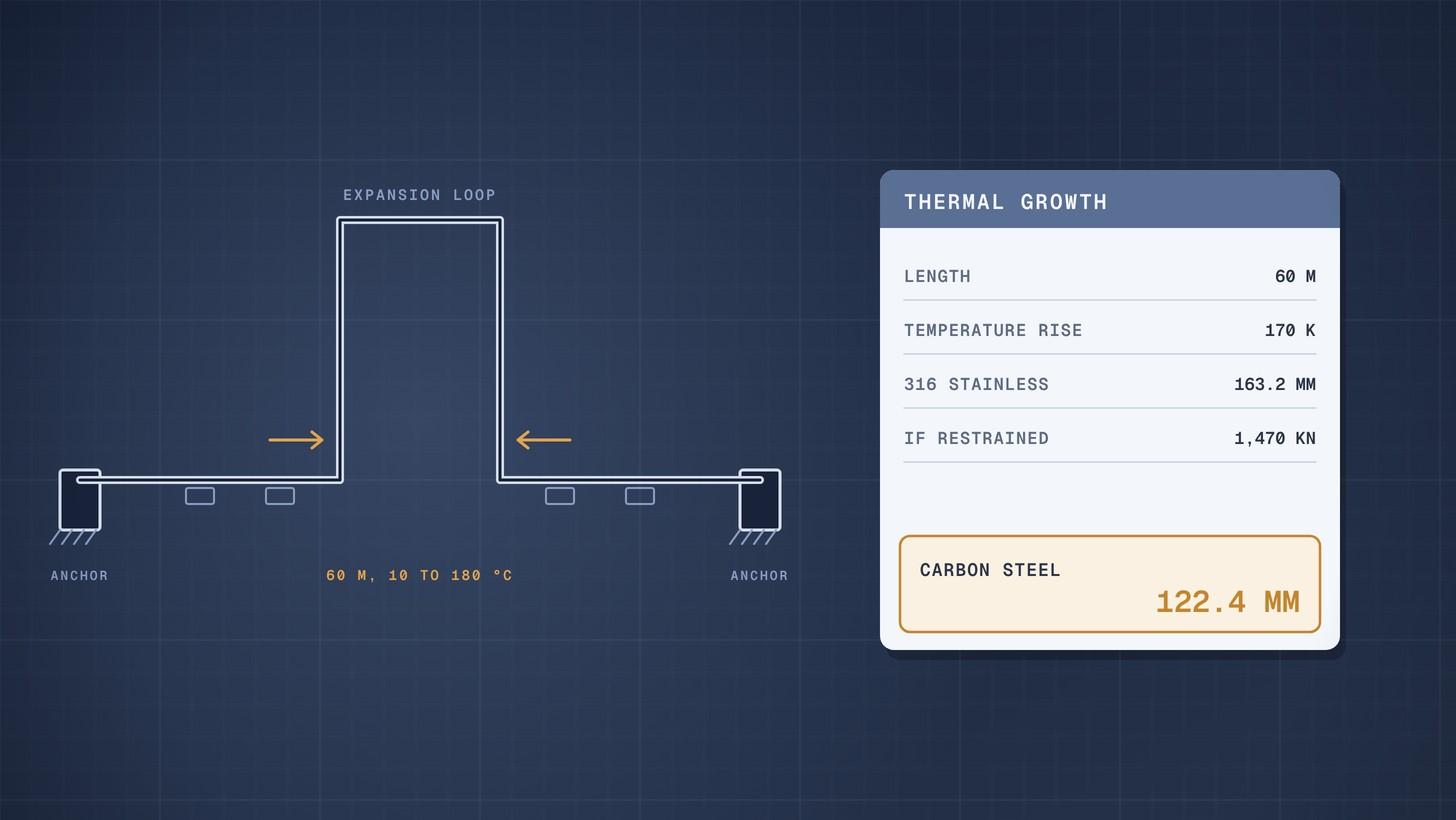
Pipe Thermal Expansion: Worked Example
How to calculate pipe thermal expansion for carbon and stainless steel, what restrained expansion does, and how loops and expansion joints absorb it.
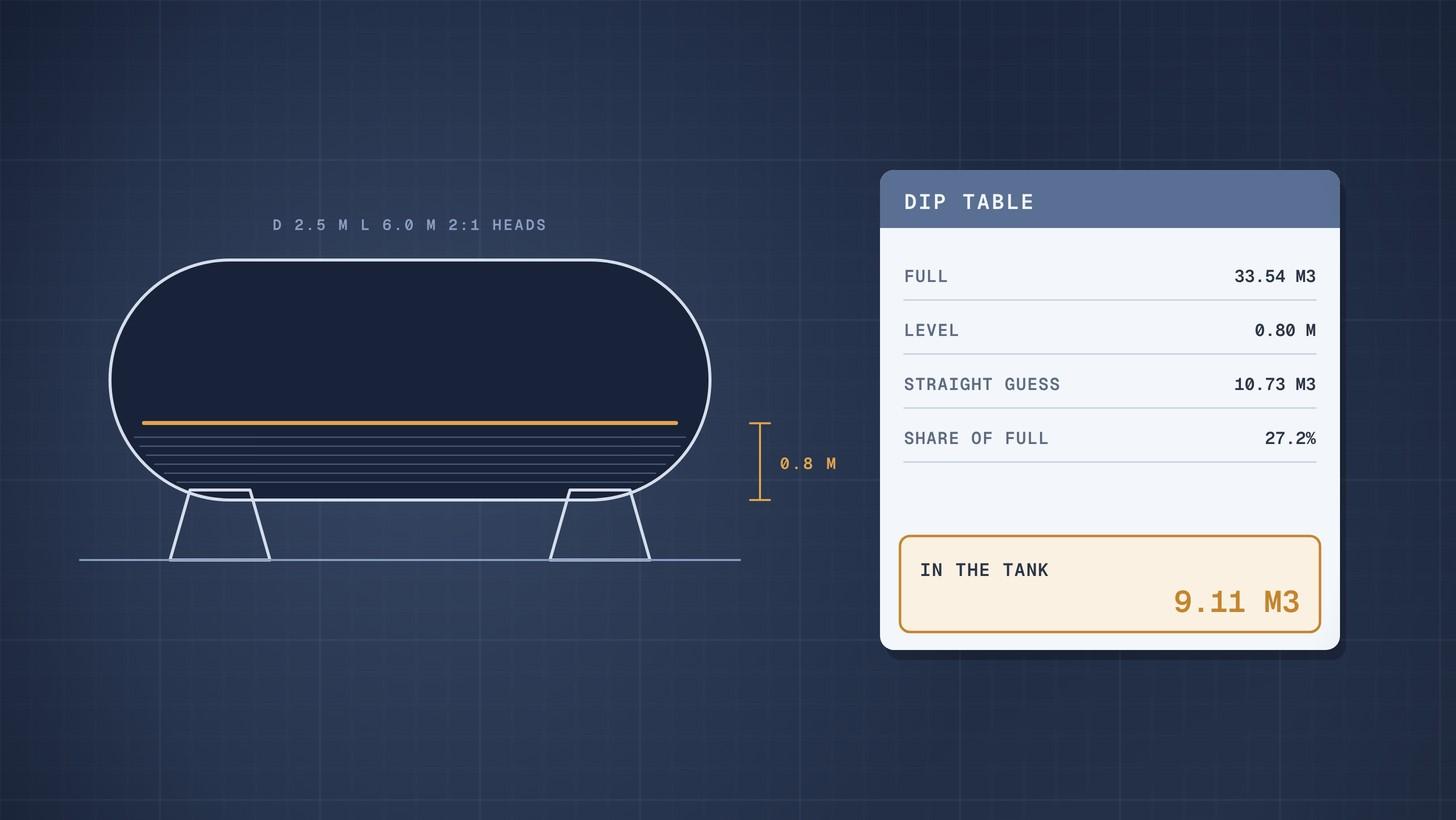
Horizontal Tank Volume When Partly Filled: Worked Example
How to calculate the volume of a partly filled horizontal tank with dished heads, with a worked example and a full dip table you can rebuild in a spreadsheet.
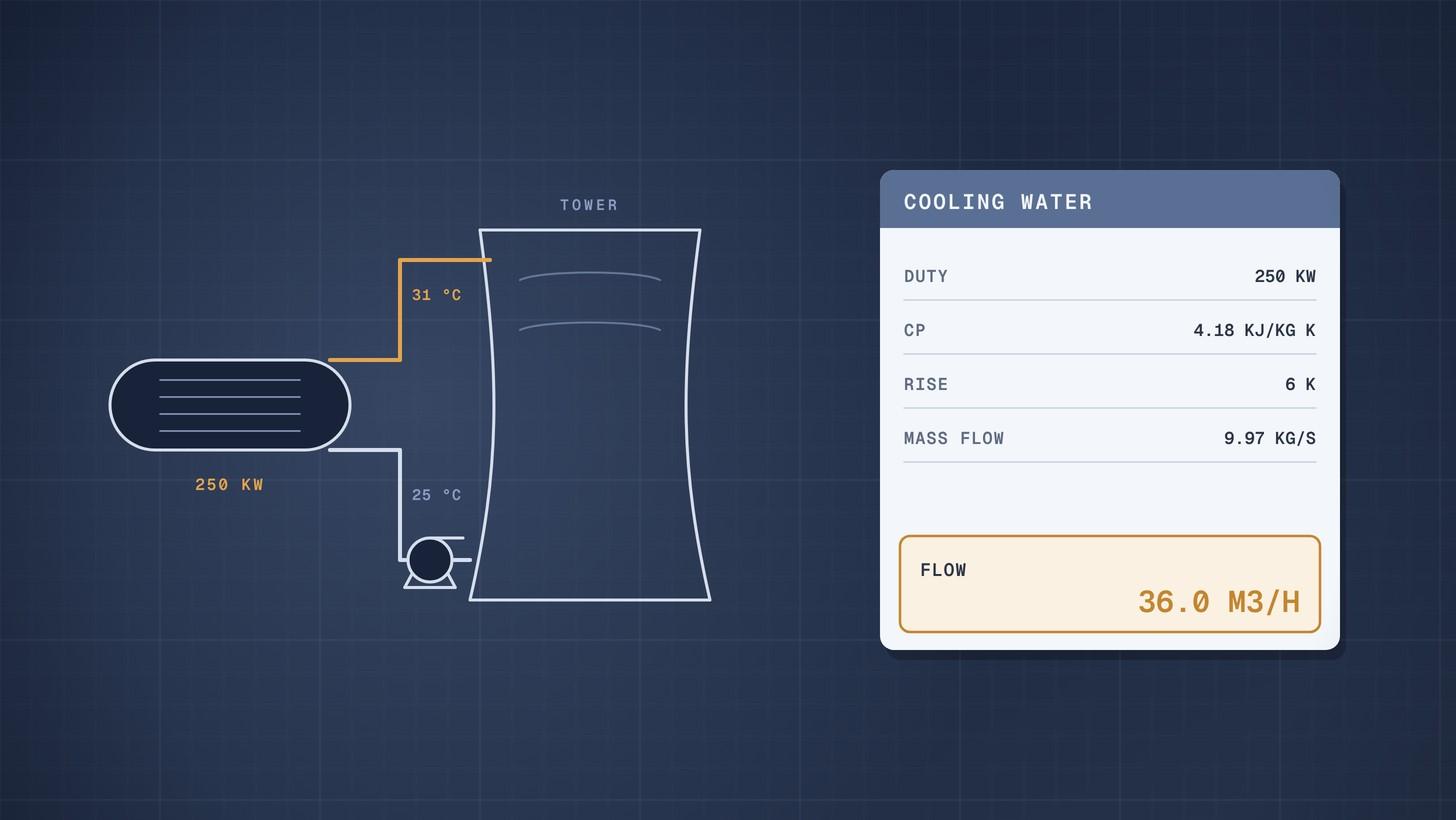
Cooling Water Flow Calculation: Worked Example
How to calculate cooling water flow from heat duty and temperature rise, then size the cooling tower circulation, evaporation and make up water.