
UKCA or CE Marking for Equipment Sold into Great Britain in 2026
As of November 2026, Great Britain accepts CE or UKCA marking for machinery and pressure equipment. Here is what suppliers still have to get right: approved bodies, the UK importer, labels and the declaration.
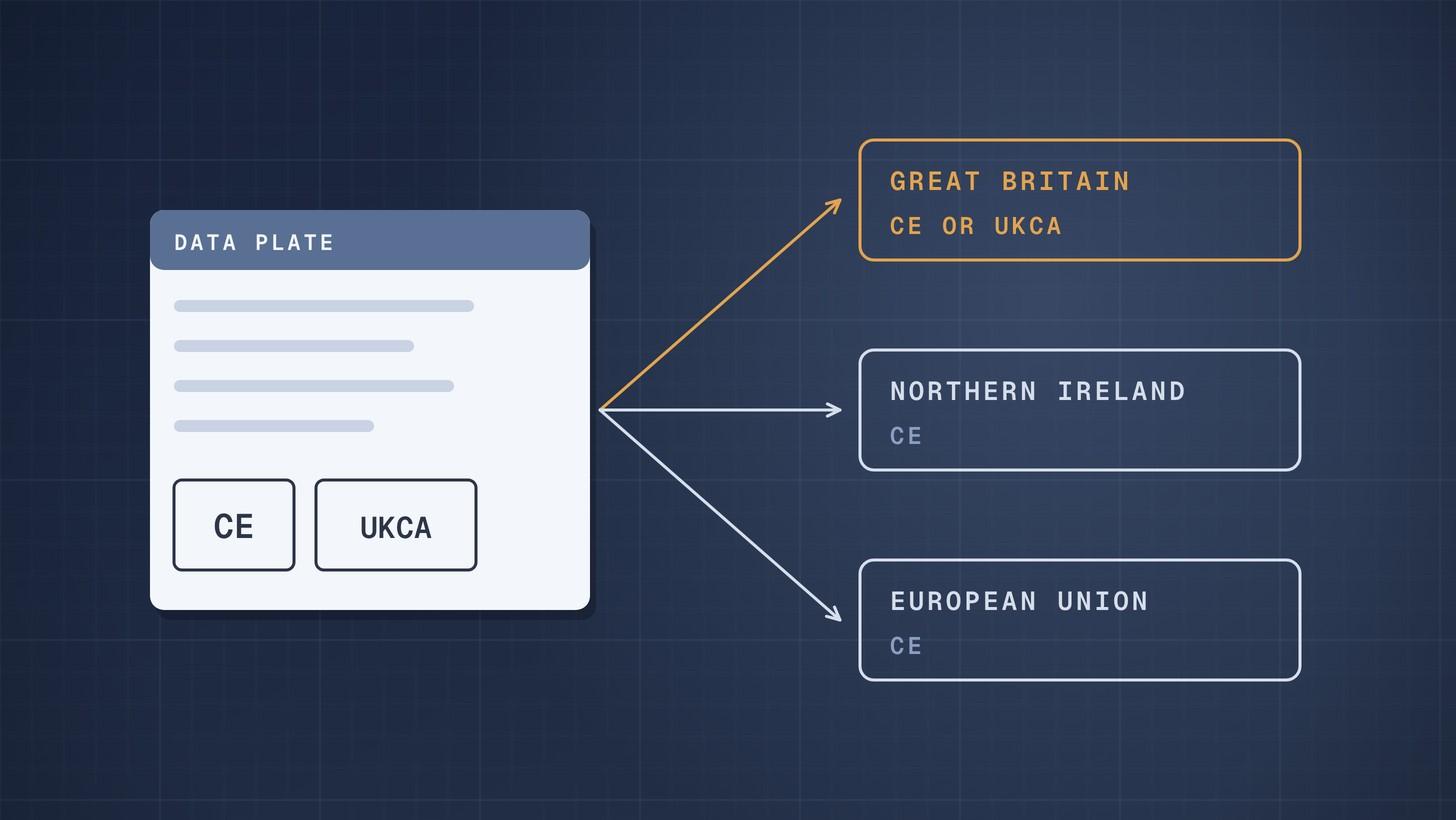
As of November 2026, Great Britain accepts either the CE or the UKCA marking for machinery, pressure equipment, simple pressure vessels, ATEX equipment, electrical equipment and EMC, and the UK government has extended CE recognition with no end date [1] [2]. So most equipment makers selling into England, Scotland and Wales can keep one CE route, but they still need a UK based importer, the right name and address on the product, English instructions and documents kept for 10 years.
Why this matters now
Three dates are worth having in your diary. On 1 October 2024 legislation came into force that continued CE recognition for these sectors in Great Britain [1]. On 20 January 2027 the new EU Machinery Regulation applies across the EU, and the UK government said in February 2026 that it will keep recognising CE marked machinery in Great Britain while it updates its own machinery rules [3]. And at 11pm on 31 December 2027 two labelling easements end: the option to put the UKCA marking on a label or accompanying document, and the option for importers of goods from the EEA to give their details on packaging or paperwork rather than on the product [4].
Buyers notice when a supplier gets this wrong. A missing UK address or an EU only declaration on a skid can hold up delivery acceptance on site.
Access real procurement opportunities from global buyers
Join ChemCapital to get discovered by verified procurement teams across pharmaceutical, chemical, and industrial manufacturing.
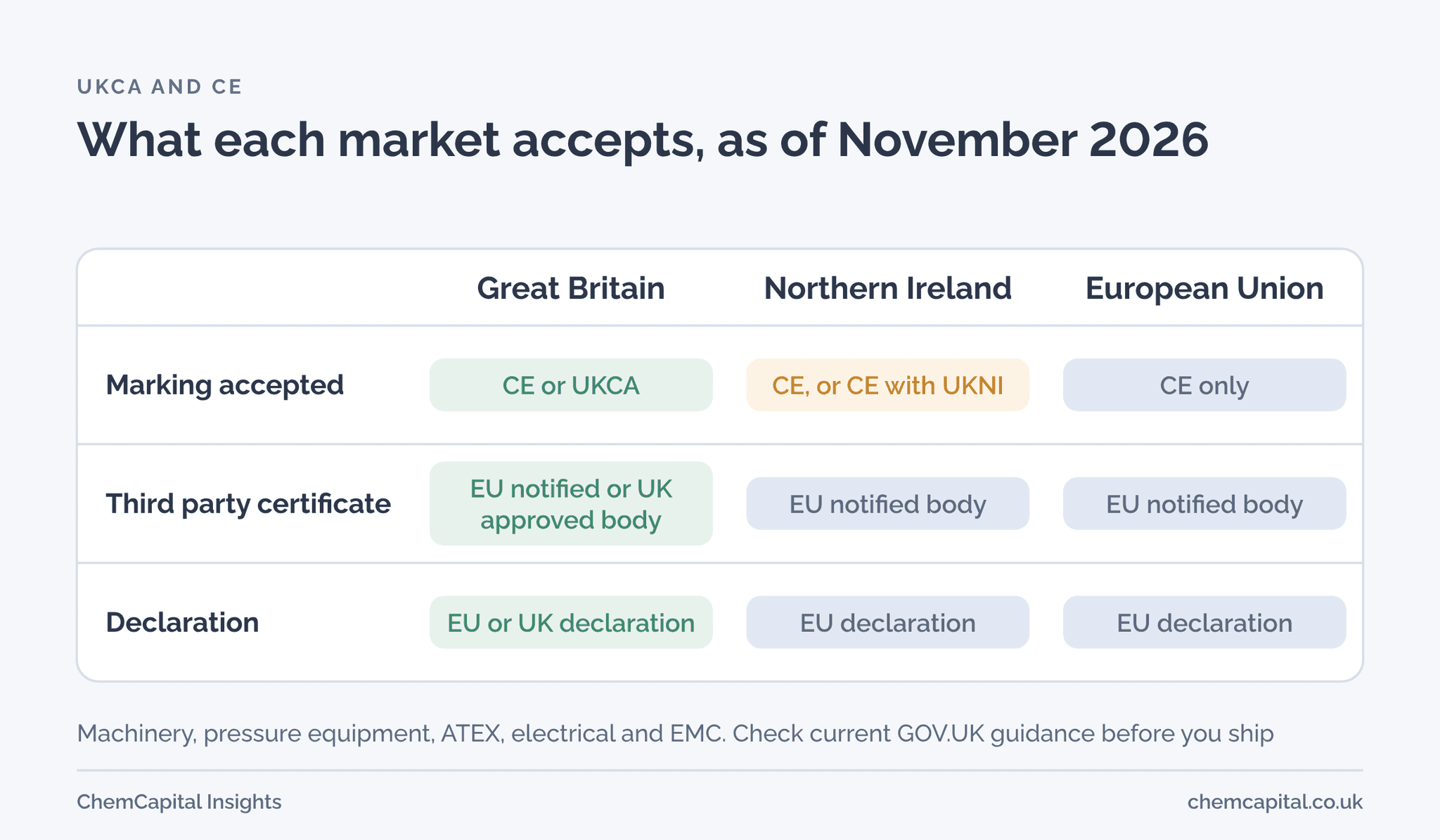
CE or UKCA: what each market accepts
| Destination | Machinery, pressure equipment, ATEX, LVD, EMC | Who certifies when a third party is needed |
|---|---|---|
| Great Britain | CE or UKCA [1] | EU notified body for CE, UK approved body for UKCA |
| Northern Ireland | CE, or CE with UKNI [1] | EU notified body for CE |
| European Union | CE only | EU notified body |
The policy announcement in August 2023 covered 18 regulations owned by the Department for Business and Trade, including machinery, pressure equipment and simple pressure vessels, and said CE recognition would be extended indefinitely [2]. The government's pressure equipment guidance now states that CE recognition in Great Britain has been extended indefinitely, and that CE remains mandatory for the EEA and for Northern Ireland [5].
The certificate matters as much as the mark. A UK approved body is accredited by UKAS and can certify only for UKCA. An EU notified body certifies against EU rules, and its certificate can be used in Great Britain under CE recognition or under the Fast Track UKCA route [4]. If your pressure equipment needs a notified body under the PED, see our guide to PED conformity assessment modules.
The UK importer and the UK address
This is the part overseas suppliers most often miss. Authorised representatives and importers must be established in the UK, and manufacturers and importers must show their name, registered trade name or trademark and postal address [4].
For pressure equipment, the importer must check that the manufacturer has carried out the right conformity assessment, prepared the technical documentation and applied the correct marking. It must put its own name and postal address on the equipment, keep a copy of the declaration and technical documentation for 10 years, supply English instructions and tell the market surveillance authority about any risk [5]. For goods from the EEA or Switzerland, the importer details can go on packaging or accompanying documents until 31 December 2027 [5].
In practice, decide who the importer is before the order. It is often the UK buyer, a UK subsidiary or a distributor. If the buyer is the importer, it takes on those duties, so expect its procurement team to ask for your technical file index and declaration early. If you work through a UK agent, our guide to finding distributors and agents covers who does what.
This is general information, not legal advice; check the current text before you rely on it.
Marking, labels and the declaration
- Where the mark goes. CE goes on the product or its data plate, or on packaging or documents where that is impossible. UKCA may go on a label or accompanying document until 31 December 2027, after which it goes on the product. Marks must be at least 5 mm high unless a regulation says otherwise [4].
- Both marks. You can carry both where the product meets both sets of requirements and each mark is clearly visible [4].
- The declaration. A UK declaration of conformity lists the manufacturer, the product, a statement of sole responsibility, any approved body, the legislation and standards with dates, and the signatory and date [4]. If you use the CE route, your EU declaration is the document the buyer expects; see our EU declaration of conformity guide.
- Partly completed machinery. It needs a declaration of incorporation, not a declaration of conformity [4].
- Sound engineering practice. Pressure equipment below the category limits is built to sound engineering practice and must not carry a conformity marking unless other law requires one [5]. Our PED sound engineering practice guide explains the limits.
- Records. Manufacturers keep the declaration and technical documentation for 10 years [5].
Mistakes that hold up delivery
These are the gaps a buyer's receiving inspection or quality team is most likely to find.
- No UK name and address. The equipment arrives with only the overseas manufacturer's details and nobody has agreed who the importer is.
- A declaration that does not match the plate. The serial number, model or edition of the standards on the declaration differs from the data plate.
- The wrong certificate for the mark. A CE mark backed only by a UK approved body certificate, when UK approved bodies can certify only for UKCA [4].
- Instructions in the wrong language. Manuals supplied in German or Italian only, when English is required for Great Britain [4].
- Marks on assemblies that should not carry them. Sound engineering practice items marked CE, or a skid marked as complete machinery when it is partly completed.
- No technical file index. The importer cannot confirm the conformity assessment without at least an index of what you hold.
Each one is cheap to fix at order stage and expensive on a loading bay. Add them to your order kick off checklist.
Machinery after 20 January 2027
The government's response of 25 February 2026 to its machinery call for evidence said it intends to amend the Supply of Machinery (Safety) Regulations 2008 in Great Britain with measures similar to the EU Machinery Regulation, adapted for the UK, and will keep recognising CE marked machinery. No Great Britain timetable had been set when that response was reported [3]. For Northern Ireland, implementation was planned for October 2026 [3]. Our article on the EU Machinery Regulation 2023/1230 covers what changes in the EU.
This is general information, not legal advice; check the current text before you rely on it.
Practical example
Illustrative. A pump skid maker in the Netherlands sells a skid with a Category III pressure vessel and its own control panel to a pharmaceutical site in England. The UK customer agrees to act as importer.
| Item | What the supplier provides |
|---|---|
| Marking | CE on the skid data plate, with the notified body number for the vessel |
| Declarations | EU declaration of conformity covering the machinery and pressure equipment rules that apply |
| Importer details | Customer name and UK address on the delivery documents for a March 2027 delivery; on the equipment itself for a delivery after 31 December 2027 |
| Instructions | Operating and maintenance manual in English |
| Records | Technical file kept for 10 years, index sent to the customer at order stage |
The same skid shipped to Belfast would still need CE, and a second skid shipped to Germany needs nothing extra. One CE route covers all three markets, which is why most suppliers have not taken up UKCA.
If you are the buyer
Ask three questions in the RFQ: which marking the equipment will carry, which notified or approved body is involved and its number, and who will be the UK importer. Then check the declaration against the data plate at delivery.
Where ChemCapital fits
Buyers search for suppliers who can deliver compliant equipment into their market. A free supplier listing on ChemCapital lets you show the markings, approvals and markets you serve, so the right buyers find you through Supplier Discovery. See what suppliers get from ChemCapital.
Ready to show UK buyers you can deliver compliant equipment? List your company on ChemCapital. It is free to start.
Frequently asked questions
Is CE marking still accepted in Great Britain in 2026?
Yes. As of November 2026, Great Britain accepts CE or UKCA for machinery, pressure equipment, simple pressure vessels, ATEX, electrical equipment and EMC, and CE recognition has been extended with no end date.
Do I need UKCA marking for machinery?
Not if the machinery is CE marked and meets the EU requirements. UKCA is an alternative for Great Britain. Northern Ireland and the EU need CE.
Can I put both CE and UKCA on the same equipment?
Yes, where the equipment meets both sets of requirements and each mark is clearly visible.
Who is the importer when selling equipment into Great Britain?
The UK based business that first places the equipment on the GB market, often the buyer, a UK subsidiary or a distributor. It must show its name and UK postal address and keep the declaration and technical documentation for 10 years.
What changes on 31 December 2027?
Two labelling easements end: UKCA can no longer go only on a label or accompanying document, and importer details for goods from the EEA must go on the product rather than on packaging or paperwork.
Continue reading
Informational only, not procurement or legal advice. Cited names, frameworks, and statistics belong to their respective owners.
Access real procurement opportunities from global buyers
Join ChemCapital to get discovered by verified procurement teams across pharmaceutical, chemical, and industrial manufacturing.
List your companyRelated articles
Design Qualification (DQ) for GMP Equipment: What It Is and What the Vendor Provides
Design qualification is the documented check that a proposed equipment design meets the URS and GMP before it is built. Here is where DQ sits in EU GMP Annex 15, what evidence the vendor supplies, and a DQ checklist.
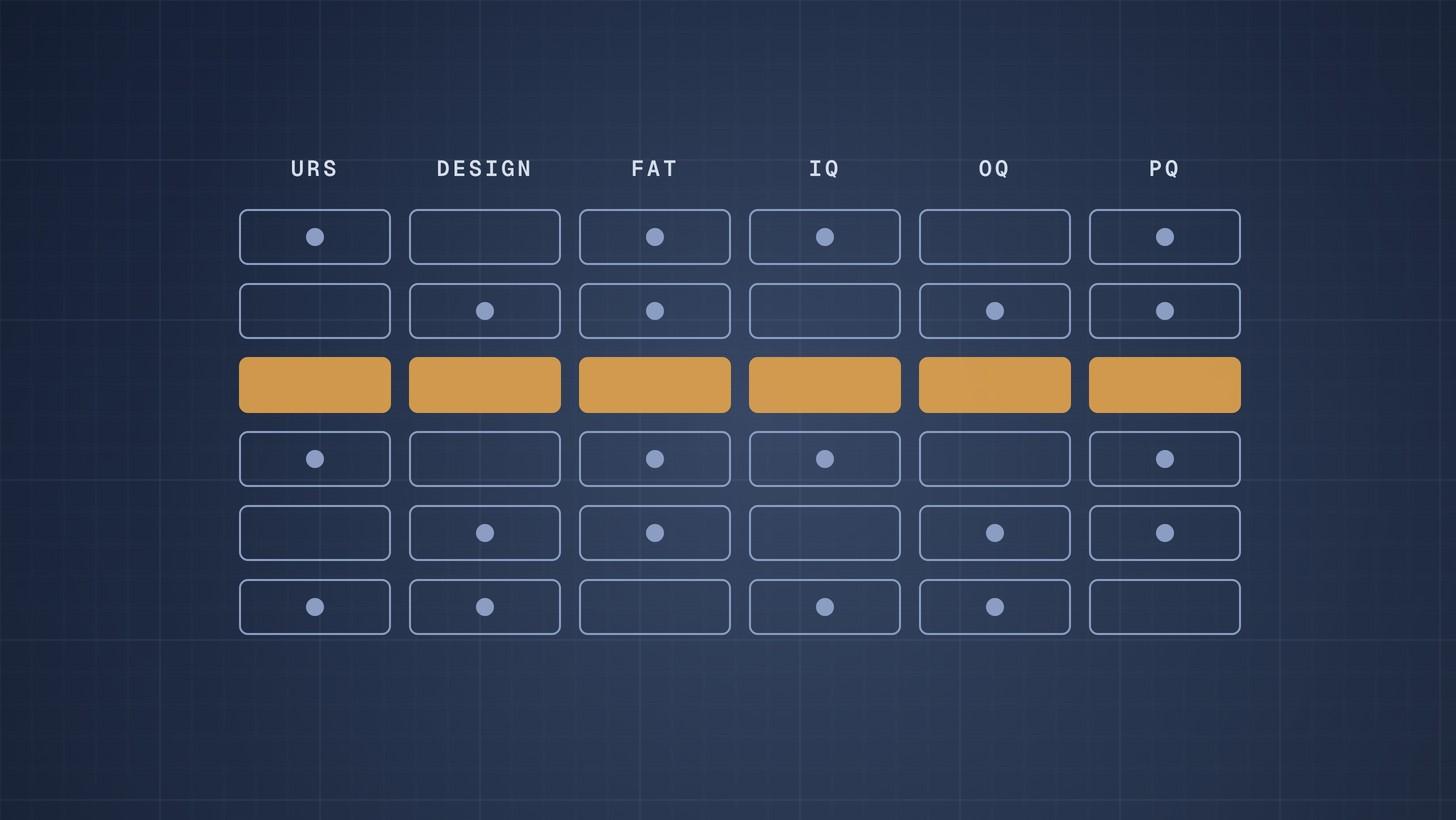
Requirements Traceability Matrix for GMP Equipment: From URS to PQ
A requirements traceability matrix links every URS line to the design document that meets it and the test that proves it, from DQ through FAT, SAT, IQ, OQ and PQ. Here is how to build one, with a template.
How to Prepare for a Customer Quality Audit as an Equipment Manufacturer
A practical guide for equipment makers facing a customer or vendor audit: the documents to have ready, how to run the walk through, the findings auditors raise most often and how to close them properly.