
API 610 Pump Types Explained: OH, BB and VS (OH2, BB2, BB5 and More)
What each API 610 pump type means, from OH1 to VS7, what each suits, when API 610 applies at all, and how to use the type code in an RFQ so bids are comparable.
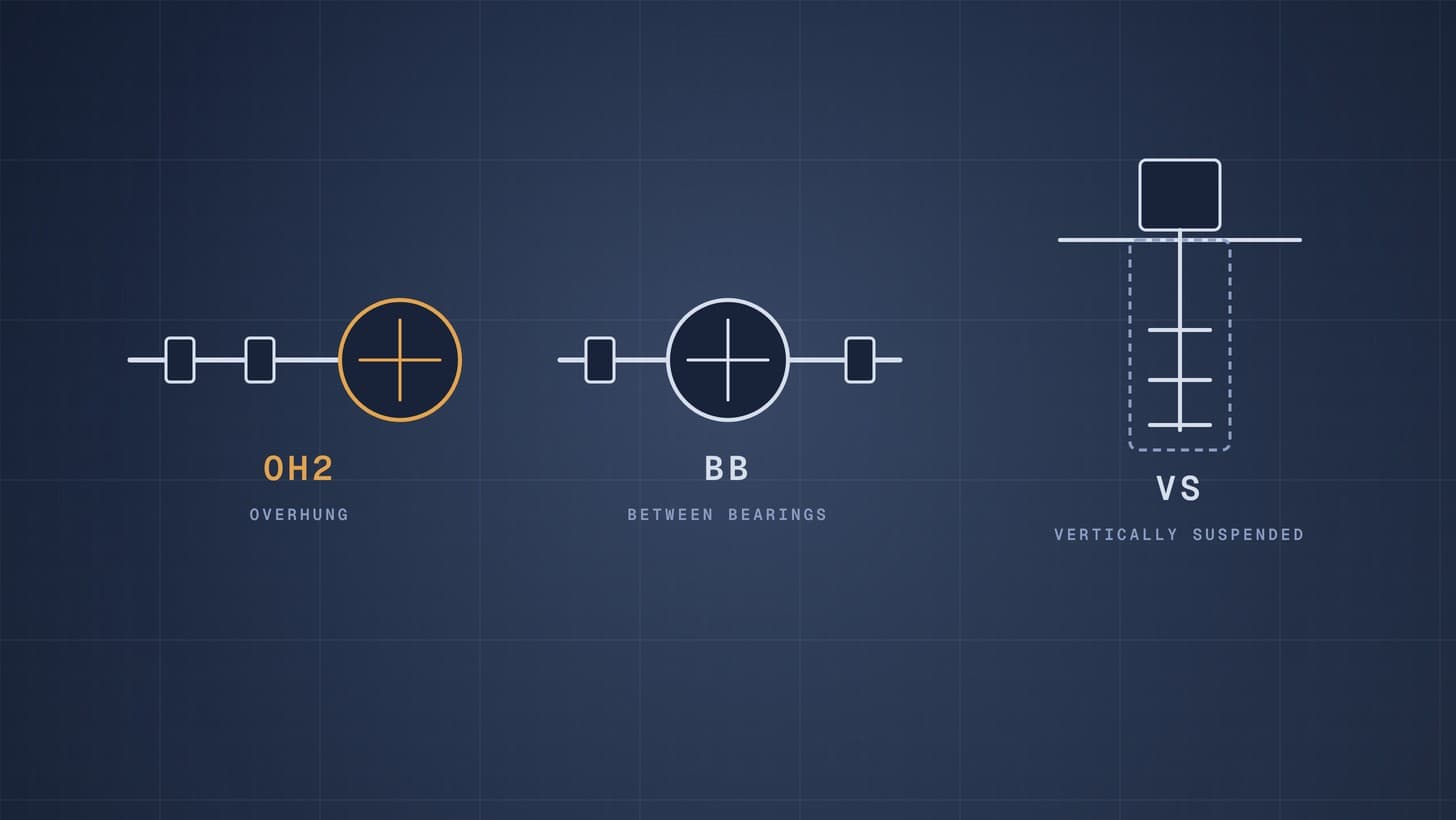
API 610 sorts centrifugal pumps into three families: overhung (OH), where the impeller sits on the end of the shaft beyond the bearings; between bearings (BB), where the impeller sits between two bearings; and vertically suspended (VS), where the pump hangs down into the liquid on a long shaft. Each family has numbered types, such as OH2, BB2 or VS6, and that two letter, one number code is how buyers and suppliers agree on the basic pump architecture before anything else.
Get the type right on the datasheet and every bid starts from the same machine. Get it wrong, or leave it blank, and you may receive an inline pump against a barrel pump, which cannot be compared. This guide explains each type, what it suits, and how to use the code in an RFQ.
Why this matters now
API published the thirteenth edition of API 610 in June 2026 [1]. The standard covers new centrifugal pumps, including pumps run in reverse as power recovery turbines, for petroleum, petrochemical and gas process services. It classifies them as overhung, between bearings and vertically suspended [2]. A trade report on the new edition says the covered pump types did not change, and the datasheets are nearly unchanged from the twelfth edition [1]. Your existing type codes and forms still work.
When is API 610 the right standard at all? The standard's own annotation says experience suggests its pumps suit liquids where any one of these is exceeded: 19 bar discharge pressure, 5 bar suction pressure, 150 °C, 3,600 rpm, 120 m rated head, or a 330 mm impeller on an overhung pump [2]. Below all of those, a chemical process pump to ASME B73 or ISO standards may be the better value; see our centrifugal pump datasheet guide. Sealless pumps are covered by API 685, not API 610 [2].
Create and manage RFQs in minutes
ChemCapital handles the entire procurement cycle, from structured RFQs and supplier comparisons to formal purchase orders and delivery tracking.
The three families
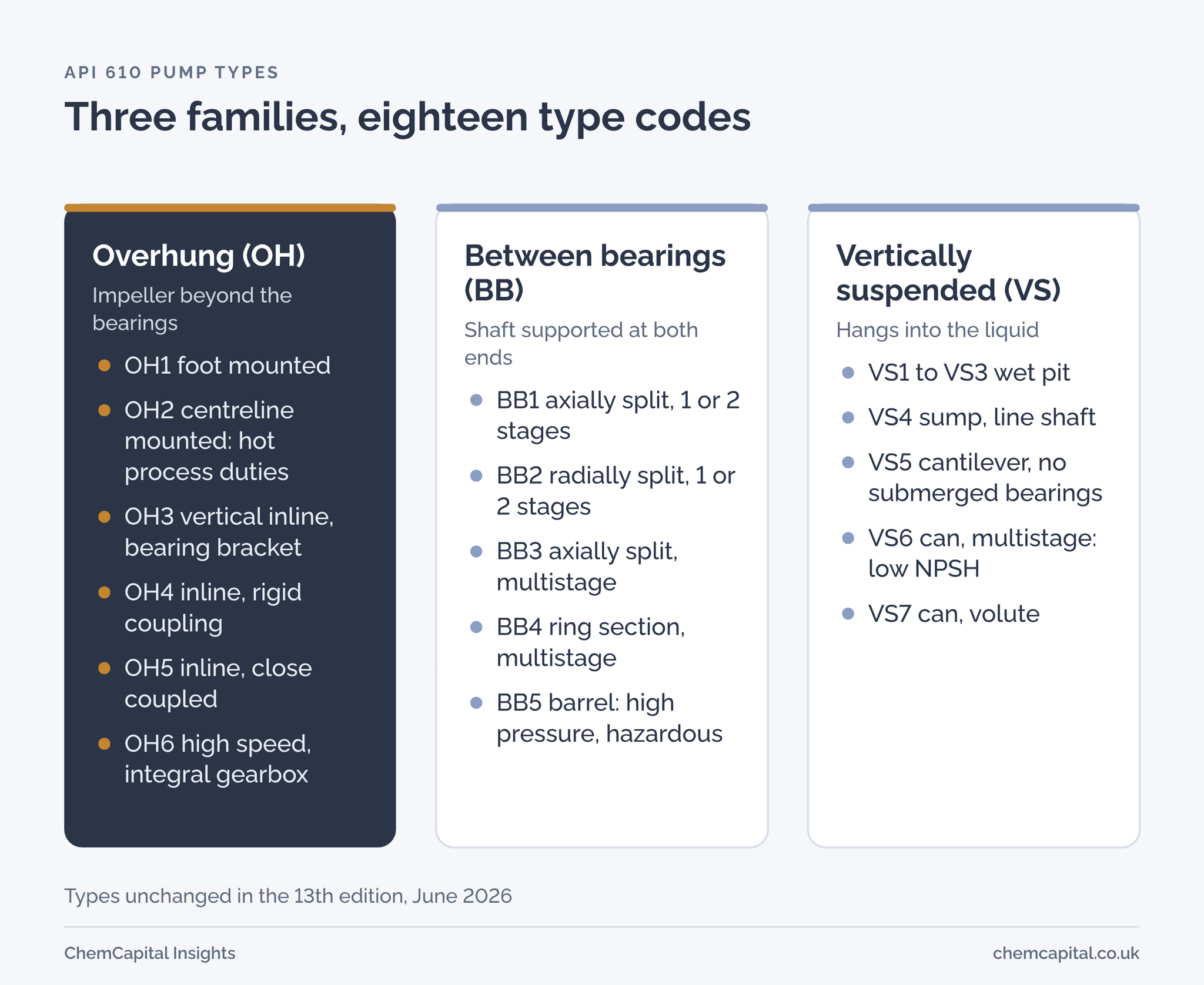
Overhung (OH)
The impeller is mounted on the end of a shaft that overhangs its bearings. OH pumps are the simplest and lowest cost family, suited to medium duties [3].
| Type | Arrangement | Notes |
|---|---|---|
| OH1 | Horizontal, foot mounted, flexibly coupled | One maker lists its OH1 range as ANSI or ISO design rather than API 610 [4] |
| OH2 | Horizontal, centreline mounted, flexibly coupled, single bearing housing | A common refinery process pump; centreline support reduces thermal effects at high temperature [3] [5] |
| OH3 | Vertical inline, separate bearing bracket, flexibly coupled | Saves floor space and piping; economical for lower head and flow [3] |
| OH4 | Vertical inline, rigidly coupled | Harder to align and maintain [3] |
| OH5 | Vertical inline, close coupled, impeller on the motor shaft | Cooling water and transfer duties in one maker's range [4] |
| OH6 | High speed, integral gearbox | High pressure from high rotational speed [3] [5] |
One maker's OH2 range runs to 2,250 m³/h, 370 m head, 75 bar and temperatures from minus 75 to 425 °C, with API 682 cartridge seals [6]. Those are one product's limits, not the standard's, but they show how far an OH2 can go.
Between bearings (BB)
The impeller sits between two bearings, so the shaft is supported at both ends. This is the family for higher flows and pressures [3].
| Type | Arrangement | Typical services in one maker's range [4] |
|---|---|---|
| BB1 | Axially split casing, one or two stages | Cooling water, tank farm, booster, crude oil pipelines |
| BB2 | Radially split casing, one or two stages | Refinery pump around and bottoms, vacuum bottoms, coker heater charge |
| BB3 | Axially split, multistage | Product and LPG pipelines, refinery charge, boiler feed |
| BB4 | Radially split, multistage, ring section with tie rods | Boiler feedwater, steam generation, auxiliary services |
| BB5 | Radially split, multistage, double casing (barrel) | Hydrotreater and hydrocracker charge, boiler feed, power recovery |
Descriptions of arrangements from engineering references [3] [5]. The axially split BB1 opens on the horizontal joint for easy access; the barrel BB5 is chosen where very high pressure or hazardous liquids make sealing critical [3].
Vertically suspended (VS)
The pump hangs from a head plate with the impeller submerged, on a long shaft. These suit sumps, wells and duties with very little NPSH available [3].
| Type | Arrangement | Typical use |
|---|---|---|
| VS1 | Wet pit, diffuser, single casing; column is the discharge | Cooling water, firewater, molten sulphur in one range [4] |
| VS2 | Wet pit, volute, single casing | Moderate flow and head sump duties [3] |
| VS3 | Wet pit, axial flow | Large flows [3] |
| VS4 | Volute, separate discharge, line shaft with column bearings | Sumps, oily water, lube oil [4] |
| VS5 | Volute, cantilever shaft, no submerged bearings | Dirty liquids without external flush [3] |
| VS6 | Double casing (can), diffuser, multistage | LPG shipping, pipeline booster, low NPSH and cryogenic duties [3] [4] |
| VS7 | Double casing (can), volute | Similar to VS6 in single stage form [3] |
If NPSH is your problem, read NPSH explained before choosing a VS6; sometimes raising the suction vessel is cheaper.
Common mix ups
Type is not compliance. The code describes an arrangement. A pump can look like an OH2 and still not meet the rest of API 610: casing design, nozzle loads, bearing life, testing and documentation. Ask for "API 610, type OH2", not just "OH2 type".
Not every type is bought as a full API 610 pump. One maker lists its OH1 range as ANSI or ISO design rather than API 610 [4]. If a bidder offers an OH1 or an inline close coupled pump for an API 610 duty, check what standard it is actually built to.
BB1 and BB3 both split axially. The difference is the number of stages: BB1 has one or two, BB3 many [5]. For high pressure in an axially split casing, the multistage BB3 is the candidate; for very high pressure or hazardous liquids, the barrel BB5 [3].
VS4 and VS6 are not interchangeable. A VS4 is a sump pump with a separate discharge and line shaft bearings; a VS6 is a multistage can pump chosen for low NPSH [3] [5].
Type is only half the specification. API 610 also uses material class codes. One maker lists classes such as S 4 to S 9, C 6, A 8, D 1 and D 2 for its OH2 range [6]. State the material class on the datasheet alongside the type.
How to use the type code in an RFQ
- Let the duty suggest the family. Flow, head, pressure, temperature, NPSH available and the liquid point to OH, BB or VS.
- Name the preferred type, and say whether alternatives are allowed. For example "OH2 preferred; BB2 acceptable if rated flow falls outside the preferred operating region".
- Put the type in the datasheet's pump type field, and attach the seal datasheet; see mechanical seal plans to API 682.
- Ask each bidder to confirm the type offered on their returned datasheet, with their curve.
ChemCapital's AI quotation comparison puts the bids side by side, so you can check each offer's pump type, efficiency and price, and an OH3 offered against your OH2 stands out before the technical review.
Practical example
Illustrative. A refinery needs a hot oil circulation pump: 180 m³/h, 140 m head, 330 °C, 25 barg suction. It exceeds several of the API 610 indicator values: suction pressure, temperature and head [2]. So API 610 applies.
At this temperature, centreline support matters for alignment, so the engineer specifies OH2 [3]. One bidder offers an OH2; another offers a two stage BB2 at a higher price, citing a better efficiency at the rated point. Because the RFQ said "OH2 preferred; BB2 acceptable", both bids can be evaluated. The buyer compares the life cycle cost, including the BB2's efficiency gain, rather than rejecting one offer as non compliant.
If you are the supplier
Confirm the type you offer on the datasheet, and if you offer a different type from the one preferred, say why in your deviation list. A clear reason, such as better efficiency or lower NPSH required, turns an alternative into an option the buyer can accept.
Where ChemCapital fits
The type code is the first line of every API 610 pump RFQ. Use it to make bids comparable, and pair it with a complete datasheet. See also how to read a pump curve.
Ready to send pump RFQs that come back on the same basis? Start a free 14 day ChemCapital trial, with no credit card needed.
Frequently asked questions
What are the API 610 pump types?
Three families: overhung (OH1 to OH6), between bearings (BB1 to BB5) and vertically suspended (VS1 to VS7). The code names the basic arrangement, for example OH2 for a horizontal centreline mounted overhung pump or BB5 for a multistage barrel pump.
What is an OH2 pump?
A horizontal, single stage, end suction overhung pump with centreline mounting and a single bearing housing, flexibly coupled to its driver. Centreline support helps keep alignment at high temperature, which is why it is a common refinery process pump.
What is a BB2 pump?
A between bearings pump with a radially split casing and one or two stages. One maker uses its BB2 range for refinery pump around, bottoms, vacuum bottoms and coker heater charge services.
When should I specify an API 610 pump?
The standard's annotation says experience suggests API 610 pumps suit liquids where any one of these is exceeded: 19 bar discharge, 5 bar suction, 150 °C, 3,600 rpm, 120 m head, or a 330 mm overhung impeller. Below all of these, an ASME B73 or ISO chemical process pump may be better value.
Did the API 610 13th edition change the pump types?
According to a trade report on the June 2026 edition, the covered pump types did not change and the datasheets are nearly unchanged from the 12th edition, apart from minor edits such as paragraph references.
Continue reading
Informational only, not procurement or legal advice. Cited names, frameworks, and statistics belong to their respective owners.
Create and manage RFQs in minutes
ChemCapital handles the entire procurement cycle, from structured RFQs and supplier comparisons to formal purchase orders and delivery tracking.
Start for freeRelated articles
Pipe Thermal Expansion: Worked Example
How to calculate pipe thermal expansion for carbon and stainless steel, what restrained expansion does, and how loops and expansion joints absorb it.
Horizontal Tank Volume When Partly Filled: Worked Example
How to calculate the volume of a partly filled horizontal tank with dished heads, with a worked example and a full dip table you can rebuild in a spreadsheet.
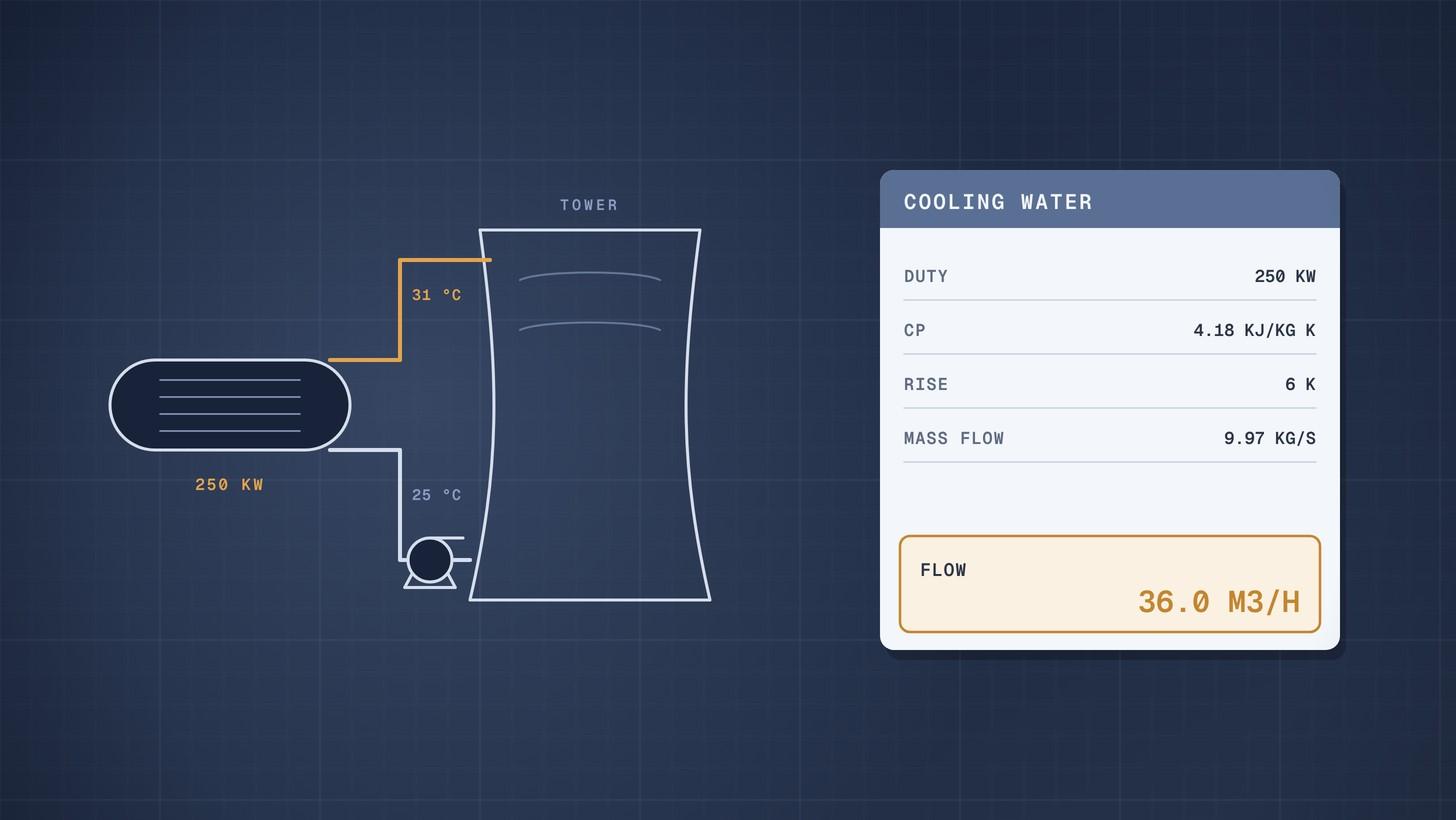
Cooling Water Flow Calculation: Worked Example
How to calculate cooling water flow from heat duty and temperature rise, then size the cooling tower circulation, evaporation and make up water.