
ASME U Stamp vs PED: Selling Pressure Equipment into the US and Europe
How the ASME U stamp and the PED each certify pressure vessels, who inspects, how long certificates last, and how to build one vessel that satisfies both.
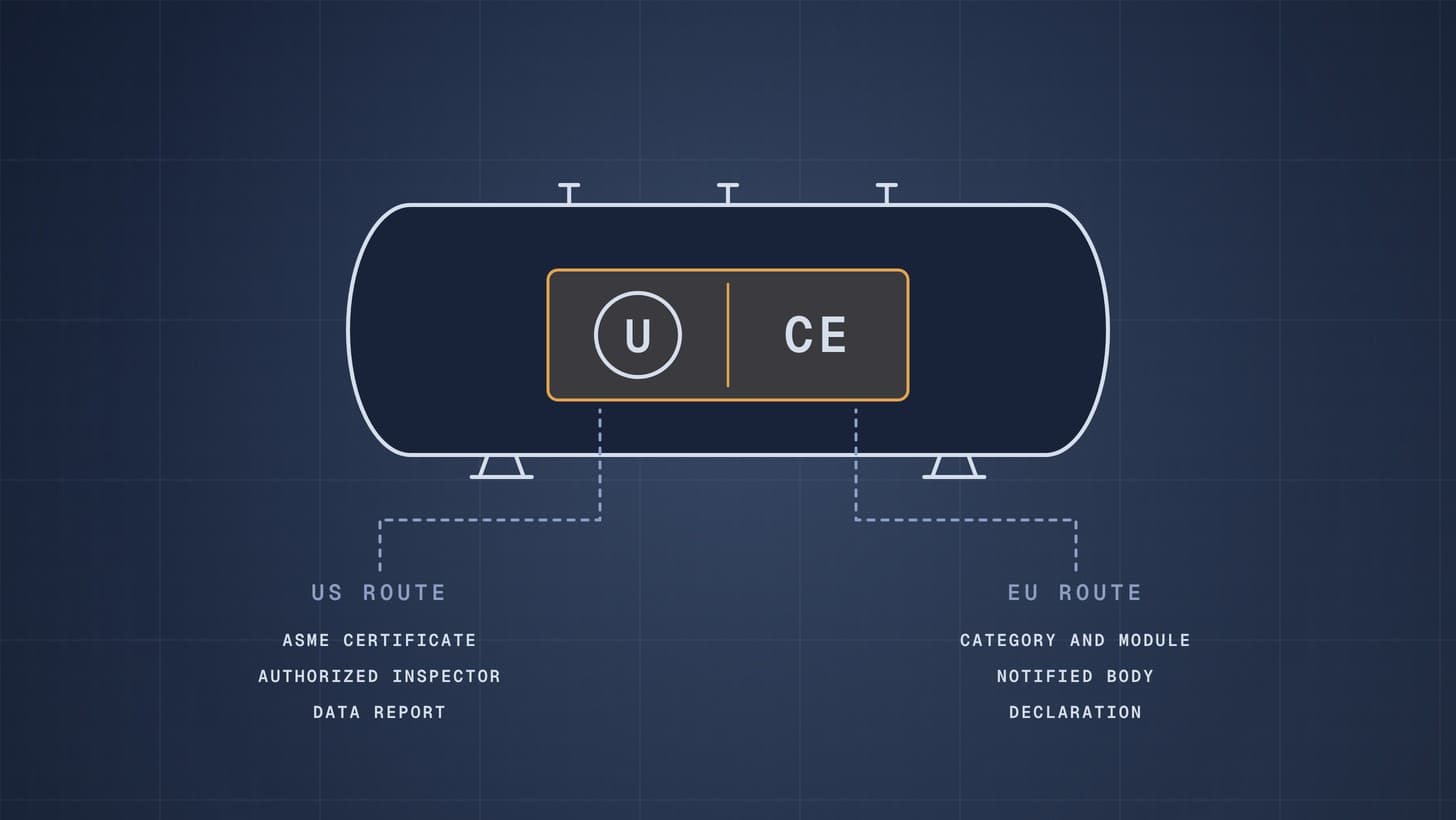
The ASME U stamp and the PED do the same job on two continents: they show that a pressure vessel was designed, built and inspected to rules a regulator accepts. The difference is who you deal with. For the US, you hold an ASME Certificate of Authorization, work with an Authorized Inspector from an accredited agency and stamp the ASME Certification Mark with the U designator. For Europe, you follow a conformity assessment module with a notified body, issue an EU declaration of conformity and affix the CE marking.
One vessel can satisfy both, but only if you plan it from the first calculation. This guide explains each route from the fabricator's side, how long the certificates last, and what changes when a buyer asks for a dual stamped vessel.
Why this matters now
Process plant is bought globally. A UK or European fabricator that wants US orders, or a US shop chasing a European pharma project, meets the other system sooner or later. Buyers also put the requirement straight into the RFQ: "ASME U stamped and National Board registered", or "PED category III, CE marked, module H". If you cannot answer that line, your bid is screened out before anyone reads the price.
The two systems are not interchangeable. An ASME stamp does not give you CE marking, and CE marking does not let you stamp the ASME mark. In Europe, equipment built to harmonised standards is presumed to meet the PED's essential safety requirements; ASME is not a harmonised standard, so a vessel designed to it must show compliance with those requirements directly [1]. For background on the codes themselves, see our comparison of ASME VIII, PD 5500 and EN 13445.
Access real procurement opportunities from global buyers
Join ChemCapital to get discovered by verified procurement teams across pharmaceutical, chemical, and industrial manufacturing.
The US route: ASME certification and the U designator
What the mark means. The ASME Certification Mark shows that the stamped item conforms to the latest edition of the Boiler and Pressure Vessel Code. Only a company holding a valid Certificate of Authorization may apply it [2]. The designator under the mark names the scope:
| Designator | Code section | Covers |
|---|---|---|
| U | Section VIII Division 1 | Pressure vessels |
| UM | Section VIII Division 1 | Miniature pressure vessels |
| UV, UD | Section VIII Division 1 | Pressure relief valves and devices |
| U2 | Section VIII Division 2 | Pressure vessels to alternative rules |
| U3 | Section VIII Division 3 | High pressure vessels |
| S | Section I | Power boilers |
| PRT | Any section | Parts fabrication |
Source: ASME's informational handbook for certification [2].
The Authorized Inspection Agency. For most certificates, including U, you need an inspection agreement with an ASME accredited Authorized Inspection Agency (AIA) before you apply; ASME checks it after the application is submitted [2]. An Authorized Inspector from that agency takes part in your joint review and inspects your Code work. Some inspection bodies operate worldwide; one large European group, for example, is an ASME accredited AIA that also offers pre joint reviews and National Board services [3].
The quality control manual. You need a written quality control manual in English that addresses every Code element within your intended scope. ASME provides a checklist, and you cross reference each element to your manual [2].
The joint review. An ASME designee leads an on site review with your AIA. They check the manual and watch you demonstrate it on current Code work, typical work or a mock up. The team reports to ASME, which decides whether to issue the certificate [2].
Validity. Most certificates last three years. Renewal applications and fees must reach ASME at least six months before expiry, or the certificate may lapse [2]. Plan your renewal joint review well ahead.
National Board registration. Many US buyers ask for the vessel to be registered with the National Board of Boiler and Pressure Vessel Inspectors. Registration means filing the Manufacturer's Data Report with the National Board. You need a separate National Board Certificate of Authorization to Register. The registration form carries the signature and commission number of a National Board commissioned Inspector. The NB symbol and registration number then go on the nameplate above the ASME markings [4]. Whether registration is required depends on the US state or Canadian province where the vessel is installed, and the National Board advises checking with each jurisdiction [5].
The European route: PED conformity and CE marking
Category first. The PED covers stationary pressure equipment with a maximum allowable pressure above 0.5 bar [6]. You classify each item into category I to IV by fluid group, pressure and volume; our guide to PED and PER 2016 categories walks through it.
Then the module. The category decides which conformity assessment procedures you may use [7]:
| Category | Modules allowed |
|---|---|
| I | A |
| II | A2, D1, E1 |
| III | B (design type) with D; B (design type) with F; B (production type) with E; B (production type) with C2; H |
| IV | B (production type) with D; B (production type) with F; G; H1 |
Above category I, a notified body is involved. Notified bodies, user inspectorates and recognised third party organisations are listed in the European Commission's NANDO database [6]. A shop that builds many vessels may prefer a quality system module such as H, where the notified body assesses and audits the quality system rather than examining each vessel.
The essential safety requirements. These are where an ASME design needs extra work. Annex I of the PED requires, among other things [8]:
- Permanent joining procedures and welders approved by a competent third party for categories II, III and IV.
- Non destructive testing personnel approved by a recognised third party organisation for categories III and IV.
- Materials that conform to harmonised standards, hold a European approval for materials, or have a particular material appraisal; for categories III and IV the notified body assesses that appraisal specifically.
- A certificate of specific product control for the main pressure bearing parts of categories II, III and IV.
- For ferritic steel (other than fine grained or specially heat treated steel), an allowable general membrane stress no higher than the smaller of 2/3 of yield at temperature and 5/12 of tensile strength at 20 °C.
- A hydrostatic test pressure of at least the greater of 1.25 times the maximum loading and 1.43 times the maximum allowable pressure.
Marking and declaration. You affix the CE marking to the equipment or its dataplate. Where the notified body takes part in production control, its identification number follows the CE marking [9]. You then issue the EU declaration of conformity.
This is general information, not legal advice; check the current text before you rely on it.
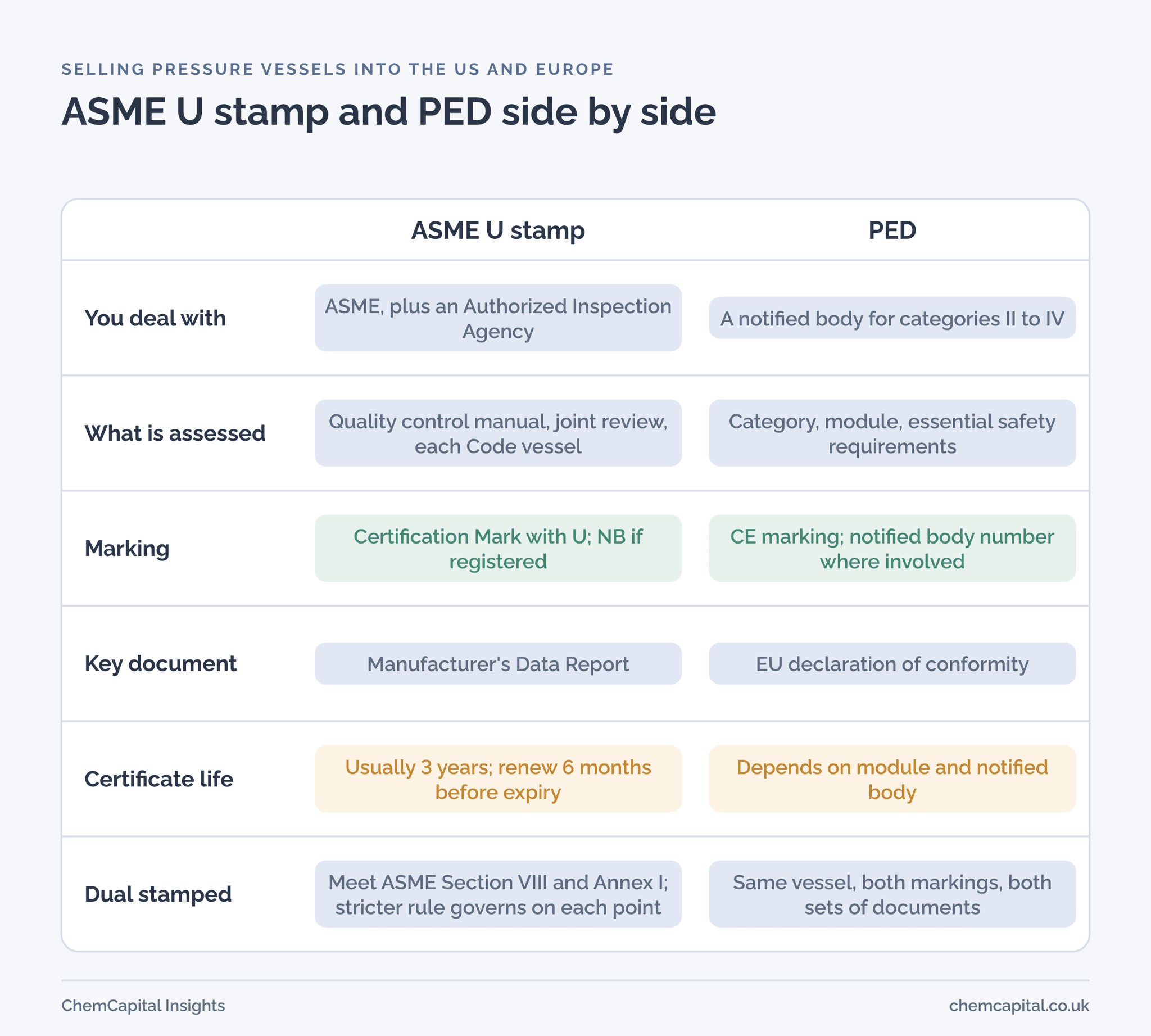
ASME and PED compared
| ASME U stamp | PED | |
|---|---|---|
| Legal basis | Laws of each US state or Canadian province | EU directive, national law in each Member State |
| Who certifies you | ASME, after a joint review | Notified body, per module |
| Who inspects the vessel | Authorized Inspector from your AIA | Notified body, depending on module and category |
| Design rules | ASME BPVC Section VIII | Essential safety requirements; harmonised standards give a presumption of conformity |
| Marking | ASME Certification Mark with U, plus NB if registered | CE marking, plus notified body number where involved |
| Key document | Manufacturer's Data Report | EU declaration of conformity |
| Certificate life | Usually three years, renewed by joint review | Depends on the module and the notified body |
Sources: ASME [2], National Board [4], PED [7] [9].
On your supplier listing, state each stamp and module you hold with its scope and expiry date. That is the line a buyer needs to see first. ChemCapital's supplier listings let you show certifications next to your products so buyers find them before they send an enquiry.
One vessel, both systems
A dual stamped vessel is one vessel that carries the ASME Certification Mark and the CE marking, with both sets of paperwork. It is common for skids shipped to several markets. The rule is simple: meet the stricter requirement on every point.
- Agree the basis in the RFQ. Which division, which PED category and module, and who the AIA and notified body are. Ask whether your AIA is also a notified body; using one organisation for both can cut duplicate witness visits.
- Design to ASME, then check against Annex I. Check allowable stresses against the PED limits, and document how each essential safety requirement is met. The stricter result governs.
- Materials. ASME SA materials are not harmonised European materials. Unless a European approval exists, you need a particular material appraisal, which the notified body must assess for categories III and IV [8]. Order mill certificates that satisfy both; see our guide to EN 10204 3.1 and 3.2 certificates.
- Welding. Qualify procedures and welders under ASME Section IX, and have them approved by a competent third party for the PED from category II up [8]. Our guide to WPS, PQR and welder qualification explains the documents.
- NDT. Use personnel approved by a recognised third party organisation for categories III and IV [8].
- Test pressure. Calculate the hydrostatic test pressure under both rules and test at a pressure that satisfies both. See hydrostatic test pressure.
- Nameplate and documents. One nameplate with both markings, a Manufacturer's Data Report signed by the Authorized Inspector, and an EU declaration of conformity signed by you.
Common mistakes in dual stamp quotes
- Quoting "ASME design" as if it were stamped. Only a certificate holder can apply the mark, and only with an Authorized Inspector involved. Say which you are offering.
- Leaving out National Board registration. If the installation site's jurisdiction requires it, the buyer cannot use the vessel without it. Ask where the vessel will be installed.
- No plan for materials. For PED categories III and IV, an ASME material needs a particular material appraisal assessed by the notified body unless a European approval exists. Agree this before you order plate.
- Testing to one rule only. Calculate both test pressures and record the one you used in both sets of documents.
- Forgetting the nameplate. Two markings, a registration number and the PED data all have to fit and stay legible. Draw the nameplate early and send it for approval with the general arrangement drawing.
Practical example
Illustrative only. A UK fabricator holds PED module H approval and is asked to quote a 3 m³ carbon steel receiver for a US site and an identical one for a German site. Maximum allowable pressure is 10 barg.
PED stress check. Take a steel with a minimum yield of 260 MPa at design temperature and a minimum tensile strength of 485 MPa at 20 °C. Both values are illustrative; use the material standard's figures. The PED limit is the smaller of 2/3 × 260 = 173 MPa and 5/12 × 485 = 202 MPa, so 173 MPa [8]. If the ASME allowable stress for the same material is lower, the ASME design already satisfies this limit. If it were higher, the PED limit would govern the European vessel.
PED test pressure. 1.43 × 10 = 14.3 barg, assuming the 1.25 times maximum loading term is lower [8]. The ASME test pressure is calculated separately and the higher one is used for the dual stamped option.
Certification path for the US vessel. The fabricator has no ASME certificate, so it signs an inspection agreement with an AIA, writes the quality control manual against ASME's checklist and books a joint review [2]. Because the certificate lasts three years and renewal must be applied for six months before expiry [2], it only pays if the fabricator expects more US work. For a single vessel, subcontracting the pressure parts to an existing U stamp holder may be cheaper. That is a commercial choice the buyer should hear about early, not at drawing approval.
If you are the buyer
Write the requirement precisely: Code section and division, whether you need National Board registration, PED category and acceptable modules, and whether the vessel must carry both markings. Ask each bidder for their certificate numbers, scope and expiry dates, and the names of their AIA and notified body. Check that ASME certificates are current and cover the right designator, and check notified bodies in NANDO. A bid that says "ASME design" without a U stamp is not an ASME stamped vessel.
Where ChemCapital fits
Buyers screening pressure equipment suppliers look for stamps, modules and scope before they look at price. Keep yours current and visible, and say plainly what you can and cannot stamp.
Ready to be found by buyers who need ASME or PED equipment? List your company on ChemCapital. It is free to start.
Frequently asked questions
What is an ASME U stamp?
It is the ASME Certification Mark with the U designator, applied to pressure vessels built to ASME Section VIII Division 1 by a company holding an ASME Certificate of Authorization. Each vessel is inspected by an Authorized Inspector from an accredited Authorized Inspection Agency.
How do you get ASME U stamp certification?
Sign an inspection agreement with an ASME accredited Authorized Inspection Agency, write a quality control manual in English that covers every Code element in your scope, apply to ASME, and pass a joint review led by an ASME designee with your agency. Most certificates last three years.
Is an ASME stamped vessel accepted under the PED?
Not automatically. ASME is not a harmonised European standard, so the manufacturer must show that the vessel meets the PED essential safety requirements, follow the conformity assessment module for its category with a notified body where required, and affix the CE marking. One vessel can carry both markings if both sets of requirements are met.
What is the difference between a U stamp and National Board registration?
The U stamp shows the vessel was built to ASME Section VIII Division 1 by a certified manufacturer. National Board registration files the Manufacturer's Data Report with the National Board and adds the NB symbol and a registration number to the nameplate. It needs a separate National Board certificate, and whether it is required depends on the jurisdiction where the vessel is installed.
Continue reading
Informational only, not procurement or legal advice. Cited names, frameworks, and statistics belong to their respective owners.
Access real procurement opportunities from global buyers
Join ChemCapital to get discovered by verified procurement teams across pharmaceutical, chemical, and industrial manufacturing.
List your companyRelated articles
Design Qualification (DQ) for GMP Equipment: What It Is and What the Vendor Provides
Design qualification is the documented check that a proposed equipment design meets the URS and GMP before it is built. Here is where DQ sits in EU GMP Annex 15, what evidence the vendor supplies, and a DQ checklist.
Requirements Traceability Matrix for GMP Equipment: From URS to PQ
A requirements traceability matrix links every URS line to the design document that meets it and the test that proves it, from DQ through FAT, SAT, IQ, OQ and PQ. Here is how to build one, with a template.
How to Prepare for a Customer Quality Audit as an Equipment Manufacturer
A practical guide for equipment makers facing a customer or vendor audit: the documents to have ready, how to run the walk through, the findings auditors raise most often and how to close them properly.